

Maddy summaryHRES 932 is a symbolic resolution passed by the House of Representatives that condemns six specific members of Congress (including Senators Kelly and Slotkin and Representatives Crow, Deluzio, Goodlander, and Houlahan) for allegedly making statements that encouraged military and intelligence personnel to disobey orders from the President. The resolution claims these lawmakers falsely suggested the administration issued "illegal orders" and undermined the military chain of command, violating the Uniform Code of Military Justice (UCMJ). It does not create new laws or policies but formally denounces the lawmakers' statements as "dangerous and seditious rhetoric." As a procedural resolution, it has no binding effect on military conduct or policy.
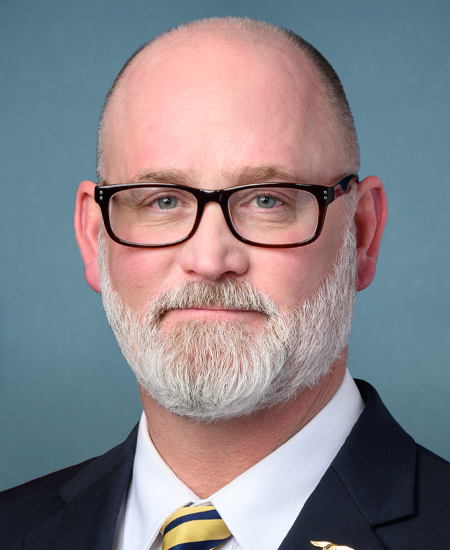
Rep. Derrick Van Orden
Sponsored bills
Maddy summaryThe Freedom to Heal Act of 2025 creates a new federal registration process for physicians to directly administer Schedule I investigational drugs under the "Right to Try" framework. It requires physicians to apply to the Attorney General with evidence of state compliance, manufacturer agreements, and training, and limits the amount of drugs they may possess based on approved applications. The bill mandates the Attorney General to issue interim rules within 240 days and final rules within two years covering drug delivery, storage, recordkeeping, and registration management. This affects physicians treating eligible patients with Schedule I drugs under federal Right to Try provisions, not the patients themselves.
Maddy summaryThe Rx ACCESS Act improves prescription drug access for TRICARE beneficiaries, including military service members, retirees, and their families, by establishing fair reimbursement standards for pharmacies and expanding medication choice. It requires pharmacies to be reimbursed at actual drug costs (or the national average drug cost for certain medications) plus a standard dispensing fee, while banning hidden fees like point-of-sale charges. Starting October 1, 2026, beneficiaries can choose how they receive non-generic medications for ongoing health conditions. The law also mandates annual audits to verify reimbursement fairness and ensure pharmacy networks provide accessible care, especially in rural and underserved areas.
Maddy summaryThe CARE Act of 2025 limits refugee resettlement by prohibiting the U.S. government from resettling refugees in any state or locality that has formally disapproved resettlement through its governor, state legislature, or local government officials. It amends the Immigration and Nationality Act to block resettlement funding in jurisdictions with such formal disapproval actions during any fiscal year. The bill directly affects refugees seeking resettlement and state/local governments that take formal opposition to refugee arrivals. Key provisions require explicit disapproval by elected officials at the state or local level to restrict resettlement, without exceptions for federal oversight. This policy change creates a new administrative barrier to refugee resettlement based on local political decisions.
Maddy summaryThis bill establishes a new interagency Task Force to dismantle foreign scam operations targeting Americans, particularly through "pig butchering" scams in Southeast Asia. The Task Force, chaired by the Secretary of State, will coordinate efforts across multiple agencies to shut down scam centers, impose sanctions on perpetrators, and support victims of trafficking. It requires a detailed strategy within 180 days and annual reports to Congress on progress, including sanctions imposed and funds recovered. The bill authorizes $30 million for these efforts in fiscal years 2026-2027, focusing on countries like Cambodia, Laos, and Burma where scam centers operate with forced labor.
Maddy summaryHR 5866 requires the Secretary of Agriculture to release the federal government's reversionary interest in approximately 31.83 acres of state forest land in Black River State Forest, Wisconsin. This enables a land exchange where the State of Wisconsin would convey this forest land to Deli, Inc. (a sphagnum moss business) in return for Deli, Inc. transferring approximately 37.27 acres of its own land to the State. The bill sets a conditional process: the release occurs only if Wisconsin formally agrees to the exchange, and the Secretary must provide a quitclaim deed to finalize the transfer. This is a procedural bill facilitating a specific land swap, not creating new policy.
Maddy summaryThis bill amends federal labeling rules for beef products sold in the U.S. It requires clear country-of-origin labeling for beef (including ground beef), expanding existing rules that previously covered lamb and venison. The key change increases penalties for non-compliance: $5,000 per pound of beef sold without required labeling, compared to $1,000 per violation for other meats. These rules directly affect meat producers, processors, and retailers selling beef products. The bill also ensures U.S. labeling authority cannot be overridden by international trade rulings.
Maddy summaryThis bill suspends payment limits for agricultural subsidies for the 2025 crop year, removing caps on payments to farmers. It also establishes a new option for farmers to receive 50% of their expected 2025 crop payments as an advance by December 1, 2025, if they opt in. The remaining balance is paid later after the marketing year ends, with farmers required to repay any overpayment if the final amount exceeds the advance. The bill directly affects farmers growing covered commodities (like corn, soybeans) who choose to participate in the advance payment program.
Give Kids a Chance Act of 2025 This bill expands the Food and Drug Administration’s (FDA’s) authority with respect to research on rare pediatric diseases, including by permitting the FDA to take enforcement action against drug sponsors that fail to satisfy pediatric study requirements and by reauthorizing programs that support pediatric research. Specifically, the bill modifies requirements relating to molecularly targeted pediatric cancer investigations to permit research on new drugs in combination with active ingredients that have already been approved, provided certain conditions are met; permits the FDA to take enforcement action against drug sponsors that fail to comply with pediatric study requirements, if such sponsors demonstrated a lack of due diligence in satisfying the requirement; renews the FDA’s authority to award priority review vouchers to sponsors of new products intended to treat rare pediatric diseases through September 30, 2029; and reauthorizes through FY2027 certain funding for the National Institutes of Health to support priority pediatric research. The bill also provides statutory authority for the FDA’s interpretation of the orphan drug exclusivity period. The bill specifies, consistent with FDA regulations, that the seven-year market exclusivity period for drugs for rare diseases or conditions (i.e., orphan drugs) prohibits the approval of the same drug for the same approved use or indication with respect to the disease or condition. (In Catalyst Pharmaceuticals, Inc. v. Becerra , a court rejected the FDA’s interpretation and held that orphan drug exclusivity extends to all uses or indications for the disease or condition.)
Maddy summaryHR 5800, the SAFE Drivers Act, requires commercial driver's license (CDL) applicants and renewers to pass a standardized English proficiency test approved by the Federal Motor Carrier Safety Administration (FMCSA). The test assesses reading road signs, understanding emergency communications, and writing required documentation - critical for safety in commercial driving. States must administer the test through their DMVs, report pass rates annually to the FMCSA, and face potential federal funding cuts if they fail to comply. The law applies to all new CDL issuances or renewals starting 12 months after enactment, directly affecting commercial drivers seeking or maintaining their licenses.