

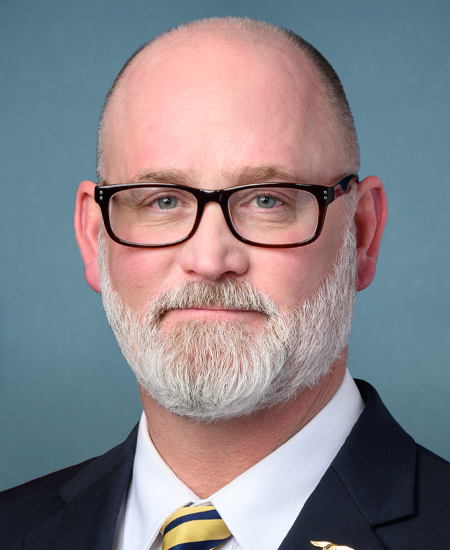
Photo of Derrick Van Orden
R United States House · District 3 · Wisconsin On the 2026 ballot

Rep. Derrick Van Orden

Compare
Total votes
1,879
all sessions
Attendance
95%
91 missed
Lower than 90% of chamber peers
With party
92%
of cast votes
Near the chamber average
Bipartisan score
4%
crosses aisle rarely
Near the chamber average
Sponsored
786
bills & resolutions
Near the chamber average
Committees
9
assignments
786 bills and resolutions

Sponsored bills

Total
786
Primary
61
Co-sponsor
725
This page
786
matching current filters
Co-sponsor HR 4509
In committee · United States House · Co-sponsor
NOPAIN for Veterans Act

Maddy summaryHR 4509, the NOPAIN for Veterans Act, requires the Department of Veterans Affairs (VA) to add FDA-approved non-opioid pain medications to its national formulary within one year of their approval for pain management. These medications must reduce pain without acting on opioid receptors, directly affecting veterans receiving VA care who need pain treatment. The bill mandates the VA include such drugs in its formulary and drug standardization list, expanding access to non-opioid options. It also prohibits using funds from the Cost of War Toxic Exposures Fund to implement these changes, with implementation required within 90 days of the bill's enactment.

In committee Jan 13, 2026 1 co-sponsor
Co-sponsor HR 2426
In committee · United States House · Co-sponsor
Veterans Mental Health and Addiction Therapy Quality of Care Act

Maddy summaryHR 2426 requires the VA Secretary to commission an independent study comparing the quality of mental health and addiction care provided by VA health care providers versus non-VA providers for veterans. The study must examine health outcomes, use of proven treatment methods, care coordination, veteran satisfaction, and access times across different care types like telehealth and in-person visits. It mandates a report to Congress and public release within 18 months, detailing findings on factors like symptom improvement, suicide risk assessment, and whether veterans with multiple conditions receive integrated care. This bill directly affects veterans seeking mental health or addiction therapy services and aims to identify gaps in care quality between VA and non-VA systems.

In committee Jan 13, 2026 1 co-sponsor
Co-sponsor HR 909
Passed · United States House · Co-sponsor
Crime Victims Fund Stabilization Act of 2025

Maddy summaryHR 909, the Crime Victims Fund Stabilization Act of 2025, modifies how funds from the False Claims Act are deposited into the Crime Victims Fund. It specifies that from 2025 through 2029, certain False Claims Act proceeds (specifically those for qui tam plaintiff payments and government damage reimbursements) cannot be deposited into the fund. This change directly affects the composition of the Crime Victims Fund by excluding these specific revenue streams during the specified period. The bill does not create new benefits or alter victim services; it only adjusts fund allocation rules for existing False Claims Act revenues.

Passed Jan 13, 2026 1 co-sponsor
Co-sponsor HRES 984
In committee · United States House · Co-sponsor
Supporting the recognition of January 9, 2026, as "National Law Enforcement Appreciation Day".

Maddy summaryHRES 984 is a symbolic resolution designating January 9, 2026, as "National Law Enforcement Appreciation Day." It directly honors all federal, state, local, and tribal law enforcement officers across the United States for their service and sacrifices. The resolution expresses the House's support and gratitude, encourages public observance through ceremonies, and recognizes officers who have made the ultimate sacrifice. As a non-binding resolution, it does not create new laws or policies but serves as a formal expression of appreciation.

In committee Jan 9, 2026 1 co-sponsor
Co-sponsor HR 6976
In committee · United States House · Co-sponsor
Duty Status Reform Act

Maddy summary# Summary of Reserve Component Duty Consolidation Legislation This legislation is a comprehensive revision of military reserve component terminology and definitions throughout the U.S. Code. The primary purpose is to replace the outdated term "inactive duty training" with the more accurate and consistent term "reserve component duty" across all relevant sections of federal law. ## Key Provisions: 1. **Terminology Change**: - Replaces "inactive duty training" with "reserve component duty" in over 50 sections of the U.S. Code (primarily Titles 10, 32, and 37) - Also replaces related terms like "inactive duty" and "inactive duty for training" with "reserve component duty" 2. **Repeals**: - Repeals Chapter 13 of Title 10 - Repeals Sections 10147, 10148, 12406, 12503, 12552 of Title 10 - Repeals Sections 114, 115, and 328 of Title 32 3. **Definition Updates**: - Creates new definitions for "reserve component duty" and "remote assignment" in Title 10 - Defines "Active Guard and Reserve functions" more precisely - Clarifies that reserve component duty includes: * Training as described in sections 552(a) and 553(a) of Title 32 * Support activities authorized for members of the reserve components * Duty prescribed under sections 543 of Title 32 4. **Transition Provisions**: - Establishes a 10-year transition period from the date of enactment - Allows for earlier implementation if all relevant departments (Defense, Homeland Security, Veterans Affairs) certify readiness - Provides for early TRICARE eligibility for members ordered to active duty or full-time National Guard duty 5. **Conforming Amendments**: - Makes numerous technical changes to ensure consistent terminology throughout the U.S. Code - Updates references to training requirements, pay, and benefits to reflect the new terminology This legislation represents a significant effort to modernize military reserve component terminology, eliminate confusing and outdated references, and create a more consistent framework for understanding and managing reserve component service obligations and benefits.

In committee Jan 9, 2026 1 co-sponsor
Co-sponsor HR 6962
In committee · United States House · Co-sponsor
Families First Housing Act of 2026

Maddy summaryThis bill requires federal housing agencies (like HUD and Fannie Mae) to prioritize qualified first-time homebuyers when selling single-family homes (1-4 units). For 180 days after listing, properties must be offered only to eligible buyers (individuals, nonprofits, local governments, or community land trusts) at fair market value based on recent third-party appraisals, with public online listings showing the priority window. Covered entities must report quarterly sales data, including prices relative to appraised value, and annual audits will verify compliance. Institutional investors (e.g., rental companies) cannot purchase during the priority period. The law aims to increase access to homeownership for specific groups through transparency and structured sales processes.

In committee Jan 7, 2026 1 co-sponsor
Co-sponsor HR 5593
In committee · United States House · Co-sponsor
To amend title 38, United States Code, to include eyeglass lens fittings in the category of medical services authorized to be furnished to veterans under the Veterans Community Care Program, and for other purposes.

Maddy summaryThis bill expands the Veterans Community Care Program to cover eyeglass lens fittings as an authorized medical service, directly affecting veterans who receive care through non-VA providers under the program. It amends the law to explicitly include "fittings for eyeglass lenses" in the list of covered services, allowing eligible veterans to schedule these appointments at nearby community providers. The Department of Veterans Affairs must establish regulations to implement this change, ensuring veterans can access these fittings without needing to go through VA facilities. A report on implementation progress, challenges, and veteran benefits must be submitted to Congress within 180 days of the bill's enactment.

In committee Dec 19, 2025 1 co-sponsor
Co-sponsor HR 4837
In committee · United States House · Co-sponsor
Written Informed Consent Act

Maddy summaryHR 4837, the Written Informed Consent Act, requires the Veterans Health Administration (VHA) to update its existing directive on informed consent to include additional medication classes. Specifically, it mandates that written informed consent must be obtained before prescribing antipsychotics, stimulants, antidepressants, anti-anxiety medications (anxiolytics), and narcotics (opioids) to veterans. This expansion directly affects veterans receiving these medications through the VA system, ensuring they are informed about specific treatment risks and alternatives. The key mechanism is amending VHA Directive 1005 to broaden its application beyond long-term opioid therapy to cover the newly listed medication types.

In committee Dec 19, 2025 1 co-sponsor
Primary HR 1230
In committee · United States House · Lead sponsor
AG VETS Act

Maddy summaryThe AG VETS Act (HR 1230) creates a new federal grant program to help military veterans enter or expand farming and ranching careers. It authorizes $5 million annually (2026-2030) for competitive grants to eligible entities like land-grant colleges, cooperative extensions, nonprofits, and state agriculture departments. These grants must be matched with non-Federal funds and will fund training, curriculum development, workshops, and field experiences focused on farm business management. The program directly affects veterans seeking agricultural careers by providing structured education and support through partner organizations.

In committee Dec 19, 2025 0 co-sponsors
Co-sponsor HR 472
In committee · United States House · Co-sponsor
Restore VA Accountability Act of 2025

Maddy summaryHR 472, the Restore VA Accountability Act of 2025, creates new disciplinary procedures for VA supervisors and management officials. It requires the VA Secretary to consider specific factors like the seriousness of misconduct and the employee's role when deciding on removal, demotion, or suspension, and limits the entire disciplinary process to 15 business days. The bill prevents courts from reviewing penalty amounts but allows review of whether procedures were followed correctly. It also strengthens whistleblower protections by requiring Special Counsel approval before disciplining employees who report misconduct, affecting VA supervisors and management officials but excluding senior executives and political appointees.

In committee Dec 19, 2025 1 co-sponsor
Showing 141 to 150 of 786 bills
Previous 1 … 14 15 16 … 79 Next