

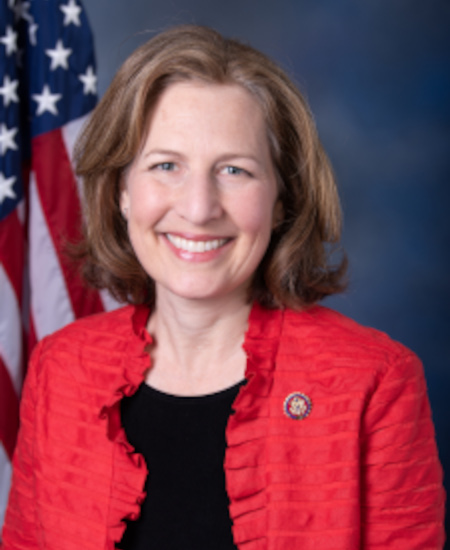
Photo of Kim Schrier
D United States House · District 8 · Washington On the 2026 ballot

Rep. Kim Schrier

Compare
Total votes
2,837
all sessions
Attendance
99%
24 missed
Near the chamber average
With party
94%
of cast votes
Lower than 83% of chamber peers
Bipartisan score
3%
crosses aisle rarely
Higher than 82% of chamber peers
Sponsored
1,071
bills & resolutions
Near the chamber average
Committees
4
assignments
1,071 bills and resolutions

Sponsored bills

Total
1,071
Primary
73
Co-sponsor
998
This page
1,071
matching current filters
Co-sponsor HR 5791
In committee · United States House · Co-sponsor
BLOOD Centers Act

Maddy summaryHR 5791, the BLOOD Centers Act, creates a 30-day expedited approval process for blood centers seeking to add apheresis collection devices to existing biologics licenses. It directly affects blood centers operating under FDA biologics licenses that already manage multiple locations or hold accredited status. The bill requires the FDA to approve such applications within 30 days unless safety concerns exist at the specific location or the center has systemic safety failures elsewhere. This streamlines the process for expanding blood collection capabilities without compromising safety standards.

In committee Oct 17, 2025 1 co-sponsor
Co-sponsor HR 5740
In committee · United States House · Co-sponsor
WIC Benefits Protection Act

Maddy summaryThis bill makes federal funding for the WIC program mandatory by requiring Congress to appropriate necessary funds annually for fiscal year 2026 and each subsequent year. It removes discretionary language from WIC funding requirements and clarifies that eligible participants must be served without participation limits. The bill directly affects low-income pregnant women, new mothers, and young children who rely on WIC for nutrition assistance, ensuring continued access to critical food, health, and education services.

In committee Oct 10, 2025 1 co-sponsor
Co-sponsor HR 5736
In committee · United States House · Co-sponsor
PAVE Act

Maddy summaryHR 5736, the PAVE Act, requires Medicare beneficiaries aged 65 and older to receive penicillin allergy verification during their initial preventive physical exam and annual wellness visit. The bill mandates that healthcare providers identify patients reporting a penicillin allergy, evaluate whether the reported reaction was a true allergy, explain the health risks of a false allergy label, and refer to specialists when needed. This verification process, effective January 2027, aims to correct false allergy labels - over 90% of which are inaccurate - improving antibiotic choices and patient outcomes. It directly affects seniors covered by Medicare who have self-reported penicillin allergies, with no cost to patients for this service.

In committee Oct 10, 2025 1 co-sponsor
Co-sponsor HRES 795
In committee · United States House · Co-sponsor
Condemning the Hamas attacks of October 7, 2023, and calling for Hamas and its leaders to immediately and unconditionally surrender and to release the hostages, including Americans.

Maddy summaryHRES 795 is a non-binding resolution condemning Hamas for the October 7, 2023, attacks that killed over 1,200 people, took 251 hostages (including Americans), and involved sexual violence. It demands Hamas immediately surrender and release all remaining hostages - specifically noting 48 people still held, including two U.S. citizens. The resolution also affirms Israel’s right to self-defense, calls for humanitarian aid to reach Palestinians, and condemns global antisemitism following the attacks. As a symbolic congressional statement, it does not create new laws or alter policies.

In committee Oct 8, 2025 1 co-sponsor
Co-sponsor HR 5684
In committee · United States House · Co-sponsor
Medical Foods and Formulas Access Act of 2025

Maddy summaryThis bill requires Medicare, Medicaid, CHIP, and federal employee health plans to cover medically necessary specialized foods, vitamins, and amino acids for people with specific digestive and metabolic conditions. It defines "medically necessary food" as prescribed formulas, vitamins, and amino acids designed for conditions like inherited metabolic disorders, inflammatory bowel disease, and severe food allergies that cannot be managed through regular diet. The bill mandates coverage of these items and necessary equipment for administration (like feeding tubes), with Medicare covering 80% of costs. This would directly benefit thousands of patients who rely on these specialized treatments to avoid serious health complications like malnutrition, hospitalizations, and developmental issues.

In committee Oct 3, 2025 1 co-sponsor
Co-sponsor HR 5673
In committee · United States House · Co-sponsor
Stop the Trump Electricity Price Hikes Act

Maddy summaryHR 5673, titled "Stop the Trump Electricity Price Hikes Act," would reinstate financial assistance awards terminated by the Department of Energy under a May 15, 2025, secretarial memorandum. It directly affects recipients of these awards - likely energy or infrastructure projects - that had their funding cut, by restoring their financial support as if the terminations never occurred. The key mechanism requires the Department to treat all such terminated awards as valid and continuing, overriding prior termination actions. This bill does not address electricity pricing, consumer rates, or introduce new energy regulations.

In committee Oct 3, 2025 1 co-sponsor
Co-sponsor HR 5653
In committee · United States House · Co-sponsor
Trust Through Transparency Act of 2025

Maddy summaryHR 5653, the Trust Through Transparency Act of 2025, requires U.S. Customs and Border Protection (CBP) and U.S. Immigration and Customs Enforcement (ICE) officers, as well as deputized personnel, to wear body cameras during all public immigration enforcement actions like stops, arrests, or checkpoints. Footage must be kept for six months unless it involves use of force, an arrest, a complaint, or a voluntary request for longer retention (up to three years) by officers, the public, or families. The bill mandates annual reports to Congress detailing enforcement actions, compliance issues, disciplinary actions taken, and public access to these reports (with privacy redactions permitted). It also creates an independent panel to advise on body camera policies, aiming to increase accountability in immigration enforcement.

In committee Oct 1, 2025 1 co-sponsor
Co-sponsor HR 5619
In committee · United States House · Co-sponsor
Federal Firefighter Paycheck Protection Act

Maddy summaryThis bill ensures federal firefighters continue receiving pay and benefits during government funding gaps and shutdowns. It authorizes continuing appropriations for firefighter pay during any period without full-year funding for fiscal year 2026, and prohibits layoffs due to reduction-in-force actions during funding lapses. The law directly affects firefighters employed by executive agencies or military departments whose primary duties involve fire control and extinguishment. Key provisions guarantee job security and pay continuity without requiring new legislation during budget implementation delays.

In committee Sep 30, 2025 1 co-sponsor
Co-sponsor HR 5660
In committee · United States House · Co-sponsor
Pay Our Military Act

Maddy summaryHR 5660, the Pay Our Military Act, ensures military personnel and support staff receive pay during a government funding gap in fiscal year 2026. It appropriates funds from the Treasury to cover pay and allowances for active-duty troops, reservists, Department of Defense civilian employees, and contractors supporting military operations, if Congress hasn’t passed regular funding by then. The funding remains available until either regular appropriations are enacted or January 1, 2027, whichever comes first. This is a temporary measure to prevent disruptions in military pay during budget negotiations.

In committee Sep 30, 2025 1 co-sponsor
Primary HR 5558
In committee · United States House · Lead sponsor
Improving Child Care for Working Families Act of 2025

Maddy summaryThe Improving Child Care for Working Families Act of 2025 increases the tax exclusion limit for dependent care assistance from $7,500 to $10,500 annually for most taxpayers. This change directly benefits working families who receive employer-provided child care benefits by allowing them to exclude more of that assistance from their taxable income. Married couples filing separately would see their exclusion limit rise from $3,750 to $5,250. The amendment applies to amounts paid or incurred in calendar years starting after the bill's enactment.

In committee Sep 23, 2025 0 co-sponsors
Showing 151 to 160 of 1,071 bills
Previous 1 … 15 16 17 … 108 Next