

Maddy summaryHR 4340, the Therapeutic Fraud Prevention Act of 2023, prohibits paid providers from offering conversion therapy - defined as any commercial service attempting to change a person's sexual orientation or gender identity - and bans advertising that claims such therapy is effective or harmless. It directly affects therapists, counselors, or organizations offering paid conversion therapy services, including those advertising such services. Key provisions make it unlawful to provide, advertise, or facilitate paid conversion therapy, with enforcement led by the Federal Trade Commission (FTC) under consumer protection laws and allowing states to pursue civil actions. The bill explicitly excludes supportive care for gender transition or identity exploration from its definition of prohibited therapy.
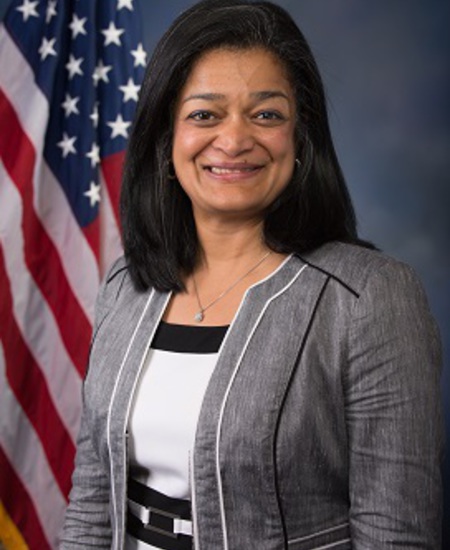
Rep. Pramila Jayapal
Sponsored bills
This resolution expresses support for (1) equal rights and protections for all people, regardless of actual or perceived sexual orientation, gender identity, or sex characteristics; and (2) the designation of LGBTQI+ Equality Day to commemorate Supreme Court decisions handed down on June 26 in 2003, 2013, and 2015. The resolution also acknowledges the need for further legislation to ensure that people in the United States are free from all forms of discrimination on the basis of actual or perceived sexual orientation, gender identity, or sex characteristics.
Equal Access to Reproductive Care Act This bill includes assisted reproduction as a tax deductible medical expense. It defines assisted reproduction as any methods, treatments, procedures, and services for effectuating a pregnancy and bringing it to term, and treats it as medical care of the taxpayer, the taxpayer's spouse, or a dependent to the extent that they intend to take legal custody or responsibility for any children born as a result of such assisted reproduction.
Customer Non-Discrimination Act This bill prohibits discrimination based on sex, sexual orientation, and gender identity with respect to public accommodations and facilities. Specifically, the bill defines and includes sex, sexual orientation, and gender identity among the prohibited categories of discrimination or segregation. The bill expands the definition of public accommodations to include places or establishments that provide (1) exhibitions, recreation, exercise, amusement, gatherings, or displays; (2) goods, services, or programs; and (3) transportation services. Protections against discrimination based on race, color, religion, sex, sexual orientation, gender identity, or national origin shall include protections against discrimination based on (1) an association with another person who is a member of such a protected class; or (2) a perception or belief, even if inaccurate, that an individual is a member of such a protected class. The bill prohibits the Religious Freedom Restoration Act of 1993 from providing a claim, defense, or basis for challenging such protections. The bill prohibits an individual from being denied access to a shared facility, including a restroom, a locker room, and a dressing room, that is in accordance with the individual's gender identity. The bill also prohibits the provision of less favorable treatment with respect to pregnancy, childbirth or related medical conditions as compared to other physical conditions.
Maddy summaryHRES 545 is a symbolic resolution expressing the House's commitment to achieving zero traffic fatalities by 2050. It calls on Congress and the Department of Transportation to collaborate on policies, improve data collection on traffic safety disparities, and implement proven safety measures. The resolution also urges federal agencies to use "crash" instead of "accident" when describing traffic incidents and addresses inequities in traffic safety outcomes. As a non-binding resolution, it does not create new laws or allocate funds but sets a policy direction for future action.
Maddy summaryThe Equal Dignity for Married Taxpayers Act of 2023 updates the Internal Revenue Code to use gender-neutral language regarding married couples. It replaces terms like "husband and wife" with "married couple" and "his spouse" with "the individual's spouse" throughout tax code provisions. The bill makes these language changes to ensure the tax code applies equally to all married couples regardless of gender, without altering tax rates, deductions, or other substantive tax policies. This affects all married taxpayers and tax professionals who apply the tax code. The bill is a language update rather than a policy change, making the tax code more inclusive while maintaining existing tax treatment.
Maddy summaryThe SAFE Act of 2023 extends a 2018 law that prohibits slaughtering animals for human consumption to include horses, donkeys, and other equine animals, such as ponies. It amends Section 12515 of the Agriculture Improvement Act of 2018 by updating the language to replace "dog or cat" with "dog, cat, or equine" in both the section title and the main prohibition. This change directly affects the livestock industry and slaughter facilities by banning the processing of equines for food. The bill modifies existing law without adding new enforcement mechanisms, closing a gap in animal protection.
Maddy summaryHJRES 76 proposes renaming the Robert E. Lee Memorial in Arlington National Cemetery to the "Arlington House National Historic Site." This procedural bill would replace all official references to the memorial with the new name and repeal two prior resolutions (1955 and 1972) that established the memorial. The change affects how the site is identified in federal laws, documents, and records but does not alter its management or historical significance. The bill focuses solely on the official designation, not on policy changes or historical interpretation.
Maddy summaryThis non-binding resolution (HRES 532) expresses congressional support for a "Third Reconstruction" to address systemic poverty and low wages affecting approximately 140 million Americans, with disproportionate impacts on communities of color, women, and essential workers. It proposes concrete policy shifts including establishing a living wage, guaranteeing universal healthcare and housing, expanding voting rights, ending debt burdens, and redirecting military spending toward social programs. The resolution frames poverty as a moral crisis - citing it as the fourth-leading cause of death - and calls for updating poverty measures to reflect modern costs of living. It does not create new laws but urges Congress to prioritize these changes through budget and legislative action.
Maddy summaryThis bill establishes the John Lewis Civil Rights Fellowship Program within the Fulbright exchange system to honor civil rights leader John Lewis and advance U.S. foreign policy through global civil rights education. It creates a new fellowship for U.S. early- to mid-career professionals, selecting at least 25 annually for 10-month programs to conduct research or intern with approved organizations in countries participating in Fulbright exchanges. Fellows must complete a work plan, attend an orientation in Washington, DC, and present findings at an annual summit, with the State Department covering costs for travel, lodging, and expenses. The program requires annual reports on participant demographics and program effectiveness, and expires seven years after enactment.