

Maddy summaryHR 4845, the Food Secure Strikers Act of 2023, amends the Food and Nutrition Act to remove a restriction that previously disqualified workers from the Supplemental Nutrition Assistance Program (SNAP) if they were on strike. The bill changes eligibility rules so that striking workers are no longer automatically ineligible for SNAP benefits solely because they are participating in a labor strike. This change directly affects workers involved in strikes who rely on SNAP for food assistance, ensuring they can access benefits during labor disputes. The key provision removes specific language from Section 6(d) of the Food and Nutrition Act that had barred strike participants from SNAP enrollment.
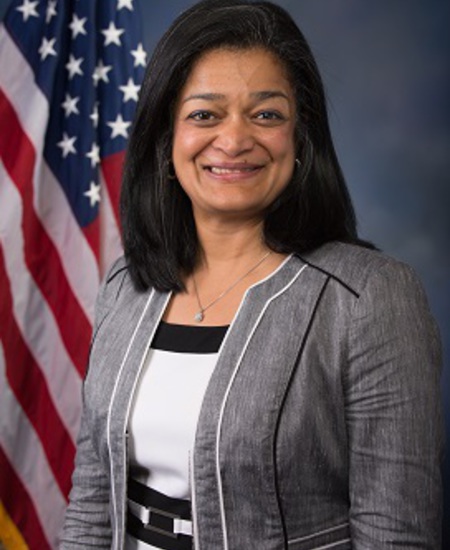
Rep. Pramila Jayapal
Sponsored bills
Maddy summaryThe John R. Lewis Voting Rights Advancement Act of 2023 would strengthen the Voting Rights Act of 1965 by updating the criteria for which states and localities must obtain federal preclearance before changing voting practices. It would establish new standards for proving vote dilution and vote denial by requiring courts to consider historical discrimination, racial polarization in voting, and whether voting practices disproportionately burden minority voters. The bill would also require states and localities to provide public notice of voting changes and share demographic data about polling locations. These changes would primarily affect jurisdictions with a history of voting rights violations, aiming to prevent discriminatory voting practices before they take effect.
This resolution condemns racism, xenophobia, discrimination, scapegoating, and ethnic and religious bigotry. It acknowledges the climate of hate that Arab, Muslim, Middle Eastern, South Asian, and Sikh communities have experienced since September 11, 2001, and suggests specified relief to support those affected.
Maddy summaryThe Humane Cosmetics Act of 2023 bans cosmetic animal testing in the United States, prohibiting companies from conducting or contracting such testing after its enactment (effective 1 year later). It also bans selling or transporting cosmetics developed using animal testing conducted after that date within U.S. interstate commerce. The law directly affects cosmetic manufacturers, retailers, and suppliers operating in the U.S. market, requiring them to use non-animal testing methods for safety evaluations. Exceptions exist for foreign regulatory requirements or when no alternative testing methods are available for specific ingredients.
Maddy summaryHRES 689 is a symbolic resolution designating October 25, 2023, as "Public Radio Music Day" and expressing the House's appreciation for public radio music stations. It directly recognizes the role of over 697 noncommercial stations serving 25.5 million weekly listeners across all 50 states, Washington D.C., Puerto Rico, and Guam. The resolution highlights how these stations support local music scenes, preserve diverse genres (like jazz, classical, and folk), and serve as community cultural hubs through programming, artist support, and educational outreach. This is a non-binding gesture of recognition, not a policy change affecting laws or funding.
Maddy summaryThe No Tax Breaks for Union Busting Act would deny tax deductions for employers who attempt to influence employees' decisions about union activities, including unfair labor practices like firing workers for organizing or using captive audience meetings. It targets expenses related to union-busting tactics, such as consulting fees and other costs used to sway workers' opinions about collective bargaining. Employers would need to report these expenses on tax returns and would no longer be able to deduct them from taxable income. The bill aims to prevent employers from using tax-deductible expenses to influence union elections, aligning with existing rules that deny tax deductions for political spending. It would apply to expenses incurred in taxable years beginning 240 days after enactment.
Maddy summaryHR 5433, the Child Care Stabilization Act, provides $16 billion annually from 2024 to 2028 to stabilize the child care sector through grants administered by the Health and Human Services Secretary. It directly affects licensed child care providers by offering stable funding to cover operating costs, while supporting higher wages for early educators without raising family fees. Key provisions include expanding access to high-quality, affordable care - especially for infants/toddlers, rural communities, and children with disabilities - and addressing shortages in underserved areas. The funding builds on existing American Rescue Plan resources, aiming to strengthen the child care workforce and increase available options for working families.
Maddy summaryHR 5428, the No Tax Breaks for Union Busting (NTBUB) Act, prevents employers from deducting certain expenses related to influencing workers' decisions about union representation. It targets spending on tactics like anti-union meetings, workplace surveillance, or consultants during organizing campaigns, making these costs non-deductible for tax purposes. Employers must report such expenses on their tax returns, including details about the activities and amounts spent. The bill aims to remove tax incentives for employer interference in union elections, aligning with federal labor law protections for workers' collective bargaining rights.
Maddy summaryThe Wage Theft Prevention and Wage Recovery Act requires employers to provide detailed paystubs showing wage calculations, initial disclosures about wage rates and classification, and timely final payments upon termination. It increases civil penalties for wage theft violations to up to $110,150 per employee affected for repeated violations and raises liquidated damages to up to 3 times the amount of unpaid wages. The bill extends the statute of limitations for wage theft claims from 2-3 years to 4-5 years and creates a $50 million grant program to support community partnerships that prevent wage theft and help workers recover unpaid wages. These provisions directly affect low-wage workers who experience wage theft, employers who engage in wage theft, and the Department of Labor's enforcement efforts under the Fair Labor Standards Act.
Maddy summaryHR 5351, the Nationwide Right to Unionize Act, repeals a federal law (Section 14(b) of the National Labor Relations Act) that currently allows states to enact "right-to-work" laws. This would prevent states from banning agreements requiring workers to pay union dues as a condition of employment, directly affecting workers in states with such laws. The bill's key mechanism is overriding state right-to-work statutes with federal law, ensuring union security agreements remain enforceable nationwide.