

Maddy summaryThis bill reauthorizes the Never Again Education program, which funds Holocaust education initiatives in schools. It extends the program's funding authorization period from ending after four fiscal years to continuing annually through fiscal year 2030. The bill modifies the existing law (Public Law 116-141) by updating the funding timeline without changing program requirements or eligibility. It directly affects the existing grant program supporting educational materials and teacher training on the Holocaust. The change ensures continued federal funding for these specific educational efforts until 2030.
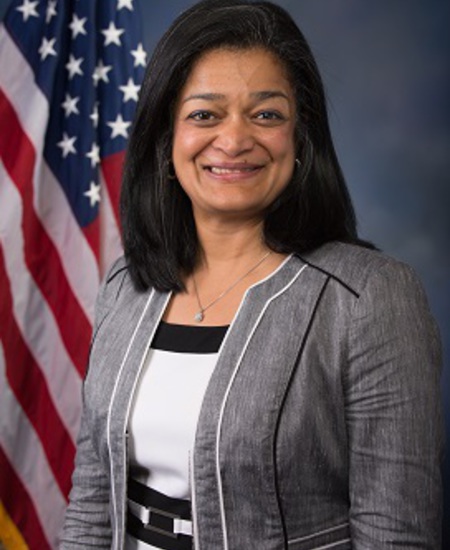
Rep. Pramila Jayapal
Sponsored bills
Maddy summaryHRES 874 is a symbolic resolution expressing the House's support for designating November as "Prematurity Awareness Month." It does not create new laws or alter funding but urges the public, organizations, and communities to observe the month through events, promote awareness, and support preterm birth prevention programs. The resolution highlights statistics on preterm births (383,000 babies born preterm in 2021) and health disparities, but its sole action is endorsing the awareness designation. As a non-binding resolution, it has no direct impact on policy or affected individuals beyond raising public visibility.
Maddy summaryHR 6451, the Mental Health Justice Act of 2023, provides $250 million in federal grants to states, tribes, and localities to hire mental health professionals as first responders for specific emergencies. It directs these professionals to replace police in situations involving mental health crises, substance use, or intellectual/developmental disabilities - such as when a 911 caller describes a mental health emergency or a first responder identifies someone needing mental health support. The bill requires grantees to train responders in de-escalation techniques, link individuals to community-based services (not incarceration), and report on outcomes like reduced arrests or use of force. It also mandates data collection on demographics and prevents funneling people into institutional settings, with annual reports to Congress on program effectiveness.
Maddy summaryHRES 886 is a non-binding House resolution supporting Transgender Day of Remembrance (TDoR) by recognizing the epidemic of violence against transgender people and memorializing those lost in the year ending September 30, 2023. It specifically acknowledges the disproportionate impact of violence on transgender women of color, citing 33 documented deaths in the U.S. during that period (with estimates suggesting the actual number is higher due to underreporting). The resolution calls for Congress to prioritize studying and preventing such violence while affirming that all transgender people deserve dignity and respect. As a symbolic resolution, it does not create new laws or allocate funding but serves to raise awareness and honor victims.
Maddy summaryThis bill closes loopholes that allow domestic violence abusers to keep or buy firearms while under restraining orders. It requires courts to issue "firearm surrender orders" when domestic violence restraining orders are issued, mandating that abusers surrender all firearms within 24 hours. The law expands the definition of "intimate partner" to include dating partners and requires law enforcement to remove firearms if abusers don't comply. It also creates a federal grant program to help states implement these policies, directly affecting domestic violence survivors and abusers subject to restraining orders.
Maddy summary# Summary of the Government Surveillance Reform Act of 2023 This comprehensive legislative proposal aims to reform government surveillance practices in the United States with a strong emphasis on privacy protections, judicial oversight, and government transparency. The key components include: 1. **Cell Site Simulator Restrictions**: - Comprehensive ban on cell-site simulators (stingrays) except under specific circumstances requiring warrants - Requires judicial approval for most uses, with strict limitations on scope, duration, and minimization of incidental collection - Mandates disclosures about potential disruptions to emergency services - Includes detailed reporting requirements for government agencies 2. **Vehicle Data Protections**: - Prohibits warrantless access to vehicle data (including telematics and onboard sensors) - Requires warrants for most access, with specific exceptions for consent and emergencies - Creates detailed definitions and procedures for consent requirements 3. **Enhanced Foreign Intelligence Surveillance Oversight**: - Requires more detailed reporting by the Foreign Intelligence Surveillance Court - Mandates annual reports on accuracy and completeness of applications - Increases transparency around Section 702 collection - Requires reporting on queries targeting U.S. persons 4. **Data Broker and Service Provider Protections**: - Strengthens privacy protections for data held by data brokers - Requires court orders for government access to certain data - Includes minimization requirements for handling collected data - Prohibits warrantless use of data obtained through cell site simulators 5. **Transparency Requirements**: - Mandates detailed public reporting on surveillance activities - Requires annual reports on accuracy of applications - Increases granular reporting on targets and queries - Requires public disclosure of statistics on surveillance use The legislation represents a significant shift toward greater privacy protections and government accountability in surveillance practices, with detailed technical requirements for compliance and enhanced reporting obligations for government agencies. It would significantly impact how law enforcement and intelligence agencies conduct surveillance operations while attempting to balance public safety needs with constitutional privacy rights.
Maddy summaryThe FAMILIES Act creates a program allowing courts to divert eligible parents and caregivers from incarceration into community-based supervision instead of prison or probation. Eligible individuals include parents of minor children, expectant parents, and caregivers for minors, elderly, or disabled family members. The program provides comprehensive services like education, job training, substance abuse treatment, and family counseling, with provisions to prevent financial barriers from hindering participation. Courts must consider factors like caregiver responsibilities and risk to family members when determining eligibility, and successful participants may qualify for record expungement.
Maddy summaryHRES 844 is a symbolic resolution recognizing the religious and historical significance of Diwali, the festival of lights. It specifically acknowledges how Diwali is celebrated by Hindus, Sikhs, and Jains in the U.S., including its meaning for Sikhs (commemorating Guru Hargobind's release) and Jains (marking Lord Mahavira's Nirvana). The resolution expresses respect for Indian-American communities and highlights Diwali's role as a celebration of light over darkness and good over evil. It also affirms religious diversity in India and the U.S. and supports U.S.-India relations. As a non-binding resolution, it does not create legal obligations or affect any policies.
Maddy summaryHRES 815 is a non-binding resolution expressing the U.S. House of Representatives' support for recognizing October 26, 2023, as "Intersex Awareness Day," which commemorates the 1996 demonstration by intersex individuals and promotes bodily autonomy. It encourages federal, state, local, and community organizations to observe the day through educational programs and to provide culturally competent care to intersex people. The resolution also urges healthcare providers and schools to connect intersex individuals and families to resources and support education about intersex diversity. As a symbolic gesture, it does not create new legal requirements but aims to raise public awareness and affirm the rights of intersex people.
Maddy summaryThis resolution (HRES 839) condemns antisemitism at U.S. colleges and universities and urges campus leaders to publicly oppose hate speech targeting Jewish students, faculty, and staff. It encourages university presidents, administrators, and faculty to speak out against speech that promotes violence or discrimination based on religion, national origin, or ancestry. The resolution specifically calls on institutions to support Jewish student organizations and ensure Jewish members can study and work without fear. As a non-binding resolution, it does not create new laws but expresses congressional support for addressing antisemitism on campuses.