

Maddy summaryHRES 963 is a symbolic resolution honoring Korean American Day, which commemorates the January 13, 1903 arrival of the first large wave of Korean immigrants to the U.S. It recognizes Korean Americans' contributions to U.S. society, including their economic, cultural, and military impacts, and marks the 121st anniversary of this historic migration. The resolution urges all Americans to observe Korean American Day to appreciate these contributions. As a commemorative measure, it does not create new policies or affect specific groups beyond this ceremonial recognition.
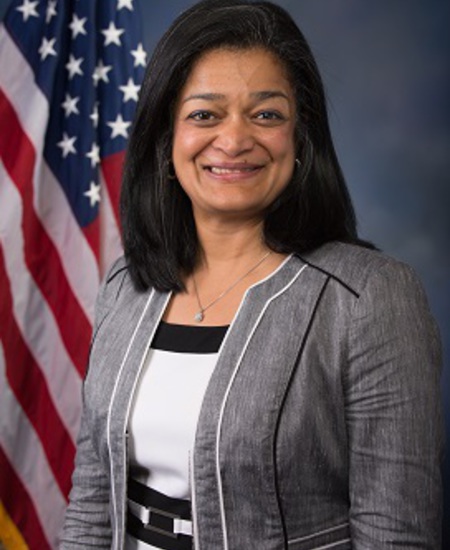
Rep. Pramila Jayapal
Sponsored bills
Maddy summaryHR 6986 limits patent holders from asserting multiple patents in infringement lawsuits against companies developing generic drugs or biosimilars. Specifically, it allows only one patent per "Patent Group" (commonly owned patents related through certain legal filings) to be claimed against such companies in a single lawsuit. This directly affects drug/biosimilar manufacturers submitting applications under FDA approval pathways (21 U.S.C. 355 or 42 U.S.C. 262) or selling approved versions of these products. The rule applies to new applications filed after the bill's enactment, aiming to reduce complex patent litigation tactics.
Maddy summaryThe Affordable Connectivity Program Extension Act of 2024 allocates $7 billion in funding for the Affordable Connectivity Program (ACP) during fiscal year 2024. The ACP provides subsidies to low-income households to help cover the cost of internet service and connected devices like laptops or tablets. This funding ensures the program can continue supporting eligible households throughout the year, with the money remaining available until fully spent. The bill extends existing program funding without changing eligibility criteria or service requirements.
Maddy summaryHR 6888, the Clean Energy Workforce Act, provides $100 million in federal grants to develop clean energy job training programs. It directly affects local schools, career technical education centers, colleges, and industry partners by funding: (1) new or expanded training programs in clean energy fields (like renewable energy and climate adaptation), designed to be shared with other schools and accessible to diverse students; and (2) upgrades to school facilities to use renewable energy and improve energy efficiency. Grants require partnerships between educational institutions, industry representatives, and community groups to create replicable training that prepares students for jobs in growing clean energy sectors. The bill focuses on concrete workforce development, not environmental outcomes.
Maddy summaryThis resolution calls on the U.S. government to formally end the Monroe Doctrine - a historical policy used to justify U.S. intervention in Latin America - and develop a new "Good Neighbor" policy focused on partnership. It specifically urges the State Department to declare the doctrine obsolete, end unilateral sanctions (like the Cuba embargo), reform international financial institutions, and support regional cooperation on issues like climate change and human rights. The resolution targets U.S. foreign policy mechanisms and aims to improve relations with Latin American and Caribbean nations by shifting from intervention to mutual respect. As a non-binding resolution, it expresses congressional intent but does not create new law.
Maddy summaryThe Public Banking Act of 2023 establishes a federal framework for public banks owned by state, tribal, or community entities. It creates a process for chartering public lending banks (which provide financial services to public entities) and public payment banks (which focus on payment services), while requiring democratic governance with community representation on boards. The bill sets specific lending preferences prioritizing environmental justice communities, quality job creation, and worker protections, while prohibiting loans to fossil fuel companies, private prisons, and tobacco industries. It also creates grant and incubator programs to help establish these banks and establishes public deposit insurance for them, fundamentally changing how public banking institutions operate in the United States.
Maddy summaryHR 6768, the Public Health Nursing Act, authorizes $5 billion annually (2024-2033) to expand public health nursing services through federal grants to state and local health departments. The bill requires grantees to use funds for recruiting and training registered nurses in underserved areas, covering wages, medical supplies (like PPE), and administrative costs to improve maternal/infant health and chronic disease management. Priority is given to applicants serving communities with high chronic disease rates, maternal mortality, low-income populations, rural areas, or health professional shortage zones. This directly affects public health departments and their ability to hire nurses providing in-person care, home visits, and mobile clinic services.
Maddy summaryThe Restore Honor to Service Members Act of 2023 establishes a Department of Defense "Tiger Team" to improve outreach to veterans with certain discharge statuses (specifically those discharged under "former section 654" before 2011, often related to policies like the "Don't Ask, Don't Tell" era). The team will collaborate with the VA, veterans' groups, and other stakeholders to identify eligible veterans, share contact information, and guide them through the existing review process under Section 527 of the 2020 National Defense Authorization Act. The bill requires the team to submit regular progress reports to Congress and a final report within three years, tracking how many veterans successfully changed their discharge status to "honorable" through the review process. This focuses on streamlining access to an existing review mechanism, not creating new benefits or altering discharge standards.
Maddy summaryHRES 936 is a symbolic resolution commemorating the 80th anniversary of the Magnuson Act of 1943, which repealed the Chinese Exclusion Act of 1882. It honors the contributions of Chinese Americans and acknowledges the historical injustice of laws that excluded Chinese immigrants and denied them citizenship. The resolution celebrates Chinese American communities and reaffirms commitment to equal civil rights for all, regardless of race. As a commemorative measure, it does not create new laws or alter policies.
Maddy summaryThe Brittany Clardy Missing and Murdered Black Women and Girls Act establishes a new Office within the Department of Justice to address the disproportionate rates of missing and murdered Black women and girls in the U.S. The Office will collect and analyze data on these cases - including case resolution times, Amber Alert usage, and trafficking links - and create a public dashboard for tracking. It also creates a grant program for community organizations to provide culturally appropriate prevention services, law enforcement training, and victim support. The Office must submit biennial reports to Congress with findings and recommendations to improve the criminal justice response to these cases. This bill directly affects Black women and girls facing violence, law enforcement agencies, and community organizations providing related services.