

Maddy summaryThis bill directs the U.S. Treasury to instruct the U.S. representative at the International Monetary Fund (IMF) to immediately review and suspend IMF surcharges on member countries. It specifically targets the 200-300 basis point fees applied to IMF loans exceeding certain thresholds, which the bill states constitute up to 39% of debt payments for some nations like Ecuador and Egypt, and will cost Ukraine an estimated $1.5 billion in surcharges from 2024-2028. The review requires a 365-day analysis of surcharge impacts on national budgets (including health, education, and food security), effectiveness in reducing IMF credit risk, and potential unintended consequences like pushing countries toward predatory loans. The bill mandates this review be completed and results published within a year, with surcharges suspended during the process.
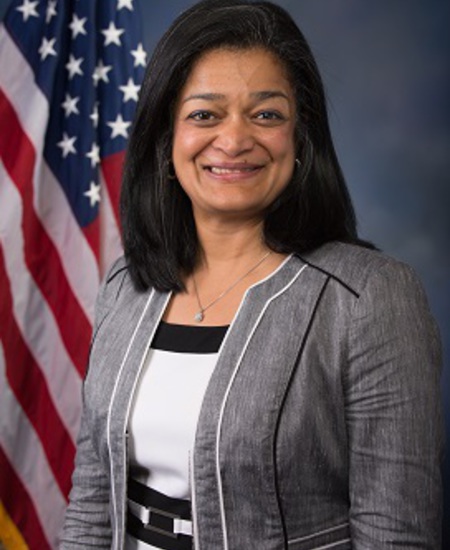
Rep. Pramila Jayapal
Sponsored bills
Maddy summaryThe STAGE Act establishes a federal grant program to support professional nonprofit theaters. Eligible theaters (nonprofits producing live performances with fair wages, 3+ years of programming, and financial need or community focus) can receive grants covering payroll, facility repairs (prioritizing accessibility), marketing, and workforce training. Grants max out at $16 million per entity or 20% of its prior year's expenses, with $1 billion annually allocated for 2024-2028. The bill also mandates a federal study on sustaining the nonprofit arts sector, including input from artists and community stakeholders.
Maddy summaryHCONRES 102 is a non-binding symbolic resolution supporting International Transgender Day of Visibility, introduced by multiple House members. It formally encourages the U.S. to observe the day with ceremonies and programs, celebrates transgender community achievements, and recognizes their ongoing fight for equality amid documented discrimination in employment, healthcare, housing, and public spaces. The resolution highlights transgender representation in politics (including 21 state legislators) and historical context, while acknowledging rising anti-transgender legislation. It directly affirms the transgender community's visibility and rights without creating new policies or funding.
Maddy summaryThis bill establishes a federal committee composed of agency heads from Education, Justice, Consumer Financial Protection, and other departments to coordinate oversight of for-profit colleges. The committee will share data across agencies, create a centralized complaint system for students, and publish an annual report with detailed data on for-profit institutions' finances, student outcomes, and complaints. It also creates a "For-Profit College Warning List" that identifies institutions with serious issues like fraud or misrepresentation, providing plain-language summaries for parents and students. The bill directly affects for-profit colleges, their students, and the federal agencies that oversee higher education programs.
Maddy summaryThis bill would provide federal grants to public housing agencies to modernize public housing through energy efficiency upgrades, infrastructure improvements, and renewable energy systems. It requires all public housing to become "zero-carbon homes" that produce enough renewable energy to meet their own consumption within 10 years. The bill includes specific requirements for workforce development, hiring from low- and very low-income communities (40% in year 1, 50% in year 2, 90% after that), and contracting with resident-owned businesses (20% in year 1, 30% in year 2, 50% after that). It also mandates resident and community engagement in planning, and requires public housing agencies to meet specific energy efficiency and water quality standards. The bill directly affects all public housing agencies managing housing for low- and very low-income residents across the United States, including tribal housing entities.
Maddy summaryThis bill establishes a federal grant program to fund projects restoring native kelp forests, directly affecting eligible entities like fishing industry members, tribes, universities, nonprofits, and state/local governments. It requires projects to address the greatest kelp declines, focus on ecosystem resilience (including natural predator-prey relationships), integrate Indigenous knowledge, and avoid commercial harvesting. The program allocates $5 million annually (2024-2028), with at least $750,000 reserved for tribal projects, and mandates that federal funds cover up to 85% of project costs (with possible waivers). Grants prioritize areas identified in tribal or government restoration plans and require monitoring plans to measure project effectiveness.
Maddy summaryThe PTO Act establishes a standard for paid annual leave, requiring most employers to provide employees with 1 hour of paid leave for every 25 hours worked, up to a maximum of 80 hours per 12-month period. It directly affects private sector employees and certain government workers, including those at the Government Accountability Office, Library of Congress, and federal agencies covered under the Congressional Accountability Act. The bill prohibits employers from interfering with employees' use of leave for any reason, requires clear notice of leave policies, and protects employees from retaliation for taking leave. It includes enforcement mechanisms through the Department of Labor, allowing employees to file complaints or lawsuits for violations of their leave rights. The Act takes effect 180 days after enactment, with specific provisions for collective bargaining agreements.
Maddy summaryThis bill would create a new wealth tax on individuals with significant assets, targeting those with net assets exceeding $50 million. It would tax assets between $50 million and $1 billion at 2%, and assets above $1 billion at 3% (potentially increasing to 6% if certain health care legislation is enacted). The tax would apply to individuals, married couples treated as a single taxpayer, and certain trusts, with specific valuation and reporting requirements for assets. The bill also includes $70 billion in funding over 10 years for the IRS to enforce this new tax and related reporting requirements.
Maddy summaryHR 6610, the Passport System Reform and Backlog Prevention Act, aims to reduce delays in U.S. passport processing for citizens applying for routine new or renewal passports. It mandates a 30-day processing standard from document submission to mailing, requires technology upgrades like digital tracking dashboards and mobile apps for applicant updates, and authorizes hiring up to 100 temporary staff annually for passport offices. The bill also sets cybersecurity standards, maintains affordable fees, and requires regular progress reports to Congress on implementation. These changes directly affect U.S. citizens seeking passports, particularly those in remote areas with limited access to processing centers.
Maddy summaryHCONRES 99 is a symbolic congressional resolution honoring Wadee Alfayoumi, a 6-year-old Palestinian-American boy murdered in a hate crime on October 14, 2023, after being stabbed 26 times by a perpetrator who made anti-Muslim and anti-Palestinian remarks. The resolution recognizes Congress's condemnation of hate crimes, Islamophobia, and anti-Palestinian discrimination, while affirming the United States' "zero tolerance" for such violence. As a procedural resolution (not a law), it does not create new policies but formally honors Wadee and his family, emphasizing the need to reject dehumanizing rhetoric targeting religious or ethnic groups.