

Maddy summaryHR 6751 authorizes the U.S. Mint to produce commemorative coins honoring Roberto Clemente, a Hall of Fame baseball player and humanitarian, including 50,000 $5 gold coins, 400,000 $1 silver coins, and 750,000 half-dollar coins. The coins must feature Clemente's image and inscriptions like "Roberto Clemente" and "2027," with all sales including a surcharge ($5-$35 per coin) paid to the Roberto Clemente Foundation. The foundation, which supports youth sports, education, and disaster relief programs, will use these funds for its mission, while the U.S. Treasury must recover all production costs. The coins will be sold exclusively in 2027, with no net cost to the government.
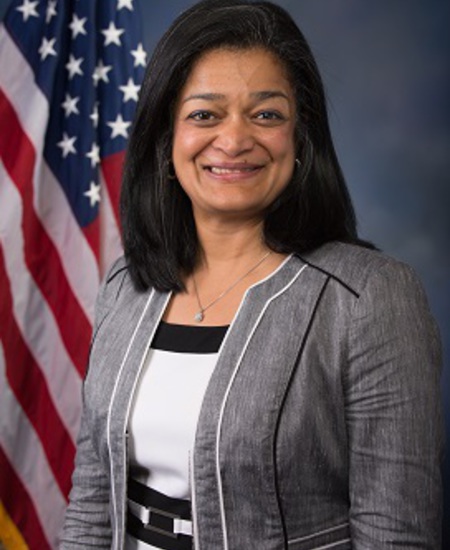
Rep. Pramila Jayapal
Sponsored bills
Maddy summaryThe FAIR Act requires the Congressional Budget Office (CBO) and Joint Committee on Taxation (JCT) to produce distribution analyses by income and race for bills with a significant budgetary impact (at least 0.1% of GDP). These analyses must show expected dollar and percentage changes in after-tax-and-transfer income for different racial and income groups over time. Additionally, the bill mandates the CBO to prepare a report within one year on methods for conducting gender-based distribution analyses for major legislation. This policy change aims to provide Congress with standardized data on how proposed laws affect economic disparities.
Maddy summaryHRES 1604 designates December 3 as National Chemical Disaster Awareness Day to commemorate the 40th anniversary of the 1984 Bhopal chemical disaster and promote public awareness of chemical safety risks. This non-binding resolution does not create new laws but calls for the House to recognize Bhopal survivors' advocacy, urge the Department of Justice to address the Bhopal case (including actions related to Dow Inc. and India), and engage with survivors to improve understanding of chemical disaster prevention. The resolution highlights ongoing risks from hazardous facilities and disproportionate impacts on vulnerable communities, emphasizing human rights and anti-discrimination principles in U.S. foreign policy. It serves as a symbolic gesture to honor victims and encourage proactive safety measures, without imposing regulatory requirements.
Maddy summaryThis bill requires the U.S. government to take specific actions to support peace in Sudan, including imposing sanctions on individuals and entities responsible for war crimes, crimes against humanity, and blocking humanitarian aid. It mandates the President to submit reports identifying those responsible for such actions and to impose sanctions against them, with exceptions for humanitarian aid. The bill establishes a Special Presidential Envoy for Sudan to coordinate U.S. diplomatic efforts and requires a comprehensive strategy to support civilian protection, humanitarian access, and inclusive peace processes. It includes specific provisions to empower Sudanese women and youth in peace processes and prohibits the sale of major defense equipment to countries supporting the Rapid Support Forces (RSF) or Sudanese Armed Forces (SAF).
Maddy summaryThis bill establishes a Truth and Healing Commission to investigate the history and impacts of U.S. Indian Boarding School policies on Native American communities, including cultural, emotional, and physical effects on survivors, descendants, and tribal communities. The Commission will document these impacts through research, public meetings, and testimony, working with two advisory committees focused on Native American perspectives and Federal agency coordination. The Commission will operate for six years, with annual reports to Congress and a final report containing recommendations for Federal action. The bill also includes provisions for managing burial sites related to boarding schools and ensures the Native American Graves Protection and Repatriation Act applies to remains found on Federal lands related to these schools.
Maddy summaryThe Our Homes, Our Votes Act requires landlords and public housing agencies managing federally assisted housing (including public housing, Section 8, and supportive housing programs) to include voter registration forms in lease agreements. When tenants sign their lease, it automatically serves as a voter registration application for federal elections, unless they opt out. Landlords must ensure forms include basic eligibility information, provide language access for limited-English speakers, and submit completed forms to election officials within 10 days. This applies to all tenants in covered housing units, streamlining registration without requiring separate action.
Maddy summaryHRES 1588 is a House resolution supporting Transgender Day of Remembrance (TDoR) by recognizing the epidemic of violence against transgender people and memorializing those killed between October 1, 2023, and September 30, 2024. It specifically honors 38 transgender or gender-nonconforming individuals whose lives were lost to violence during that period, highlighting that transgender women of color face disproportionate risks. The resolution acknowledges systemic issues like underreporting, barriers to healthcare, and higher rates of homelessness and suicide within the community. It calls for the U.S. government to prioritize solutions to this violence while affirming transgender people's right to dignity and safety. As a symbolic resolution, it does not create new laws or policies but formally recognizes these issues for congressional record.
Maddy summaryHRES 1581 is a symbolic resolution expressing congressional support for designating November 2024 as "Prematurity Awareness Month." It highlights the U.S. maternal and infant health crisis, including higher preterm birth rates and disparities affecting Black and Native American women and their infants. The resolution urges Americans, communities, and organizations to observe the month through events and education focused on preterm birth prevention. It does not create new laws or funding but aims to raise public awareness about this health issue, which contributes to infant mortality and costs an estimated $25.2 billion annually.
Maddy summaryHR 10165, the Security Clearance Review Act, requires the FBI Director to approve security clearances and access to classified information for political appointees working in the Executive Office of the President. It prohibits such appointees from holding clearances or accessing classified information without the FBI Director’s explicit authorization. If the FBI denies clearance, the Director must immediately notify the President and Congress. If the President overrides this denial, they must provide a written explanation to Congress within 30 days. The bill directly affects political appointees in the White House and establishes new oversight steps for security clearance decisions.
Maddy summaryThis bill prohibits Medicaid from covering conversion therapy for any enrollee. It amends federal law to block Medicaid payments for any therapy aimed at changing a person's sexual orientation or gender identity (defined as "conversion therapy" in the bill), starting in the first full quarter after the law takes effect. The prohibition applies to all Medicaid providers who offer such therapy for compensation, but explicitly excludes support for gender transition, acceptance-based care, and interventions focused on safety or unlawful conduct. It directly affects Medicaid recipients seeking therapy and providers who previously billed for conversion therapy services.