

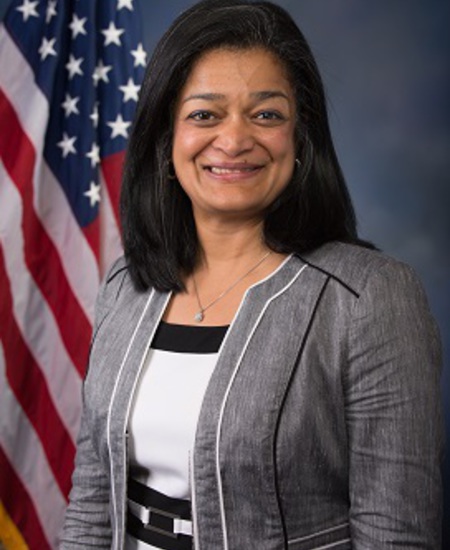
Photo of Pramila Jayapal
D United States House · District 7 · Washington On the 2026 ballot

Rep. Pramila Jayapal

Compare
Total votes
2,837
all sessions
Attendance
96%
101 missed
Lower than 89% of chamber peers
With party
96%
of cast votes
Near the chamber average
Bipartisan score
2%
crosses aisle rarely
Near the chamber average
Sponsored
1,928
bills & resolutions
Higher than 90% of chamber peers
Committees
7
assignments
1,928 bills and resolutions

Sponsored bills

Total
1,928
Primary
131
Co-sponsor
1,797
This page
1,928
matching current filters
Co-sponsor HR 4797
In committee · United States House · Co-sponsor
EATS Act of 2025

Maddy summaryThis bill removes a barrier preventing most low-income students from accessing SNAP benefits. It amends the Food and Nutrition Act to explicitly allow students enrolled at least half-time in recognized higher education programs to qualify for SNAP, reversing a prior exclusion. The key change eliminates the previous requirement that students meet specific exceptions (now deleted) and adds a new eligibility category under Section 3(m)(5). This directly affects low-income undergraduate and graduate students at colleges and training programs who were previously ineligible. The changes take effect January 2, 2026.

In committee Jul 29, 2025 1 co-sponsor
Co-sponsor HR 4796
In committee · United States House · Co-sponsor
Restoring Essential Healthcare Act

Maddy summaryHR 4796, the Restoring Essential Healthcare Act, repeals a provision that blocked Medicaid payments to certain healthcare providers during a specific period. It directly affects Medicaid beneficiaries who received care from these providers between the enactment of the prior law (Public Law 119-21) and this bill's enactment. The key provision retroactively restores Medicaid payments for services already provided during that blocked period, treating the payment restriction as if it never existed. This change ensures eligible individuals and providers receive reimbursement for covered care delivered during the prohibited timeframe.

In committee Jul 29, 2025 1 co-sponsor
Co-sponsor HR 4763
In committee · United States House · Co-sponsor
PTO Act

Maddy summaryHR 4763, the PTO Act, requires most employers to provide employees with at least 1 hour of paid annual leave for every 25 hours worked, with a maximum of 80 hours per year. It applies to private-sector workers and certain government employees, protecting their right to use paid leave for any purpose without disclosing the reason. The bill mandates employers to maintain health benefits during leave, allow carryover of up to 40 hours of unused leave, and pay out unused leave upon separation. It also prohibits employers from discriminating against employees for using paid leave or requiring them to find replacements while on leave. The law includes enforcement mechanisms, allowing employees to file complaints with the Department of Labor or pursue private lawsuits.

In committee Jul 25, 2025 1 co-sponsor
Co-sponsor HR 4761
In committee · United States House · Co-sponsor
Eviction Right to Counsel Act of 2025

Maddy summaryThe Eviction Right to Counsel Act of 2025 establishes a $100 million annual federal fund (2026-2030) to support legal representation for low-income tenants facing eviction. It directly affects tenants with incomes at or below 200% of the federal poverty line in eviction cases or housing subsidy terminations. The bill provides grants to states, localities, or tribal governments that already have laws guaranteeing free legal counsel for these tenants, prioritizing jurisdictions with additional tenant protections like longer eviction notice periods or emergency rental assistance. Funds can cover attorney training and implementation costs but do not require new federal mandates - eligibility depends on pre-existing state/local "right to counsel" laws.

In committee Jul 25, 2025 1 co-sponsor
Co-sponsor HR 4667
In committee · United States House · Co-sponsor
VISIBLE Act

Maddy summaryHR 4667, the VISIBLE Act, requires U.S. Immigration and Customs Enforcement (ICE), U.S. Customs and Border Protection (CBP), and other authorized immigration officers to visibly display their agency name and either their last name or unique badge number during all public immigration enforcement activities (such as stops, arrests, raids, or checkpoints). This identification must be clearly legible from 25 feet away on outer clothing, not obscured by gear, and officers cannot wear face coverings that hide their face during public interactions unless for covert operations or hazardous conditions. The bill mandates DHS to discipline non-compliant officers and submit annual reports to Congress detailing enforcement activities, violations, and disciplinary actions. It also directs DHS’s Civil Rights Office to investigate public complaints about noncompliance.

In committee Jul 24, 2025 1 co-sponsor
Co-sponsor HR 4696
In committee · United States House · Co-sponsor
Renewing Immigration Provisions of the Immigration Act of 1929

Maddy summaryHR 4696 amends Section 249 of the Immigration and Nationality Act to update eligibility for a registry program that provides a pathway to legal status for long-term residents. It changes the requirement from entering the U.S. before January 1, 1972, to entering at least 7 years before the application date. This adjustment bases eligibility on a rolling 7-year window instead of a fixed historical cutoff, allowing more recent long-term residents to qualify. The bill directly affects individuals who entered the U.S. after 1972 but maintained continuous residence for at least seven years prior to applying.

In committee Jul 23, 2025 1 co-sponsor
Co-sponsor HR 4682
In committee · United States House · Co-sponsor
End Solitary Confinement Act

Maddy summaryThe End Solitary Confinement Act would prohibit most solitary confinement in federal prisons and detention centers, requiring all incarcerated people to have at least 14 hours daily of out-of-cell group interaction in shared spaces. It establishes strict limits on when solitary confinement can be used (only for brief counts, emergencies as a last resort, or medical isolation), with specific protections for vulnerable populations including youth, the elderly, people with disabilities, pregnant people, and LGBTQ+ individuals. The bill creates a community monitoring body to oversee implementation, requires detailed reporting on confinement practices, and provides incentives for states to adopt similar standards through funding adjustments. It also includes due process protections for placement in restrictive housing and prohibits punitive practices like limiting access to services or confiscating personal property.

In committee Jul 23, 2025 1 co-sponsor
Co-sponsor HR 4724
In committee · United States House · Co-sponsor
Corporate Crime Database Act of 2025

Maddy summaryThe Corporate Crime Database Act of 2025 requires the Bureau of Justice Statistics to create a public database tracking federal enforcement actions related to corporate crimes. Federal agencies must submit data on corporate offenses - such as violations committed by businesses or employees acting in their job roles - and include details like the business involved, the offense type, relevant laws, enforcement agency, and outcome. The database will be searchable online, updated annually, and include historical and future enforcement actions. This affects federal agencies that handle enforcement and makes corporate crime data accessible to the public for transparency.

In committee Jul 23, 2025 1 co-sponsor
Co-sponsor HR 4678
In committee · United States House · Co-sponsor
RAP Act of 2025

Maddy summaryThe RAP Act of 2025 amends federal evidence rules to generally prohibit the use of a defendant's creative or artistic expression (such as music, poetry, or visual art) as evidence in criminal or civil trials. It directly affects defendants whose artistic works might otherwise be presented against them, making such evidence inadmissible unless the government proves specific conditions by "clear and convincing evidence." These conditions require showing the expression was intended literally, directly relates to the specific facts of the case, is uniquely relevant, and has distinct probative value not available through other admissible evidence. If admitted under the exception, courts must redact the evidence and provide special jury instructions. The law aims to protect artistic expression from being misused in legal proceedings.

In committee Jul 23, 2025 1 co-sponsor
Co-sponsor HR 4731
In committee · United States House · Co-sponsor
Resident Physician Shortage Reduction Act of 2025

Resident Physician Shortage Reduction Act of 2025 This bill increases the number of residency positions eligible for graduate medical education payments under Medicare for qualifying hospitals, including hospitals in rural areas and health professional shortage areas. The bill provides for an additional increase of 2,000 positions per fiscal year from FY2026-FY2032; during this period, each hospital may receive up to 75 additional positions in total under the bill and current law. Additionally, one-third of the positions that are made available under the bill must be allocated to hospitals that are already operating above applicable resident limits. The bill also requires the Government Accountability Office to report on strategies to increase the diversity of the health professional workforce, including with respect to representation from rural, low-income, and minority communities.

In committee Jul 23, 2025 1 co-sponsor
Showing 321 to 330 of 1,928 bills
Previous 1 … 32 33 34 … 193 Next