

This resolution expresses the sense of Congress that legislation and policies that address poverty, low wages, and related issues should be prioritized. Among other priorities, the resolution commits to updating the poverty measure; raising the minimum wage; expanding unemployment insurance; ensuring that all workers receive paid family and medical leave; implementing a federal jobs guarantee; guaranteeing safe and quality housing, a right to water, high-quality public education, and quality health care for all; enacting relief from household and personal debt that cannot be paid; ensuring that state, local, and tribal governments are adequately funded; expanding and protecting the right to vote; eliminating persistent racial inequities; protecting the constitutional rights of assembly and free speech; enacting comprehensive and just immigration reform; ensuring all the rights of Native and Indigenous peoples and tribal nations; transforming the economy into a green renewable energy economy; demilitarizing U.S. foreign policy, borders, and policing; enacting fair taxes on corporations and the wealthy; using deficit spending to meet pressing needs; and encouraging states and cities to enact policies that follow the direction provided by this resolution.
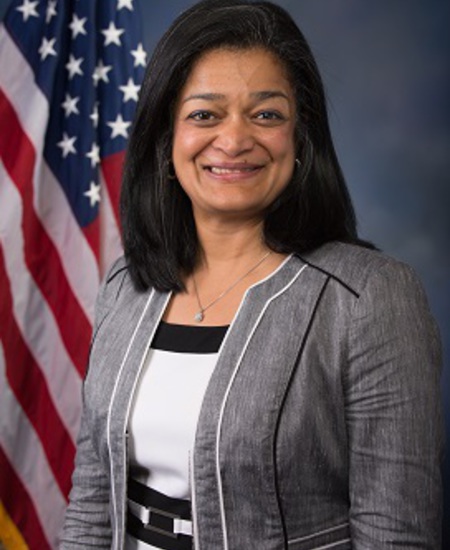
Rep. Pramila Jayapal
Sponsored bills
Keeping All Students Safe Act This bill prohibits the use of seclusion and limits the use of physical restraint in schools and Head Start programs that receive federal funding. Specifically, the bill prohibits the use of seclusion, which is the involuntary confinement of a student alone in a room or area from which the student is physically prevented from leaving. The term does not include a time out, which may involve separating the student from others in a non-locked setting. The bill prohibits the use of mechanical or chemical restraints or physical restraints that restrict breathing or are life threatening. The bill outlines the requirements for the use of physical restraint, including that the student's behavior must pose an imminent danger of serious physical injury to the student or other individual. Each state must ensure that a sufficient number of program personnel are trained and certified by a state-approved crisis intervention training program. Additionally, each program must establish procedures to follow after an incident involving physical restraint. Further, the bill establishes enforcement provisions, including a private right of action for a student who has been subjected to unlawful seclusion or restraint. The Department of Education and the Department of Health and Human Services must withhold payments from a program for unlawful seclusion or restraint. Finally, the bill requires each state educational agency (SEA) to establish, implement, and enforce policies and procedures required by the bill. It also creates a grant program to assist SEAs with these activities.
Stop Child Hunger Act of 2021 This bill establishes a permanent program and provides funds for electronic benefit transfer (EBT) cards to cover meals for children during extended school closures. Specifically, the Department of Agriculture must establish a program to provide EBT cards to cover meals for children who are enrolled in the National School Lunch Program or School Breakfast Program when a school is closed, operating remotely, or a combination of both for a period of five days or more. Cards may be used to purchase food from approved retailers under the Supplemental Nutrition Assistance Program.
Air America Act of 2021 This bill establishes the service of Air America employees as qualifying service for purposes of the Civil Service Retirement System. (Air America was a government-owned airline that provided air transport for certain covert operations in Southeast Asia, including Laos and Vietnam, between 1950 and 1976.) The bill applies to U.S. citizens who were employees of Air America or another affiliated company, as specified, between January 1, 1950 and December 31, 1976. Benefit applications must be filed within two years of the date of enactment of this bill.
This joint resolution prohibits the issuance of an export license for specified defense articles, defense services, and technical data for end use by Israel.
This resolution censures Representative Jody Hice for certain statements he made regarding the events at the U.S. Capitol on January 6, 2021.
This resolution censures Representative Paul Gosar for certain statements he made regarding the events at the U.S. Capitol on January 6, 2021.
This resolution censures Representative Andrew Clyde for certain statements he made regarding the events at the U.S. Capitol on January 6, 2021.
Peace on the Korean Peninsula Act This bill requires the Department of State to report to Congress on various issues relating to North Korea. Specifically, the State Department must report to Congress a review of the restrictions on travel by U.S. nationals to North Korea, including whether such restrictions should be adjusted to allow travel to North Korea to attend a commemoration of a relative. The State Department must also report to Congress a clear roadmap for achieving permanent peace on the Korean Peninsula.
Diversifying by Investing in Educators and Students to Improve Outcomes For Youth Act or the Diversify Act This bill revises the Teacher Education Assistance for College and Higher Education (TEACH) grant program. The TEACH program awards grants to undergraduate and graduate students who commit to teaching in a high-need field and in an elementary or secondary school that serves low-income students. First, the bill raises the maximum amount for TEACH grants. Second, the bill allows TEACH grants to cover the full cost of attendance. Currently, these grants may be used only for tuition, fees, and on-campus housing. The bill allows teaching in a high-need early childhood education program to count toward service requirements for the program. Next, the bill eliminates the process for converting a TEACH grant to a loan if a recipient does not complete the requirements of the program. Further, the bill prohibits the Department of Education (ED) from instituting or creating a monetary penalty for failure or refusal to complete the service requirement. In addition, the bill requires ED to send an electronic certificate to grant recipients who have completed their service requirement. The bill also exempts the TEACH program from sequestration, which is a process of automatic, usually across-the-board spending reductions under which budgetary resources are permanently cancelled to enforce specific budget policy goals.