Maddy summaryHRES 845 is a procedural resolution passed by the U.S. House of Representatives to remove Representative Lauren Boebert (Colorado) from two standing committees: the Committee on the Budget and the Committee on Natural Resources. The resolution directly affects Boebert's committee assignments, which are part of her official duties as a House member. It does not change laws or policies but alters her participation in specific legislative committees. This action was taken under House rules requiring members to "reflect creditably on the House," though the resolution itself only addresses committee membership. The resolution was submitted by multiple House members and referred to the Committee on Ethics.
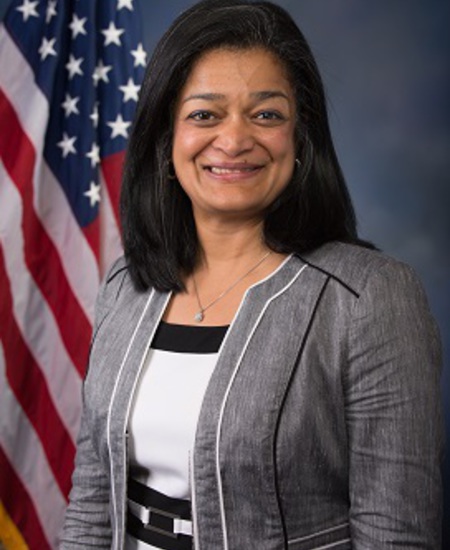
Rep. Pramila Jayapal
Sponsored bills
Radiation Exposure Compensation Act Amendments of 2021 This bill expands two programs that compensate individuals who were exposed to radiation during certain nuclear testing or uranium mining and subsequently developed medical conditions, including cancers. First, the bill expands and extends a program that compensates individuals who were exposed to radiation from atmospheric nuclear testing or other sources and subsequently developed specified cancers. Under current law, this program compensates individuals who were present in a designated geographic area during a period of nuclear testing and certain individuals employed in uranium mining. The bill expands the designated areas to include Colorado, Idaho, Montana, New Mexico, and Guam and additional areas in Arizona, Nevada, and Utah; makes more individuals who worked in uranium mining eligible for the program; increases the amount of compensation awarded to and provides medical benefits for eligible claimants; and extends for 19 years following the bill's enactment the fund that supports this program and the statute of limitations for filing claims (currently, the program terminates on July 10, 2022). Second, the bill makes certain individuals employed in uranium mines or mills eligible for a program that compensates workers, including Department of Energy employees and contractors, for illnesses caused by occupational exposure to radiation and hazardous substances during development and testing of the nation's nuclear weapons stockpile. The bill also establishes a grant program in the National Institute of Environmental Health Sciences for institutions of higher education to study the epidemiological impacts of uranium mining and milling among individuals without occupational exposure.

This bill sets forth provisions to establish (1) vessel speed restrictions to reduce injuries to marine mammals, and (2) a variety of new programs to protect marine mammals.
Strength in Diversity Act of 2021 This bill establishes a program through which the Department of Education may award planning and implementation grants to specified educational agencies (e.g., local educational agencies) to improve diversity and reduce or eliminate racial or socioeconomic isolation in publicly funded early childhood education programs, public elementary schools, or public secondary schools.
Equity and Inclusion Enforcement Act of 2021 This bill authorizes private civil causes of action for disparate impact violations (to the same extent as intentional violations) of Title VI of the Civil Rights Act of 1964, which prohibits discrimination based on race, color, or national origin in federally funded programs or activities. Education programs that receive financial assistance authorized or extended by the Department of Education (ED) must designate at least one Title VI compliance coordinator to carry out responsibilities, investigate complaints, and provide assistance to ensure students and employees are aware of their rights and responsibilities. The bill requires ED to appoint a Special Assistant for Equity and Inclusion to (1) promote, coordinate, and evaluate efforts to engender program compliance and inform individuals of their rights; and (2) advise ED on matters relating to compliance.
Aviation Noise and Emissions Mitigation Act This bill requires the Environmental Protection Agency to establish pilot grant programs to measure and mitigate aircraft and airport noise and emissions (e.g., greenhouse gases and toxic pollutants) in communities near airports and air flight pathways.
Access to Birth Control Act This bill requires pharmacies to comply with certain rules related to ensuring access to contraceptives. Specifically, pharmacies must provide without delay a customer with any contraceptive or related medication that is in stock. If the contraceptive is not in stock, the pharmacy must immediately inform the customer and either order the contraceptive or refer the customer to a pharmacy that has it in stock. Laws in some states provide pharmacists with the right to refuse to dispense contraceptive-related drugs on religious or conscience grounds. Pharmacies may refuse to provide a contraceptive to a customer (1) if the customer lacks a valid prescription for a prescription contraceptive or is unable to pay for the contraceptive, or (2) based on a pharmacy employee's professional clinical judgment. The bill also establishes a private cause of action and civil monetary penalties for violations of the bill.
This resolution (1) censures Representative Paul Gosar for posting a certain video on his social media accounts that depicts violence against Representative Alexandria Ocasio-Cortez and President Joseph R. Biden , and (2) removes him from the Committee on Natural Resources and the Committee on Oversight and Reform.
Protect Older Job Applicants Act of 2021 or the POJA Act of 2021 This bill prohibits employers from limiting, segregating, or classifying job applicants based on an applicant's age. It also requires the Equal Employment Opportunity Commission to study and report on claims received from job applicants involving age discrimination.
Maddy summaryHJRES 63 is a joint resolution that would block a specific proposed commercial sale of U.S. weapons to Saudi Arabia. It targets 280 AMRAAM air-to-air missiles, 596 missile launchers, and related support equipment, which were submitted to Congress for review under the Arms Export Control Act. The resolution would prohibit the U.S. government from issuing an export license for these items, preventing the sale from moving forward. This directly affects Saudi Arabia's planned acquisition of these weapons through a commercial transaction with U.S. defense companies.