

Maddy summaryHR 6525, the Lunar New Year Day Act, would designate the Lunar New Year as an official federal holiday. The bill amends Section 6103(a) of Title 5 of the U.S. Code to add "Lunar New Year Day" to the list of holidays observed by federal employees. This holiday would be observed on the actual date of the Lunar New Year, which varies annually based on the lunar calendar. As a result, federal employees would receive a paid day off, and federal agencies would adjust operations to accommodate the new holiday.
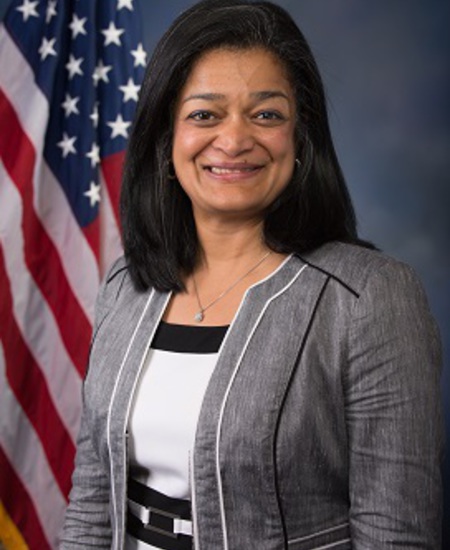
Rep. Pramila Jayapal
Sponsored bills
Heating and Cooling Relief Act This bill provides additional energy assistance to households, including heating and cooling assistance. Specifically, the bill reauthorizes through FY2031 and revises the Low Income Home Energy Assistance Program. Under the existing program, the Department of Health and Human Services (HHS) may award grants to states for assisting low-income households that pay a high proportion of their income for home energy. To be eligible under the existing program, households must have incomes which do not exceed the greater of an amount equal to 150% of the poverty level for their state or an amount equal to 60% of the state median income. The bill expands eligibility to households with incomes which do not exceed the greater of an amount equal to 250% of the poverty line as defined in the Community Services Block Grant Act or an amount equal to 80% of the state median income. In addition, the bill expands eligibility to households with a monthly energy burden of 3% or more per year. It also requires states to establish procedures to protect households receiving assistance under the program from energy shutoffs and certain late fees. In addition, the bill requires HHS and the Department of Energy to jointly carry out a program that awards grants to states and local governments for developing and implementing interagency plans to reduce energy burdens for eligible households with high home energy use. The plans must promote the reduction of energy from fossil fuels.
This resolution expresses the policy of the United States for addressing and mitigating national security challenges, including the spread of infectious diseases and pandemics, the climate crisis, the proliferation and threat of the use of nuclear weapons, human rights violations, corruption, conflict, and violence, authoritarianism, gender, economic, and social inequality, and transnational White supremacist violence and racist nationalism.
This resolution expresses support for the goals and ideals of Endometriosis Awareness Month. Endometriosis is a painful condition in which the tissue that normally lines the inside of the uterus grows outside the uterus.
Puerto Rico Recovery Accuracy in Disclosures Act of 2021 or PRRADA This bill requires professionals employed in debt adjustment cases involving Puerto Rico to file verified statements disclosing their connections with interested parties before seeking compensation for their services. The Financial Oversight and Management Board for Puerto Rico must establish a list of such interested parties, which shall include the debtor, creditors, any attorney or accountant of the debtor or creditors, persons employed by the U.S. Trustee Program, persons employed by the board, and any other interested party. Compensation may be denied to such a professional if these disclosures are not filed, are inadequate, or if the professional is found to have certain conflicts of interest.
Climate Risk and Emergency Support In Livable Inclusive and Equitable Neighborhoods and Communities Everywhere Act or the Climate RESILIENCE Act This bill makes changes to the Robert T. Stafford Disaster Relief and Emergency Assistance Act to take into account climate change. The bill includes extreme temperature events, such as heat waves or freezes, within the scope of the act and defines resilience for purposes of disaster assistance and mitigation efforts. Federal and state preparedness and mitigation assistance may be used for reducing the impacts of extreme temperatures and improving air quality and mitigating against wildfire smoke.. The bill authorizes implementing predisaster hazard mitigation measures that will be cost-effective and equitable long-term and provide enhanced protection to the community. The Federal Emergency Management Agency (FEMA) must (1) provide technical assistance to underserved and disadvantaged communities for such measures; and (2) provide guidance to implement the latest published editions of relevant consensus-based codes, specifications, and standards that incorporate the latest hazard-resistant designs. The bill includes within the hazard mitigation program requirements the abatement of lead, mold, mildew, radon, asthma, and allergen triggers, or other pollutants and hazardous materials directly caused by a major disaster or emergency. FEMA must report to Congress regarding challenges posed by FEMA requirements for determining the cost-effectiveness of mitigation activities and how such requirements may disproportionately burden underserved or disadvantaged communities.
This resolution expresses support for the goals and ideals of Korean American Day and honors the 119th anniversary of the arrival of the first Korean immigrants to the United States.
Federal Adjustment of Income Rates Act or the FAIR Act This bill modifies pay rates for federal employees in 2023. Specifically, the bill increases rates under the statutory pay systems and for prevailing rate employees by 4.1% and increases locality pay by 1%.
Masks for All Act of 2022 This bill directs the Federal Emergency Management Agency (FEMA) to manufacture and distribute N-95 respirator masks to every individual in the United States and to provide N-95 masks to all individuals working in health care settings in the United States that are experiencing a shortage of such masks. FEMA must provide the masks at no cost to individuals and deliver them, to the greatest extent possible, using the U.S. Postal Service. Additionally, FEMA shall designate mask pickup sites in each community and shall provide masks to each site, allocated according to population; consider new designs for masks to improve comfort, fit, and size options; and submit to Congress a strategic plan that includes monthly, measurable targets to eliminate shortages and increase domestic production of N-95 masks and to fulfill all other requirements of this bill. The President shall make use of any and all available authorities (including emergency authorities) at the disposal of the federal government to procure and domestically manufacture N-95 masks and support the domestic manufacturing of N-95 masks.
Maddy summaryThis bill (H.J.Res. 68) is a symbolic, procedural measure that would require the President to issue an annual proclamation designating a day as "Democracy Day." It directs the President to call on state/local governments and citizens to observe the day through programs and activities, with January 6 referenced as a potential date. The bill does not create new government programs or change existing laws - it only establishes a recurring presidential proclamation. It directly affects federal, state, and local governments by encouraging them to participate in annual observances. The bill has no budgetary impact and remains focused on promoting civic engagement through a designated day.