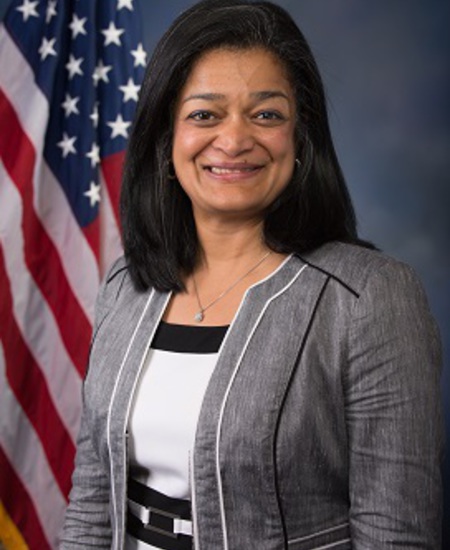
Photo of Pramila Jayapal
D United States House · District 7 · Washington On the 2026 ballot

Rep. Pramila Jayapal

Compare
Total votes
2,837
all sessions
Attendance
96%
101 missed
Lower than 90% of chamber peers
With party
96%
of cast votes
Near the chamber average
Bipartisan score
2%
crosses aisle rarely
Near the chamber average
Sponsored
1,931
bills & resolutions
Higher than 90% of chamber peers
Committees
7
assignments
1,931 bills and resolutions

Sponsored bills

Total
1,931
Primary
131
Co-sponsor
1,800
This page
1,931
matching current filters
Co-sponsor HR 3621
In committee · United States House · Co-sponsor
Neighbors Not Enemies Act of 2021

Neighbors Not Enemies Act of 2021 This bill repeals provisions authorizing the President to apprehend and remove from the United States the citizens of a particular nation, if the United States has declared war against that nation or that nation has threatened an invasion against the United States.

In committee Nov 1, 2022 1 co-sponsor
Co-sponsor HR 3614
In committee · United States House · Co-sponsor
Menstrual Equity For All Act of 2021

Menstrual Equity For All Act of 2021 This bill expands access to free sanitary napkins and tampons (i.e., menstrual products) in certain locations and for particular groups. It also requires Medicaid to cover menstrual products, as well as liners, cups, and similar items used by individuals with respect to menstruation. Specifically, the bill imposes requirements to make free menstrual products available in federal and state correctional facilities (including facilities that house aliens detained by the Department of Homeland Security) and restrooms in federal buildings that are open to the public. It also establishes a demonstration grant program to support the provision of free menstrual products on campuses of institutions of higher education and permits elementary and secondary schools to use certain grants to provide menstrual products to students. Furthermore, the bill requires employers with at least 100 employees to provide free menstrual products for employees. It also permits the use of certain grants for emergency food and shelter to provide menstrual products to homeless individuals.

In committee Nov 1, 2022 1 co-sponsor
Co-sponsor HR 3548
In committee · United States House · Co-sponsor
Keeping Our Promise Act

Keeping Our Promise Act This bill authorizes issuing visas to certain individuals who were previously refused a diversity immigrant visa or admission into the United States because of certain executive orders or the COVID-19 public health emergency. (Diversity immigrant visas are available to eligible immigrants from countries with relatively low rates of immigration to the United States.) Specifically, this bill applies to individuals who were refused such a visa solely due to certain executive orders from 2017 to 2020, including orders which suspended the entry of individuals from certain countries. The bill also applies to diversity visa applicants who, because of the COVID-19 emergency, were (1) unable to receive a visa interview despite requesting one, or (2) unable to be admitted into the United States despite being approved for a visa. The Department of State must notify each individual covered under this bill of the individual's visa eligibility. To retain eligibility, an individual must respond to the State Department's notice within one year of the notice. An individual may also lose eligibility if the State Department determines that the applicant fails to meet certain requirements. The bill also relaxes certain annual numerical limits for individuals obtaining a visa under this bill. An individual who was a child when initially selected for a visa shall be treated as a child for the purposes of a visa application under this bill.

In committee Nov 1, 2022 1 co-sponsor
Co-sponsor HR 3510
In committee · United States House · Co-sponsor
First Step Implementation Act of 2021

First Step Implementation Act of 2021 This bill makes various changes related to federal sentencing law and requires the Department of Justice (DOJ) to establish procedures to ensure the prompt release and accuracy of employment-related background check records. The bill allows certain reduced mandatory minimum sentences for drug offenses to be applied retroactively to offenders who committed their offenses on or before December 21, 2018; permits a court, in certain circumstances, to grant safety valve relief (i.e., impose a sentence without regard to the statutory mandatory minimum penalty for certain drug offenses) for an otherwise eligible defendant who does not meet the requirement pertaining to criminal history; permits a court to reduce a sentence imposed on a defendant convicted as an adult for an offense committed as a juvenile if the defendant has served at least 20 years of the sentence; establishes a process to seal and expunge certain records of juvenile nonviolent offenses; and requires DOJ to establish and enforce procedures to ensure that records exchanged for employment-related background checks are promptly released and accurate.

In committee Nov 1, 2022 1 co-sponsor
Co-sponsor HR 3541
In committee · United States House · Co-sponsor
Conrad State 30 and Physician Access Reauthorization Act

Conrad State 30 and Physician Access Reauthorization Act This bill modifies the Conrad 30 Waiver program, which incentivizes qualified foreign physicians to serve in underserved communities. It also extends statutory authority for the program for three years from this bill's enactment. Aliens coming to the United States under a J-1 nonimmigrant visa to receive medical training typically must leave the country and reside for two years abroad before being eligible to apply for an immigrant visa or permanent residence. The Conrad program waives this requirement for individuals who meet certain qualifications, including serving for a number of years at a health care facility in an underserved area. The bill increases the number of waivers that a state may obtain each fiscal year from 30 to 35 if a certain number of waivers were used the previous year, and provides for further adjustments depending on demand. An alien physician may be employed at an academic medical center to meet the Conrad program's employment requirements if the alien's work is in the public interest, even if the medical center is not in an underserved area. Employment contracts for alien physicians under the Conrad program shall contain certain information, such as the maximum number of on-call hours per week the physician shall have to work. Certain alien physicians (along with the physician's spouse and children) shall be exempt from the direct annual numerical limits on immigration, including those physicians that have met certain requirements related to visas for physicians to serve in underserved areas.

In committee Nov 1, 2022 1 co-sponsor
Co-sponsor HR 3480
In committee · United States House · Co-sponsor
Extreme Risk Protection Order Act of 2021

Extreme Risk Protection Order Act of 2021 This bill establishes grants to support the implementation of extreme risk protection order laws at the state and local levels, extends federal firearms restrictions to individuals who are subject to extreme risk protection orders, and expands related data collection. Extreme risk protection order laws, or red flag laws, generally allow certain individuals (e.g., law enforcement officers or family members) to petition a court for a temporary order that prohibits an at-risk individual from purchasing and possessing firearms. Among its provisions, the bill directs the Office of Community Oriented Policing Services within the Department of Justice to establish a grant program to help states, local governments, Indian tribes, and other entities implement extreme risk protection order laws; extends federal restrictions on the receipt, possession, shipment, and transportation of firearms and ammunition to individuals who are subject to extreme risk protection orders; and requires the Federal Bureau of Investigation to compile (and later destroy) records from federal, tribal, and state courts and other agencies that identify individuals who are subject to extreme risk protection orders.

In committee Nov 1, 2022 1 co-sponsor
Co-sponsor HR 9233
In committee · United States House · Co-sponsor
Trust in Government Act of 2022

Trust in Government Act of 2022 This bill directs certain agencies (e.g., the Department of State, the Department of Veterans Affairs, and the Social Security Administration) to take specified steps to improve service delivery and public perception of agency interactions. The Office of Management and Budget must designate a team of individuals to lead and support agency initiatives to improve public perception of agency interactions.

In committee Oct 26, 2022 1 co-sponsor
Co-sponsor HR 9207
In committee · United States House · Co-sponsor
Keep Americans Safe Act

Keep Americans Safe Act This bill establishes a new criminal offense for the import, sale, manufacture, transfer, or possession of a large capacity ammunition feeding device (LCAFD). The bill does not prohibit certain conduct with respect to an LCAFD, including the following: importation, sale, manufacture, transfer, or possession related to certain law enforcement efforts, or authorized tests or experiments; importation, sale, transfer, or possession related to securing nuclear materials; and possession by a retired law enforcement officer. The bill permits continued possession of, but prohibits sale or transfer of, a grandfathered LCAFD. Newly manufactured LCAFDs must display serial number identification and the date of manufacture. Additionally, the bill allows a state or local government to use Edward Byrne Memorial Justice Assistance Grant Program funds to compensate individuals who surrender an LCAFD under a buy-back program.


In committee Oct 21, 2022 1 co-sponsor
Co-sponsor HR 4693
Signed into law · United States House · Co-sponsor
Global Malnutrition Prevention and Treatment Act of 2021

Global Malnutrition Prevention and Treatment Act of 2021 This act sets out programs and otherwise directs the U.S. Agency for International Development (USAID) to carry out activities to prevent and treat malnutrition globally. Specifically, USAID may leverage resources to address malnutrition through the Global Nutrition Coordination Plan (an interagency effort to strengthen the impact of U.S. investments in nutrition) and its role on the board of directors of the U.S. International Development Finance Corporation. USAID must also select countries based on specified malnutrition-related indicators for purposes of targeting malnutrition prevention and treatment programs and update the selection within five years. Additionally, USAID may establish the Nutrition Leadership Council to coordinate federal government activities to prevent and treat malnutrition; and target resources and nutrition interventions to the populations most susceptible to severe malnutrition and otherwise support efforts to prevent and treat malnutrition globally. The act also requires USAID to provide to Congress an implementation plan and annual reports concerning its programs for treating and preventing malnutrition. The act's provisions terminate seven years after its enactment.

Signed into law Oct 19, 2022 1 co-sponsor
Co-sponsor HR 3843
Passed · United States House · Co-sponsor
Merger Filing Fee Modernization Act of 2022

Merger Filing Fee Modernization Act of 202 2 This bill modifies and expands the schedule for graduated merger filing fees and requires that such fees be adjusted each year based on the Consumer Price Index. It also (1) requires parties to disclose in their premerger notification filings any subsidy received from a foreign entity of concern, (2) modifies the venue rules for multi-district antitrust litigation, and (3) establishes various reporting requirements.

Passed Oct 11, 2022 1 co-sponsor
Showing 1,321 to 1,330 of 1,931 bills