

Preventing Health Emergencies And Temperature-related Illness and Deaths Act of 2021 or the Preventing HEAT Illness and Deaths Act of 2021 This bill provides statutory authority for, and otherwise revises, the National Integrated Heat Health Information System Program to improve the capacity of the United States to prepare for, adapt to, and mitigate health risks of extreme heat. The Office of Oceanic and Atmospheric Research of the National Oceanic and Atmospheric Administration (NOAA) must carry out this program. (Currently, the program is jointly administered by NOAA and the Centers for Disease Control and Prevention.) Under the bill, the program may provide financial assistance for projects to increase awareness, education, and research about extreme heat events and mitigate the human health impacts of those events. In awarding the assistance, the program must prioritize historically disadvantaged communities and communities with significant heat disparities associated with race or income. Other components of the program include grants for research on climate and health and a study of relevant policy, research, and data gaps concerning extreme heat information and response. The bill also establishes an interagency committee within the White House Office of Science and Technology Policy to develop a strategic plan and otherwise coordinate federal activities related to the program.
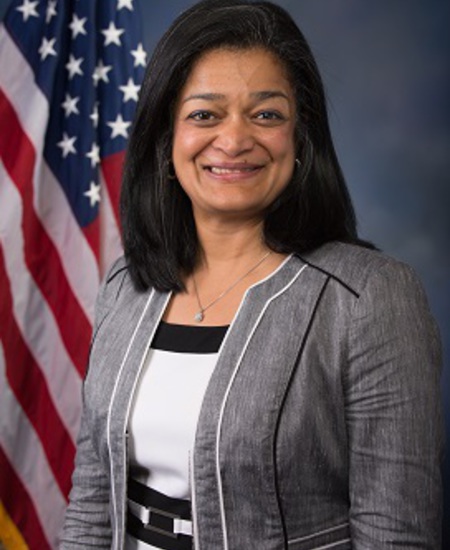
Rep. Pramila Jayapal
Sponsored bills
This resolution expresses support for the principles of Transgender Day of Remembrance by recognizing the epidemic of violence toward transgender people and memorializing the lives lost this year.
Lymphedema Treatment Act This bill provides for Medicare coverage of lymphedema compression treatment items. Specifically, the bill provides for coverage of standard and custom fitted gradient compression garments and other approved items that are prescribed by a physician or other specified health care professional to treat lymphedema.
Stopping Abuse and Fraud in Electronic Lending Act of 2022 or the SAFE Lending Act of 2022 This bill revises requirements related to consumer financial protection and small-dollar lending, including matters concerning remotely created checks, electronic fund transfers, registration of small-dollar lenders, overdraft fees, and the collection of personal information. Under the bill, remotely created checks may only be issued by a person specifically designated in writing by a consumer and provided to the consumer's depository institution. (A remotely created check is a check not issued by the bank and not signed by the account owner.) A voluntary agreement to repay a small-dollar consumer credit transaction by an electronic fund transfer is subject to certain protections, including the right of the consumer to stop payment. Small-dollar consumer credit providers must register with the Consumer Financial Protection Bureau. Any small-dollar consumer credit transaction is subject to the laws of the state in which the consumer resides. The bill also prohibits overdraft fees on prepaid accounts.
Keeping Ecosystems Living and Productive Act or the KELP Act This bill directs the National Oceanic and Atmospheric Administration (NOAA) to award grants to carry out projects related to the conservation, restoration, or management of kelp forest ecosystems. NOAA shall award grants for projects that address greatest relative regional declines in kelp forest ecosystems; focus on, among other things, long term ecosystem resilience, kelp forest seeding and connectivity, or urchin removal and other actions to reestablish trophic structure; or are identified by federal or state restoration and management plans as focal areas for recovery of kelp forests and associated species.
Safeguarding America's Future and Environment Act or the SAFE Act The bill requires the development of an integrated national approach to help fish, wildlife, and plants adapt to extreme weather changes and climate change. Specifically, the bill requires the President to establish an interagency National Fish, Wildlife, and Plants Climate Adaptation Strategy Joint Implementation Working Group. The working group must adopt the 2013 National Fish, Wildlife, and Plants Climate Adaptation Strategy, which addresses the effects of extreme weather and climate change on fish, wildlife, and plants. After the Committee on Earth and Environmental Sciences releases a periodic scientific assessment required under the U.S. Global Change Research Program, the working group must use sound science to review and revise the strategy to incorporate new information and advances in the development of strategies to help fish, wildlife, and plants adapt. Each federal agency must integrate the strategy into agency plans, environmental reviews, and programs. The Department of the Interior must establish a National Climate Change and Wildlife Science Center to assess and develop scientific information, tools, strategies, and techniques to support the working group and other interested parties in addressing the effects of extreme weather and climate change. Interior must establish an Advisory Committee on Climate Change and Natural Resource Sciences to advise the working group.
Prevent All Soring Tactics Act of 2022 or the PAST Act of 2022 This bill addresses the practice of soring horses. The soring of horses includes various actions taken on horses' limbs to produce higher gaits that may cause pain, distress, inflammation, or lameness. Specifically, the bill expands soring regulation and enforcement at horse shows, exhibitions, sales, and auctions, including by establishing a new system for inspecting horses for soring. In addition, the bill increases penalties for violations.
This bill requires the Federal Bureau of Investigation and the Department of State to report to Congress on the death of Shireen Abu Akleh. The report shall also be made available to the public on the State Department's website. (Abu Akleh was a U.S. citizen and journalist who was shot and killed in the city of Jenin in the West Bank in May 2022. At the time of her shooting, Israeli security forces and Palestinians were trading fire in the area.)
Norman Y. Mineta Japanese American Confinement Education Act This bill increases the authorization of appropriations for the Japanese American Confinement Sites (JACS) grant program, which supports the preservation of U.S. confinement sites that were used to detain Japanese Americans during World War II (i.e., internment camps). It also establishes a program within JACS to provide grants to Japanese American nonprofits to educate individuals about the historical significance of these events.
Asunción Valdivia Heat Illness and Fatality Prevention Act of 2022 This bill directs the Occupational Safety and Health Administration to promulgate a standard that requires employers to implement certain measures for protecting workers from heat stress and related illnesses or injuries. Heat stress refers to the load of heat that a person experiences due to sources of heat or heat retention (including metabolic heat, environmental factors, and clothing or personal protective equipment) or the presence of heat in a work setting. Further, if an employer cannot reduce exposure to heat stress below hazardous levels through engineering controls (e.g., heat shields and insulation) or personal protective equipment (e.g., heat reflective clothing), the employer must implement a program that mitigates such exposure through access to appropriate hydration and cool-down spaces, acclimatization policies, and periodic paid rest breaks. Additionally, the bill establishes requirements concerning judicial review, implementation, enforcement, recordkeeping, and whistle-blower protections related to the standard. The bill also requires the Department of Labor to include questions about heat-related illness and injury in the National Agricultural Workers Survey (an employment-based, random-sample survey of U.S. crop workers that collects demographic, employment, and health information).