Streamline Pentagon Budgeting Act of 2022 This bill repeals reporting requirements related to the unfunded priorities of the (1) armed force or forces or combatant command, and (2) the Missile Defense Agency.
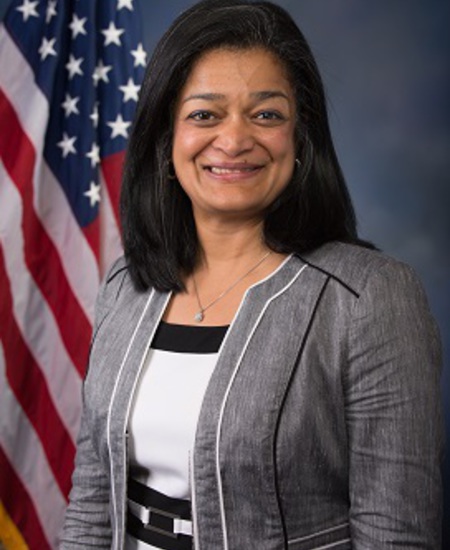
Rep. Pramila Jayapal
Sponsored bills
Zero-Emission Vehicles Act of 2022 or the ZEVs Act of 2022 This bill requires the Environmental Protection Agency (EPA) to establish a zero-emission passenger vehicle standard. Specifically, the bill sets a schedule for increasing the percentage of zero-emission vehicles a vehicle manufacturer delivers for sale, culminating in a requirement to sell only zero-emission vehicles from 2035 on. The bill also requires the EPA to establish a zero-emission vehicle credit program that approves one zero-emission vehicle credit for each zero-emission vehicle delivered for sale in the United States and partial credits for qualified electric vehicles based on the estimated proportion of the mileage driven on the battery. Manufacturers that fail to meet the minimum required percentage of zero-emission vehicle sales must submit to the EPA a quantity of zero-emission vehicle credits sufficient to offset the excess. Credits may also be sold, transferred, exchanged, or retired in certain circumstances. The bill imposes civil penalties for the failure to comply with zero-emission vehicle credit standards, with collected penalties being deposited into the Highway Trust Fund. After 2035, the EPA must issue injunctions on the manufacture of passenger vehicles other than zero-emission vehicles.
Equal Access to Green cards for Legal Employment Act of 2022 or the EAGLE Act of 2022 This bill modifies requirements related to employment-based visas and addresses related issues. The bill increases the per-country cap on family-based immigrant visas from 7% of the total number of such visas available that year to 15% and eliminates the per-country cap for employment-based immigrant visas. The bill establishes transition rules for employment-based visas such as (1) reserving a percentage of EB-2 (workers with advanced degrees or exceptional ability) and EB-3 (skilled and other workers) visas for individuals not from the two countries with the largest number of recipients of such visas, and (2) allotting a number of visas for professional nurses and physical therapists. The bill imposes additional requirements on an employer seeking an H-1B visa, such as prohibiting (1) an employer from advertising that a position is only open to H-1B applicants or that H-1B applicants are preferred, and (2) certain employers from having more than half of their employees as nonimmigrant visa workers. The Department of Labor shall create a publicly available website where an employer seeking an H-1B visa must post certain information about the open position. The bill also expands Labor's authority to review and investigate H-1B applications for fraud or misrepresentations. The bill also allows certain aliens to obtain lawful permanent resident status if the alien (1) is in the United States as a nonimmigrant, (2) has an approved immigrant visa petition, and (3) has waited at least two years for a visa.
Ending Taxpayer Welfare for Oil and Gas Companies Act of 2021 This bill addresses royalties related to the development of federal energy resources. Among other requirements, the bill increases the onshore royalty rates for new oil, gas, and coal leases; increases onshore rental rates for oil and gas leasing; modifies the current onshore oil and gas minimum bid from $2 to $10 and requires it to be adjusted every four years for inflation; and increases inspection fees and penalties on oil and gas operators.
Stop Anticompetitive Healthcare Act of 2022 This bill provides the Federal Trade Commission with enforcement authority over certain tax-exempt, hospital or cooperative hospital service organizations.
Access to School Supplies Act of 2022 This bill directs the Department of Education to carry out a pilot program to make competitive grants for up to 10 qualified local educational agencies to purchase school supplies. School supplies refer to books, supplies, and supplementary materials used by students and instructional staff in the classroom.
Respect for Marriage Act This act provides statutory authority for same-sex and interracial marriages. Specifically, the act replaces provisions that define, for purposes of federal law, marriage as between a man and a woman and spouse as a person of the opposite sex with provisions that recognize any marriage between two individuals that is valid under state law. (The Supreme Court held that the current provisions were unconstitutional in United States v. Windsor in 2013.) The act also replaces provisions that do not require states to recognize same-sex marriages from other states with provisions that prohibit the denial of full faith and credit or any right or claim relating to out-of-state marriages on the basis of sex, race, ethnicity, or national origin. (The Supreme Court held that state laws barring same-sex marriages were unconstitutional in Obergefell v. Hodges in 2015; the Court held that state laws barring interracial marriages were unconstitutional in Loving v. Virginia in 1967.) The act allows the Department of Justice to bring a civil action and establishes a private right of action for violations. The act does not (1) affect religious liberties or conscience protections that are available under the Constitution or federal law, (2) require religious organizations to provide goods or services to formally recognize or celebrate a marriage, (3) affect any benefits or rights that do not arise from a marriage, or (4) recognize under federal law any marriage between more than two individuals.

Dignity Act This bill provides for visitation between federal prisoners who are primary caretaker parents and their family members, in accordance with specified procedures.
International Violence Against Women Act of 2022 This bill requires a U.S. global strategy to prevent and respond to violence against women and girls. The bill establishes in the Department of State an Office of Global Women's Issues, which shall be headed by an Ambassador-at-Large for Global Women's Issues. The Ambassador-at-Large shall (1) coordinate U.S. government efforts regarding gender equality and the advancement of women and girls in foreign policy, and (2) develop or update periodically a U.S. global strategy to prevent and respond to gender-based violence. The bill establishes in the U.S. Agency for International Development the position of Senior Coordinator for Gender Equality and Women's Empowerment who shall coordinate policies, programs, and funding regarding gender equality and women's empowerment.
This concurrent resolution recognizes the disparity between wages paid to Latina women, and its impact on women, families, and the nation and reaffirms Congress' commitment to supporting equal pay and to narrowing the gender wage gap.