

Maddy summaryHR 51, the Washington, D.C. Admission Act, would admit Washington, D.C. as the 51st state, named "Washington, Douglass Commonwealth," granting its residents full representation in Congress with two Senators and one Representative. The bill establishes procedures for admission, including elections for state officials, with the state initially having one Representative until the next congressional apportionment. It would create a "Capital" area (including the White House, Capitol, and other key federal buildings) that remains under federal jurisdiction as the seat of the U.S. government, while the rest of the District becomes the new state. The bill also includes provisions to ensure continuity of federal services, property management, and legal procedures during the transition to statehood.
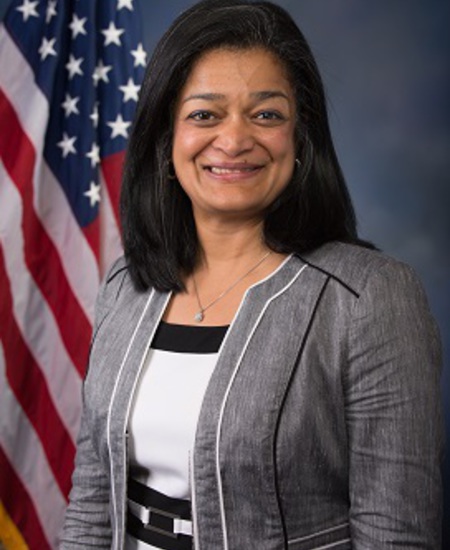
Rep. Pramila Jayapal
Sponsored bills
Commission to Study and Develop Reparation Proposals for African Americans Act This bill establishes the Commission to Study and Develop Reparation Proposals for African Americans. The commission must (1) compile documentary evidence of slavery in the United States; (2) study the role of the federal and state governments in supporting the institution of slavery; (3) analyze discriminatory laws and policies against freed African slaves and their descendants; and (4) recommend ways the United States may recognize and remedy the effects of slavery and discrimination on African Americans, including through a formal apology and compensation (i.e., reparations). The commission consists of individuals from civil society and reparations organizations and individuals appointed by the President and congressional leadership; Members of Congress and governmental employees may not serve on the commission. The commission may hold hearings, subpoena witnesses and records, and contract with other entities to conduct its work. The commission must submit its final report within 18 months of its first meeting.
Maddy summaryThe Sea Turtle Rescue Assistance Act of 2022 establishes a federal grant program administered by the Secretary of Commerce to fund organizations rescuing and rehabilitating stranded sea turtles. It directly affects coastal rescue groups, research institutions, and conservation organizations working in designated "stranding regions" along U.S. coasts. The program provides grants up to $150,000 annually per recipient (with a 25% non-Federal cost share requirement) to cover turtle care, data collection for scientific research, and related facility costs. Funding of $5 million per year (2023-2028) must be distributed equitably based on historical stranding events, turtle population sizes, and conservation needs of endangered species. All grant details will be publicly published to ensure transparency.
This bill authorizes the Confederated Tribes of the Chehalis Reservation to lease their land held in trust for a term of up to 99 years. The tribe is located in western Washington State.
American Music Fairness Act of 2022 This bill establishes that the copyright holder of a sound recording shall have the exclusive right to perform the sound recording through an audio transmission and addresses other related issues. (Currently, the public performance right only covers performances through a digital audio transmission in certain instances, which means that nonsubscription terrestrial radio stations generally do not have to secure a license to publicly perform a copyright-protected sound recording.) Under the bill, a nonsubscription broadcast transmission must have a license to publicly perform such sound recordings. The Copyright Royalty Board must periodically determine the royalty rates for such a license. When determining the rates, the board must base its decision on certain information presented by the parties, including the radio stations' effect on other streams of revenue related to the sound recordings. Terrestrial broadcast stations (and the owners of such stations) that fall below certain revenue thresholds may pay certain flat fees, instead of the board-established rate, for a license to publicly perform copyright-protected sound recordings.
Illegal Fishing and Forced Labor Prevention Act This bill sets forth and revises federal law concerning activities to combat human trafficking and illegal, unreported, or unregulated fishing in the seafood industry. The National Oceanic and Atmospheric Administration (NOAA) shall expand the Seafood Import Monitoring Program to apply to all seafood and seafood products imported into the United States. The Departments of Commerce, Homeland Security, Labor, and Health and Human Services must jointly execute a memorandum of understanding to codify and improve interagency cooperation on seafood safety, preventing illegal, unreported, or unregulated fishing and human trafficking, including forced labor, and seafood fraud prevention, enforcement, and inspections. NOAA shall engage with each flag, coastal, port, and market nation that exports seafood to the United States to collect information sufficient to evaluate the effectiveness of such nation's management of fisheries and control systems to prevent illegal, unreported, or unregulated fishing.
Environmental Justice For All Act This bill establishes several environmental justice requirements, advisory bodies, and programs and modifies the scope of environmental review under the National Environmental Policy Act of 1969. The bill sets forth provisions to address the disproportionate adverse human health or environmental effects of federal laws or programs on communities of color, low-income communities, or tribal and indigenous communities. It also prohibits disparate impacts on the basis of race, color, or national origin as discrimination. Aggrieved persons may seek legal remedy when faced with such discrimination. In addition, the bill directs agencies to follow certain requirements concerning environmental justice. For example, agencies must prepare community impact reports that assess the potential impacts of their actions on environmental justice communities under certain circumstances. It also raises coal, oil, and gas royalty rates to create a funding source to support fossil fuel-dependent communities and displaced workers as they transition away from fossil fuel industries. Additionally, the bill creates a variety of advisory bodies and positions, such as the White House Environmental Justice Interagency Council. Among other things, the council must issue an environmental justice strategy. It also establishes requirements and programs concerning chemicals or toxic ingredients in certain products. For example, the bill (1) requires certain products (e.g., cosmetics) to include a list of ingredients or warnings; and (2) provides grants for research on designing safer alternatives to chemicals in certain consumer, cleaning, toy, or baby products that have an inherent toxicity or that are associated with chronic adverse health effects. Finally, it creates a variety of funding programs, such as a grant program to enhance access to park and recreational opportunities in urban areas.
Refugee Protection Act of 2022 This bill modifies provisions related to asylum seekers and addresses related issues. For example, the bill (1) eliminates the statutory time limit for applying for asylum (currently one year after arriving in the United States), (2) establishes stateless protected status for individuals who are not considered a national by any country under that country’s law, and (3) requires the goal for refugee admissions for any given fiscal year to be no fewer than 125,000.
Bus Rapid Transit Act This bill directs the Federal Transit Administration (FTA) to establish a grant program to provide grants to state, local, and tribal governments for the design and implementation of bus rapid transit systems, including for the redesign, retrofit, renovation, update, and repair of existing bus systems. As a condition of receiving a grant, eligible entities must certify that fares for riding the bus rapid transit system shall not increase solely due to improvements carried out with grant funds and for any reason for at least one year after completion of a project funded by the bill. In carrying out the program, the FTA must prioritize projects located in economically disadvantaged communities.
Expanding the Voluntary Opportunities for Translations in Elections Act or the Expanding the VOTE Act This bill expands access to voting materials for individuals with limited proficiency in the English language, including by establishing incentive grants for states and political subdivisions to provide translated voting materials. Additionally, the bill directs the Government Accountability Office to study the impact of (1) reducing the threshold requirement under Section 203 of the Voting Rights Act of 1965, and (2) expanding the definition of language minorities to include native speakers of additional languages.