

Maddy summaryThis bill requires major airlines and ticket agents to provide full cash refunds - including all fees - for canceled flights or tickets canceled at least 48 hours before departure, within 30 days of a passenger’s request. It limits refunds to one flight per city pair per date, allows alternatives like vouchers (with indefinite validity and clear disclosure of cash refund rights), and permits retroactive cash refunds for passengers who received vouchers since March 2020. Passengers must be informed in writing before purchase and when cancellations occur about their right to a cash refund. The law applies to airlines with over $1.5 billion in 2018 revenue or foreign carriers operating U.S. flights, with a $1,000 penalty for violations.
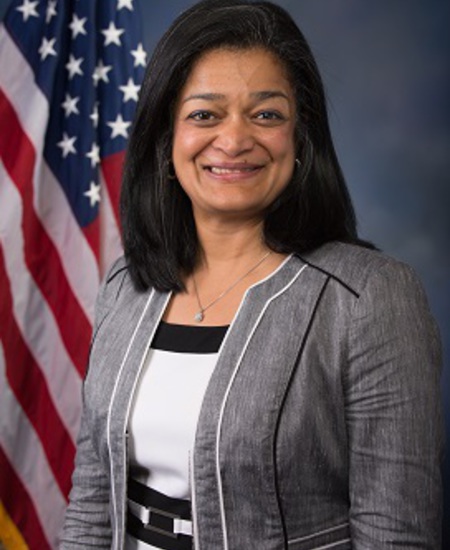
Rep. Pramila Jayapal
Sponsored bills
Maddy summaryThis bill establishes pay equity for federal firefighters by adjusting how their retirement benefits are calculated and setting a standard workweek. It requires retirement annuities to include overtime hours worked as part of a firefighter's regular schedule (e.g., overtime during standard shifts), rather than excluding them. The bill also mandates a maximum 60-hour regular workweek for federal firefighters, set by the Office of Personnel Management within one year of enactment. These changes directly affect federal firefighters, aiming to improve pay comparability with municipal firefighters and other federal employees while supporting recruitment and retention.
Maddy summaryHR 1249, the Opportunities for Fairness in Farming Act of 2023, regulates agricultural "checkoff programs" that collect mandatory fees from producers to fund commodity promotion and research. The bill prohibits checkoff boards from using funds for lobbying, engaging in conflicts of interest, anticompetitive behavior, or disparaging other commodities. It requires boards to publicly disclose all budgets and disbursements, including recipient identities and purposes, and mandates regular audits by the USDA Inspector General and the Comptroller General. These provisions directly affect all 25+ existing checkoff programs (covering commodities like cotton, dairy, pork, and wheat) by enforcing transparency and preventing misuse of producer-funded promotion dollars.
Maddy summaryThe HITS Act changes tax rules to help independent music producers by allowing them to deduct costs for creating sound recordings as immediate business expenses, rather than spreading costs over time. It specifically applies to U.S.-produced sound recordings (like albums or podcasts) by qualifying independent producers, with a $150,000 annual cap on deductible costs. The bill also enables bonus depreciation for equipment used in these productions, treating them similarly to film or theater projects for tax purposes. This aims to improve cash flow for smaller music businesses by reducing upfront tax burdens on recording costs.
Maddy summaryHR 1244 authorizes Congress to award a gold medal collectively to Africans and their descendants who were enslaved in the U.S. from 1619 to 1865, recognizing their contributions to America's economic foundation. The bill directs the Treasury Secretary to design and strike the medal, which will be permanently displayed at the Smithsonian's National Museum of African American History & Culture. It also permits the sale of bronze duplicates to cover costs, with proceeds going to the U.S. Mint. This is a commemorative measure, not a policy change, focusing on symbolic recognition of historical contributions.
Maddy summaryThe Richard L. Trumka Protecting the Right to Organize Act of 2023 strengthens workers' rights to organize unions by making it harder for employers to interfere with organizing efforts. Key provisions include changing the definition of "employee" to make it more difficult to classify workers as independent contractors, prohibiting employers from threatening to permanently replace striking workers, and requiring employers to provide voter lists for union elections. The bill also creates a new electronic voting system for union elections, strengthens whistleblower protections for workers reporting labor violations, and increases penalties for unfair labor practices. These changes directly affect workers seeking to form unions, employers who may interfere with organizing, and labor organizations. The bill aims to make it easier for workers to exercise their right to collective bargaining under the National Labor Relations Act.
Maddy summaryHR 1204, the Protect Access to Justice for Veterans Act, limits attorney fees for veterans pursuing claims related to water contamination at Camp Lejeune, North Carolina. It caps fees at 20% for claims resolved within 180 days and 33.3% for later settlements or judgments. All settlement funds must be placed into a trust account for the veteran, with attorneys required to notify the veteran and deliver their share promptly before receiving payment. Violations, such as charging excessive fees, can result in fines up to $5,000.
Health Center Community Transformation Hub Act This bill permits the Health Resources and Services Administration (HRSA) to award supplemental funds to certain health centers that care for medically underserved populations for addressing primary social determinants of health (i.e., nonmedical factors that influence health outcomes, such as transportation, food security, and economic security). To receive the supplemental funding, health centers must be recipients of other HRSA grants that support health center operations and activities. Health centers must use the supplemental funds to implement a community-based network of organizations capable of addressing the social determinants of health. Additionally, HRSA and the Centers for Medicare & Medicaid Services must issue guidance on sustaining these networks after the supplemental funding terminates.
Maddy summaryThis bill mandates a study on airborne ultrafine particles (UFPs) near nine major U.S. airports, including Seattle, Boston, Chicago, New York, Atlanta, and others. The study, to be conducted by a qualified university in partnership with the FAA and EPA, will examine UFP sources (especially aircraft operations), health effects like respiratory issues, and potential mitigation strategies such as sustainable aviation fuels. It requires a detailed report on findings, including data gaps and health impacts on vulnerable groups, to be submitted to Congress within two years of the study's completion. The bill does not impose new regulations but aims to provide data for future policy decisions affecting communities near these airports.
Maddy summaryThe Aviation Noise and Emissions Mitigation Act creates two grant programs to address noise and pollution from airports. The first program funds 3-year pilots for communities near airports to measure noise and emissions (including greenhouse gases and particulate matter) using technology that traces sources to specific aircraft and neighborhoods, with a focus on identifying disproportionately impacted areas. The second program provides grants to community groups, health departments, and local governments to implement mitigation strategies - such as noise-reducing building upgrades, health services, and environmental programs - prioritizing low-income and disadvantaged communities identified through the monitoring. Both programs require regular community engagement, public reporting, and alignment with environmental justice goals.