

Maddy summaryThis House Resolution expresses support for the staff of public, school, academic, and special libraries across the United States and the essential services they provide to communities. It recognizes libraries as critical infrastructure and supports prioritizing full funding for their services at federal, state, and local levels. The resolution also reaffirms the public's right to access information, the right of library workers to organize and collectively bargain, and their civil rights to perform their duties without intimidation.
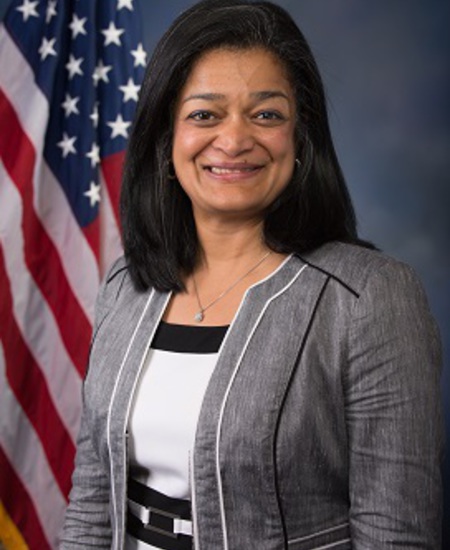
Rep. Pramila Jayapal
Sponsored bills
Maddy summaryThe Hazard Pay for Health Care Heroes Act establishes a grant program to provide financial compensation and safety resources to essential health care workers during declared emergencies or disasters. This legislation directly affects medical providers, support staff, and other frontline workers whose jobs cannot be performed remotely, such as orderlies and janitors in health care settings. Under the bill, eligible facilities can receive federal funds to pay workers an additional hourly rate of up to $13 for hazardous duties, with a yearly cap of $25,000 per employee, while also allowing funds for protective equipment and alternative transportation. The program is triggered by various federal or state emergency declarations and authorizes the necessary funding to implement these hazard pay measures.
Savings Opportunity and Affordable Repayment Act This bill creates a new income-driven repayment plan for student loans called the Savings Opportunity and Affordable Repayment (SOAR) plan. The SOAR plan has similar provisions to, but further expands on, the Department of Education's (ED's) final rule published on July 10, 2023, that created the Saving on a Valuable Education (SAVE) plan. The SAVE plan was blocked by federal courts. The bill directs ED to carry out a SOAR plan program that complies with specified requirements. The bill allows all federal student loan types to be eligible for repayment under the SOAR plan, including Parent PLUS Loans and Federal Family Education Loans. Under the SOAR plan, a federal student loan borrower whose income is at or below 250% of the federal poverty level (FPL) has $0 monthly payments. A borrower whose income is over 250% of the FPL pays 5% of their discretionary income on loans obtained for undergraduate study and 10% of their discretionary income for all other outstanding loans (e.g., loans obtained for graduate study). Additionally, under the SOAR plan, holders of eligible federal student loans (e.g., ED or private lenders) must apply 50% of the borrower's monthly payment toward outstanding principal. The other 50% must be applied in the following order: (1) accrued charges and collection costs on the loan, (2) outstanding interest, and (3) outstanding principal. ED must forgive any loan balance that remains outstanding after a specified maximum repayment period (e.g., 10 years or 15 years).
Maddy summaryHouse Resolution 1208 expresses the House of Representatives' support for honoring Earth Day and its historical role in promoting environmental protection and action. It encourages American citizens to engage in environmental stewardship and urges the President and the U.S. Government to take immediate action to address climate change, environmental injustices, and rejoin international climate agreements.
Maddy summaryThis bill, the Energy Consumer Protection Act of 2026, strengthens enforcement powers for the Federal Energy Regulatory Commission (FERC) to protect consumers in the electricity and natural gas markets. It allows FERC to ban companies or individuals who violate reporting rules or engage in deceptive practices from buying or selling energy and related services. The legislation also adds specific penalties for knowingly submitting false information about natural gas prices or availability to federal agencies. These changes apply to utilities, energy traders, and other market participants regulated by FERC.
Maddy summaryThis bill, the "Stop Deadly Denials Act of 2026," aims to significantly restrict prior authorization requirements for Medicare beneficiaries. It prohibits Medicare Advantage plans from imposing prior authorization for most medical services and items starting January 1, 2027, with non-compliant plans facing potential sanctions. For traditional Medicare, the bill blocks a specific prior authorization pilot program and limits future models from implementing prior authorization if they use artificial intelligence for denials without individual physician review or do not use Medicare administrative contractors for processing. Additionally, it requires public notice and comment for all future Medicare innovation models.
Maddy summaryThe Momnibus Act is a comprehensive legislative bill designed to improve maternal health outcomes across the United States by addressing social determinants of health, expanding access to care, and reducing disparities among pregnant and postpartum individuals. The bill establishes a federal task force to coordinate efforts between agencies and stakeholders to eliminate preventable maternal mortality and severe morbidity, while providing sustained funding to community-based organizations to address nonclinical factors like housing, nutrition, and transportation. Key provisions include extending WIC eligibility to 24 months postpartum, creating grants to grow and diversify the perinatal workforce, implementing respectful maternity care training for all healthcare employees, and establishing compliance programs to track and address bias in maternity care settings. The legislation also includes specific measures for incarcerated mothers, veterans, and vulnerable populations affected by climate change, alongside funding for maternal mental health services and technology-enabled care models to expand access in underserved areas.
Maddy summaryThis resolution expresses the sense of the House of Representatives that former President Donald Trump, his Special Envoy Steven Witkoff, and all federal officials must comply with the Constitution's Foreign Emoluments Clause. It specifically calls for them to immediately turn over to the Department of the Treasury any payments received from the United Arab Emirates or other foreign states. Furthermore, the resolution urges them to divest from all business interests linked to foreign governments, including those tied to United Arab Emirates officials.
Maddy summaryThis resolution expresses the House of Representatives' opinion that the Department of Justice and other federal agencies should not administratively settle legal claims for money filed against the United States by a sitting President, specifically referencing President Donald Trump. The House believes that such settlements would violate the Domestic Emoluments Clause of the Constitution, which prevents a President from receiving payments from the government beyond their official salary. Therefore, the resolution advises the Department of Justice to refuse any administrative settlement of these claims, while clarifying that a President can still pursue lawsuits in independent courts. This position directly affects how the Department of Justice would handle such claims from a President.
Maddy summaryThis bill establishes the 6PPD Task Force, led by the Department of Transportation and the Environmental Protection Agency, to address the environmental impacts of 6PPD, a chemical commonly used in tires. The Task Force will bring together experts from federal agencies, Tribal governments, the tire industry, and research institutions to improve data sharing and identify federal funding opportunities. Its key duties include researching 6PPD's effects on aquatic species and human health, developing safer alternatives, and recommending ways to expedite their testing and adoption. The Task Force will also share best practices for mitigating 6PPD runoff and identify other exposure pathways, submitting annual public reports to Congress on its findings and recommendations.