

Maddy summaryThe Keeping All Students Safe Act prohibits the use of "unlawful" seclusion and restraint in schools, including physical restraint that's life-threatening, contraindicated for a student's disability, or not properly trained for. It requires schools to use less restrictive interventions first, mandates training for school personnel in crisis intervention, and establishes reporting requirements for restraint incidents, including immediate parent notification and annual public reporting. The bill prohibits using physical restraint as a planned intervention in student education plans and requires states to submit compliance plans with data on restraint incidents disaggregated by race, disability status, and other factors. It applies to public schools and programs receiving federal funding, but does not affect private schools not receiving federal funds or home schools.
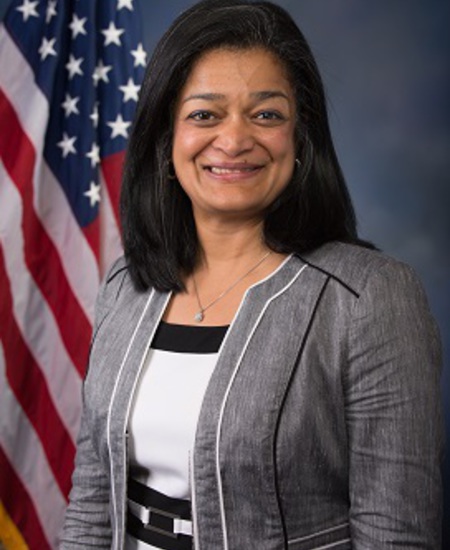
Rep. Pramila Jayapal
Sponsored bills
This bill requires the Federal Bureau of Investigation and the Department of State to report to Congress on the death of Shireen Abu Akleh. The report shall also be made available to the public on the State Department's website. (Abu Akleh was a U.S. citizen and journalist who was shot and killed in the city of Jenin in the West Bank in May 2022. At the time of her shooting, Israeli security forces and Palestinians were trading fire in the area.)
Maddy summaryHCONRES 44 is a non-binding congressional resolution urging the creation of a U.S. Commission on Truth, Racial Healing, and Transformation. It does not establish the commission itself but calls for its formation to acknowledge historical injustices against Black, Indigenous, and other people of color - including systemic discrimination in housing, Social Security, the GI Bill, and land policies - and to address ongoing racial inequities. The resolution emphasizes the need to dismantle the "belief in a hierarchy of human value" and promote racial healing as a national priority. It complements ongoing efforts like H.R. 40 (a bill to study reparations) but does not create new legal requirements or funding.
This resolution condemns the great replacement theory, which it describes as a white supremacist conspiracy theory that has been used to falsely justify racially motivated, violent acts of terrorism domestically and internationally.
Maddy summaryHR 3409, the Healthy Families Act, requires most employers to provide employees with paid sick leave. Employees earn 1 hour of paid sick time for every 30 hours worked, up to a maximum of 56 hours per year, which can be used for their own illness, caring for family members, or addressing domestic violence, sexual assault, or stalking situations. Smaller employers with fewer than 15 employees can provide unpaid sick leave instead of paid leave. The bill includes protections against retaliation for using sick leave and requires employers to inform employees about their rights under this law.
Maddy summaryHR 3442, the America’s CHILDREN Act of 2023, creates a pathway to permanent residency for certain college graduates who entered the U.S. as children on specific work visas. It directly affects individuals who were lawfully present as dependents of nonimmigrant visa holders (like H-4 or L-2) for at least 8 years, graduated from a U.S. college, and have lived in the U.S. for 10+ years total. Key provisions include protecting applicants from "aging out" of eligibility by basing age calculations on when their parent’s visa petition was filed (not current age), and allowing them to retain their original visa application date ("priority date") if they later switch to a different visa category. The bill aims to provide stability for young adults who grew up in the U.S. but face immigration barriers due to visa status.
Maddy summaryThis bill requires public schools (K-12) to integrate Asian American, Native Hawaiian, and Pacific Islander (AANHPI) history into their American history and civics curricula. It amends the Elementary and Secondary Education Act to mandate that all required history content "shall include" AANHPI history, updating existing standards for teachers, textbooks, and national assessments. The law directs the Smithsonian Institution’s Asian Pacific American Center to provide educational resources for schools implementing this change. It directly affects school districts, educators, and curriculum developers by requiring concrete revisions to history instruction. The bill does not fund new programs but modifies existing federal education law to ensure AANHPI contributions and experiences are included in required teaching.
Maddy summaryHR 3422, the Judiciary Act of 2023, would amend the structure of the U.S. Supreme Court by increasing the number of associate justices from eight to twelve. It would also raise the required quorum for court proceedings from six to eight justices. This bill directly affects the Supreme Court's operational structure and composition. The change is purely procedural, altering the Court's size and voting requirements without impacting other legal processes or specific groups of people.
Maddy summaryHR 3445, the Equity and Inclusion Enforcement Act of 2023, strengthens civil rights enforcement in federally funded education programs. It allows individuals to sue for "disparate impact" discrimination (where policies unintentionally harm specific groups) under Title VI of the Civil Rights Act, similar to suing for intentional discrimination. The bill requires schools and programs receiving federal education funds to designate a compliance coordinator and notify students/employees of their contact information. It also creates a new Special Assistant for Equity and Inclusion within the Department of Education to coordinate enforcement efforts and inform the public about their rights under Title VI.
Maddy summaryThe Strength in Diversity Act of 2023 creates a federal grant program to help school districts address racial and socioeconomic isolation in public schools (K-12). Eligible school districts, states, or consortia with significant segregation gaps can apply for planning or implementation grants to develop strategies like equitable school assignments, transportation plans, or teacher recruitment programs. Grants require community engagement, data tracking on academic outcomes and diversity metrics, and plans to sustain efforts after funding ends. The program aims to increase student diversity and improve outcomes for students of color and low-income students in segregated schools.