

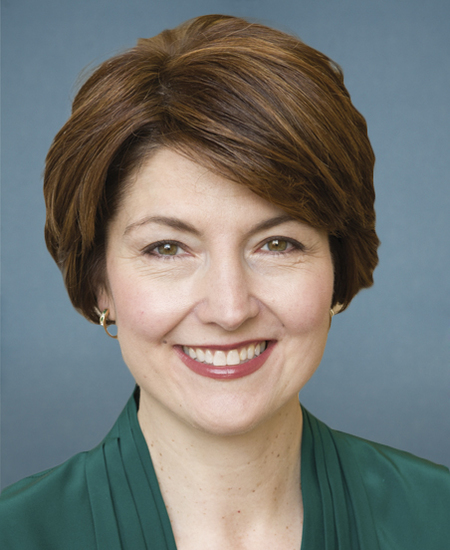
Photo of Cathy McMorris Rodgers
R United States House · District 5 · Washington

Rep. Cathy McMorris Rodgers

Compare
Total votes
2,168
all sessions
Attendance
96%
92 missed
Lower than 85% of chamber peers
With party
96%
of cast votes
Near the chamber average
Bipartisan score
2%
crosses aisle rarely
Near the chamber average
Sponsored
475
bills & resolutions
Lower than 87% of chamber peers
Committees
0
assignments
475 bills and resolutions

Sponsored bills

Total
475
Primary
65
Co-sponsor
410
This page
475
matching current filters
Co-sponsor HR 4786
In committee · United States House · Co-sponsor
RISE Act of 2021

Respond, Innovate, Succeed, and Empower Act of 2021 or the RISE Act of 2021 This bill establishes requirements for institutions of higher education (IHEs) concerning students with disabilities. Specifically, the bill requires IHEs to allow students to use certain documents, such as individualized education programs, to establish their disabilities. In addition, IHEs must make the process for determining the eligibility for accommodations transparent. Finally, IHEs must submit key data related to their undergraduate students with disabilities for inclusion in federal postsecondary institution data collection efforts.

In committee Jul 29, 2021 1 co-sponsor
Co-sponsor HR 4829
In committee · United States House · Co-sponsor
Distillery Revitalization Act

Distillery Revitalization Act This bill requires the Small Business Administration to modify the Restaurant Revitalization Program, established to support food and beverage purveyors in response to COVID-19, to allow certain distilleries to participate in the program. To be program-eligible, a distillery must have at least 33% of revenue from on-site sales. However, certain states limit the percentage of revenue that a distillery may have from on-site sales to less than 33%. For a distillery located in such a state, the bill allows the distillery to use its combined revenue from on-site sales and sales to retailers for on-site sales to reach the 33% threshold.

In committee Jul 29, 2021 1 co-sponsor
Co-sponsor HR 1652
Signed into law · United States House · Co-sponsor
VOCA Fix to Sustain the Crime Victims Fund Act of 2021

VOCA Fix to Sustain the Crime Victims Fund Act of 2021 This bill adds a new source of revenue for the Crime Victims Fund and makes changes to formula grants supported by the fund. Specifically, the bill directs revenues collected from deferred prosecution and non-prosecution agreements to be deposited into the Crime Victims Fund. Currently, such revenues are deposited into the general fund of the Treasury. Additionally, the bill increases the percentage—from 60% to 75%—of state compensation payments to crime victims in the prior fiscal year used to calculate formula grants for state victim compensation programs. Finally, the bill directs states to waive the matching requirement for recipients of state victim assistance formula grants during and for one year after a pandemic-related national emergency. It also allows states to waive the matching requirement pursuant to a policy established by the state.

Signed into law Jul 22, 2021 1 co-sponsor
Co-sponsor HR 4568
In committee · United States House · Co-sponsor
ENTRÉE Act

Entrepreneurs Need Timely Replenishment (for) Eating Establishments Act or the ENTRÉE Act This bill provides FY2021 supplemental appropriations for the Restaurant Revitalization Fund and modifies requirements related to administration of the fund. The fund was established in response to COVID-19 to make grants to eligible food and beverage purveyors for covering specified costs such as payroll, operational expenses, and paid sick leave. The bill correspondingly rescinds unobligated amounts previously made available for the Economic Injury Disaster Loan Program and coronavirus state and local fiscal recovery funds. Further, the bill requires the Small Business Administration (SBA) to (1) review and process grant applications in the order in which they are received; (2) impose requirements on applicants that reduce waste, fraud, and abuse; and (3) submit and report monthly on an oversight and audit plan outlining the SBA's policies, procedures, and activities with respect to these grants.

In committee Jul 20, 2021 1 co-sponsor
Co-sponsor HR 3835
In committee · United States House · Co-sponsor
PRIME Act

Processing Revival and Intrastate Meat Exemption Act or the PRIME Act This bill expands the exemption of custom slaughtering of animals from federal inspection requirements. Under current law, the exemption applies if the meat is slaughtered for personal, household, guest, and employee uses. The bill expands the exemption to include meat that is slaughtered and prepared at a custom slaughter facility in accordance with the laws of the state where the facility is located; and prepared exclusively for distribution to household consumers in the state or restaurants, hotels, boarding houses, grocery stores, or other establishments in the state that either prepare meals served directly to consumers or offer meat and food products for sale directly to consumers in the state. The bill does not preempt any state law concerning (1) the slaughter of animals or the preparation of carcasses, parts thereof, meat and meat food products at a custom slaughter facility; or (2) the sale of meat or meat food products.

In committee Jul 15, 2021 1 co-sponsor
Primary HR 3435
In committee · United States House · Lead sponsor
American Broadband Act

American Broadband Act This bill addresses broadband and other communications services. The bill limits applicable state and local regulatory authority. Limitations include setting (and providing statutory authority for) deadlines for reviews and decisions related to personal wireless and other telecommunication service facilities, as well as cable franchises and services. Further, a state or locality may not provide broadband services in areas with more than one other commercial provider. The bill exempts certain telecommunications infrastructure projects from environmental and historic preservation reviews, including projects carried out after a declared disaster or emergency (e.g., a wildfire). The bill also establishes a rebuttable presumption that a request for a review of the effects of deploying wireless service on historically, culturally, or religiously significant tribal or Native Hawaiian land is complete if the tribe or Native Hawaiian organization receives certain forms. The bill enhances criminal penalties for willful or malicious destruction of a communication facility. Furthermore, the General Services Administration must establish a common fee schedule for deploying wireless facilities that affect federal property. Additionally, the National Telecommunications and Information Administration must award grants for expanding high-speed broadband access, facilitate through an interagency strike force timely reviews of telecommunications-related requests that affect federal property (e.g., a request for an easement or right-of-way), and report on certain requests concerning communications facilities on federal real property. The bill also requires collaboration among federal agencies that support broadband deployment.

In committee Jul 7, 2021 0 co-sponsors
Co-sponsor HR 4248
In committee · United States House · Co-sponsor
Workflex in the 21st Century Act

Workflex in the 21st Century Act This bill establishes a voluntary option under which employers who provide flexible workplace arrangement plans that include a combination of paid leave and flexible work options are exempt from certain state and local laws regarding employee benefits. A flexible workplace arrangement plan must provide all employees with a minimum amount of paid leave per year that ranges from 12 to 20 days, depending on the size of the employer and the tenure of the employee. The plan must also provide employees that meet certain service requirements with at least one of the following flexible work options: a biweekly work program, a compressed work schedule, a remote work program, a job sharing program, flexible scheduling, or predictable scheduling. The bill also specifies various requirements for paid leave and the flexible work options.

In committee Jun 30, 2021 1 co-sponsor
Co-sponsor HR 4215
In committee · United States House · Co-sponsor
Rebuilding Communities After Disasters Act

Rebuilding Communities After Disasters Act This bill requires the Small Business Administration (SBA) to increase the loan limits for the disaster loan program and to communicate certain information about the program following disasters. Specifically, the bill raises from $40,000 to $75,000 the loan amount for repair or replacement of household and personal effects and from $200,000 to $400,000 the loan amount for repair or replacement of a primary residence. Further, the bill requires the SBA to communicate through radio, television, print, and web-based outlets all relevant information needed by disaster loan applicants if a disaster is declared or the SBA declares eligibility for additional disaster assistance. (Currently, the SBA is only required to endeavor to communicate such information.) The SBA must submit a report on the disaster loan program that includes information such as the number and dollar value of program loans and the average estimated dollar value of damage sustained by borrowers.

In committee Jun 29, 2021 1 co-sponsor
Co-sponsor HR 4141
In committee · United States House · Co-sponsor
Promotion and Expansion of Private Employee Ownership Act of 2021

Promotion and Expansion of Private Employee Ownership Act of 2021 This bill expands tax incentives and federal assistance for employee stock ownership plans (ESOPs) that are sponsored by S corporations. The bill provides additional tax incentives for ESOPs by (1) extending to all domestic corporations, including S corporations, provisions allowing deferral of tax on gain from the sale of employer securities to an ESOP; and (2) allowing a tax deduction for 50% of the interest received by a bank on loans to S corporation-sponsored ESOPs for the purchase of employer securities. The Department of the Treasury must establish the S Corporation Employee Ownership Assistance Office to foster increased employee ownership of S corporations. The bill defines an ESOP business concern for purposes of the Small Business Act as a business concern that was eligible for a loan, preference, or other program under such Act before more than 49% of the business concern was acquired by an ESOP.

In committee Jun 24, 2021 1 co-sponsor
Showing 361 to 370 of 475 bills
Previous 1 … 36 37 38 … 48 Next