

Federal Land Freedom Act This bill sets forth a process that allows a state (including the District of Columbia) to seek to transfer the responsibility of energy development on federal land within its boundaries from the federal government to the state. Federal land does not include land that, as of May 31, 2013, is (1) held for the benefit of an Indian tribe, (2) in the National Park System, (3) in the National Wildlife Refuge System, or (4) in a congressionally designated wilderness area. To qualify for such a transfer of responsibility, a state must have a program that regulates the exploration and development of oil, natural gas, and other forms of energy on its land. The federal responsibility transfers to the state once the state submits to the Department of the Interior, the U.S. Department of Agriculture, and the Department of Energy a declaration that it has such a program and that it seeks to transfer the responsibility. Any action taken by a state to lease, permit, or regulate the exploration and development of energy on federal land in lieu of the federal government is not subject to the Administrative Procedure Act, the National Historic Preservation Act, the Endangered Species Act of 1973, or the National Environmental Policy Act of 1969.
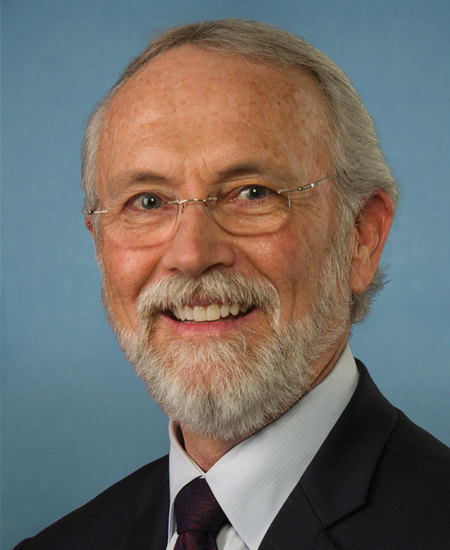
Rep. Dan Newhouse
Sponsored bills
This bill extends through FY2021 the inapplicability of the requirement for counties to elect to receive certain payments under the Secure Rural Schools and Community Self-Determination Act of 2000. That act provides compensation to counties for the presence of untaxable federal land within their borders.
This resolution expresses that the House of Representatives is committed to building upon the 20 years of success of the George McGovern-Robert Dole International Food for Education and Child Nutrition Program, complementing humanitarian assistance efforts and development programs through the continued implementation of the McGovern-Dole Program to address global food insecurity and create conditions for peace and stability, and supporting U.S. farmers, millers, shippers, and commodity groups that provide agricultural commodities for use in the McGovern-Dole Program to help combat global malnutrition and food insecurity and advance global education.
This concurrent resolution commends the bravery, courage, and resolve of the women and men of Iran who are (1) participating in the current protests to defend their fundamental human rights, and (2) risking their safety to speak out against the human rights abuses committed by the Iranian regime. The resolution condemns (1) the brutal beating and death of Mahsa Amini; and (2) the violent suppression by the Iranian regime of women and men participating in the current demonstrations, including children, and calls for transparent accountability for all killings of protesters by Iranian security forces. Finally, the resolution encourages continued efforts by the Biden Administration to respond to the protests, including the recent sanctioning of the Iranian morality police.
Promoting Local Management of the Lesser Prairie Chicken Act This bill prohibits any population of the lesser prairie-chicken ( Tympanuchus pallidicinctus ) in Kansas, Oklahoma, Texas, Colorado, or New Mexico from being listed as endangered or threatened under the Endangered Species Act of 1973 (ESA). The lesser prairie-chicken is a type of grouse. Currently, two distinct population segments (DPS) of the lesser prairie-chicken are listed under the ESA. The Southern DPS of the lesser prairie-chicken is listed as endangered and the Northern DPS is listed as threatened. The bill removes both populations from the list. In addition, the bill bans Interior from listing any population of the lesser prairie-chicken as endangered or threatened in the future.
Maddy summaryHR 7075 designates a specific triangular area in Washington, D.C. (bounded by 22nd Street NW, P Street NW, and Florida Avenue NW) as "Ukrainian Independence Park," including National Park Service reservations 57D and 360 (which contains the Taras Shevchenko Memorial). The bill updates all federal references to this area to use the new name and authorizes signage highlighting Ukraine's independence and U.S.-Ukraine solidarity. This is a procedural designation bill with no substantive policy changes, solely renaming a park area.
Partnership Agreements Creating Tangible Savings Act or the PACTS Act This bill revises provisions permitting cooperative management agreements between the National Park Service and other governmental entities regarding management of park areas. Specifically, the bill (1) allows tribal governments, public universities, public utilities, or quasi-governmental entities to enter agreements; and (2) eliminates the requirement that the nonfederal park areas be adjacent or near to National Park System units.
The Jackie Walorski Maternal and Child Home Visiting Reauthorization Act of 2022 This bill reauthorizes through FY2027, increases funding for, and modifies the Maternal, Infant, and Early Childhood Home Visiting Program. This program supports home visits for expectant and new parents who live in communities that are at-risk for poor maternal and child health outcomes. Changes to the program include setting out requirements for allocating program funds; increasing the percentage of funds reserved for tribal entities; establishing a publicly available dashboard that reports program outcomes; requiring activities to reduce unnecessary data collection, reporting, and other administrative requirements of the program; and allowing for virtual home visits (provided certain conditions are met). The bill also reduces funding for the Medicare Improvement Fund.
Supporting Market Access to Reinvigorate Trade Act of 2022 or the SMART Act This bill increases through FY2029 funding to carry out the Market Access Program and the Foreign Market Development Cooperator Program, which are programs administered by the Department of Agriculture to promote exports of U.S. agricultural products.
Lymphedema Treatment Act This bill provides for Medicare coverage of lymphedema compression treatment items. Specifically, the bill provides for coverage of standard and custom fitted gradient compression garments and other approved items that are prescribed by a physician or other specified health care professional to treat lymphedema.