

Maddy summaryHJRES 53 proposes a constitutional amendment to ban slavery and involuntary servitude as a criminal punishment. Currently, the 13th Amendment to the U.S. Constitution permits such punishments for crimes, creating a legal loophole. If ratified by 3/4 of state legislatures, this amendment would eliminate that exception nationwide, making it unconstitutional to impose forced labor or slavery as part of criminal sentences. The change would directly affect all states' criminal justice systems, particularly prison labor practices, by prohibiting these punishments for any offense.
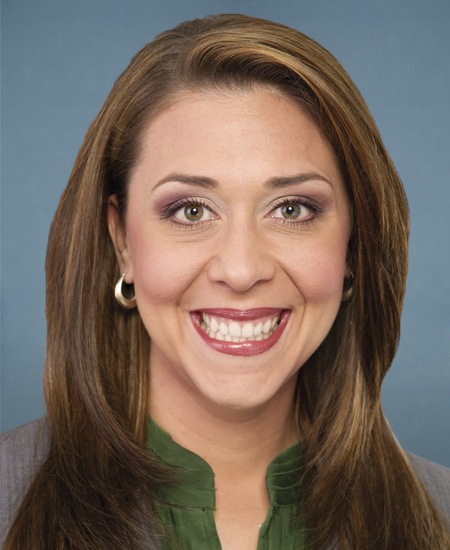
Rep. Jaime Herrera Beutler
Sponsored bills
Pathways to Policing Act This bill authorizes the Office of Community Oriented Policing Services within the Department of Justice to award grants to states, local governments, and law enforcement agencies to support recruitment of law enforcement officers. In particular, these grants may be used for (1) marketing and recruitment campaigns to encourage candidates to seek careers in law enforcement; and (2) developing, operating, or expanding Pathways to Policing programs (e.g., programs that facilitate entry into full-time law enforcement positions for certain candidates).
Ensuring Security for Military Spouses Act This bill waives for certain military spouses a residency requirement pertaining to naturalization, specifically the requirement that the applicant must have resided for at least three months in the state or service district where the naturalization application is filed. Under the bill, this residency requirement shall not apply to an applicant who is (1) a lawful permanent resident, and (2) the spouse of a member of the Armed Forces serving on active duty in the United States.
Porch Pirates Act of 2022 This bill extends federal criminal penalties for obstruction of correspondence and theft of stolen mail matter (which apply to U.S. Postal Service mail) to matter (e.g., packages) sent or delivered by private or commercial interstate carriers.
Protecting Parental Rights Act This bill establishes a new federal criminal offense for administering a COVID-19 vaccine to a minor without the prior consent of a custodial parent or legal guardian of the minor. A violation is subject to a fine, a prison term of up to one year, or both.
Refund the Police Act of 2022 This bill authorizes the Bureau of Justice Assistance within the Department of Justice to make grants to state and local governments for the same purposes as grants under the Community Oriented Policing Services Program. To be eligible for a grant, a state or local government must certify that it does not have a law requiring a heighted standard for use of force and has taken steps to expand efforts to hire and retain law enforcement officers, and has not taken steps to eliminate drive-by shootings as a basis for first degree murder.
COPS on the Beat Grant Program Reauthorization and Parity Act of 2022 This bill reauthorizes through FY2031 and makes changes to the Community Oriented Policing Services grant program. Among the changes, the bill reduces the required matching contribution for certain rural communities during the first three years of a grant and eliminates the preference for agencies that exceed the matching requirements; allows grant funds to be used to increase wages of career law enforcement officers in states or localities that have a median household income of less than 70% of the national median household income and qualify for a reduced matching contribution; and provides statutory authority for the Office of Community Oriented Policing Services within the Department of Justice. Additionally, the bill requires the Government Accountability Office to report on whether law enforcement workforces are representative of the communities they serve, the percentage of law enforcement employees who live in the community they serve, the average pay of officers compared to the cost of living in the community they serve, and recommendations for improvements.
Restoring America's Leadership in Innovation Act of 2021 This bill revises several aspects of patent law. The bill changes the U.S. patent system back to a first-to-invent system, in which the first inventor to conceive of an invention is entitled to a patent. Currently, the first person to file an application that meets all the necessary requirements is entitled to the patent. Several types of administrative patent challenge proceedings are abolished, as well as the Patent and Trademark Office (PTO) body that decides those proceedings. The bill relaxes the standard for what constitutes patent-eligible subject matter. The only ineligible inventions shall be those that exist in nature independent or prior to human activity or that exist solely in the human mind. The bill also makes it easier for a patent owner that has won an infringement case in court to secure a permanent injunction against the infringing defendant. Specifically, there shall be a presumption that further infringement would cause irreparable harm to the prevailing patent owner, and the burden shall be on the infringer to prove otherwise. (Currently, a prevailing patent owner seeking a permanent injunction must prove, among other things, that further infringement would cause irreparable harm.) The bill limits what types of publications shall be treated as prior art that could be used to make an invention be considered to be anticipated or obvious (and therefore not patentable). The bill authorizes the PTO to keep and spend all the fees that it collects.
Illegal Immigrant Payoff Prohibition Act This bill prohibits the payment of a settlement to an alien for a civil action brought against the United States in connection with the alien's inadmissibility to, or unlawful presence in, the United States.
Protecting First Responders from Secondary Exposure Act of 2021 This bill expands the allowable uses of grant funds under the Comprehensive Opioid, Stimulant, and Substance Abuse Program administered by the Department of Justice. Specifically, the bill allows grants to be used for purchasing containment devices for first responders and training first responders on the use of containment devices to prevent secondary exposure to fentanyl and other potentially lethal substances.