

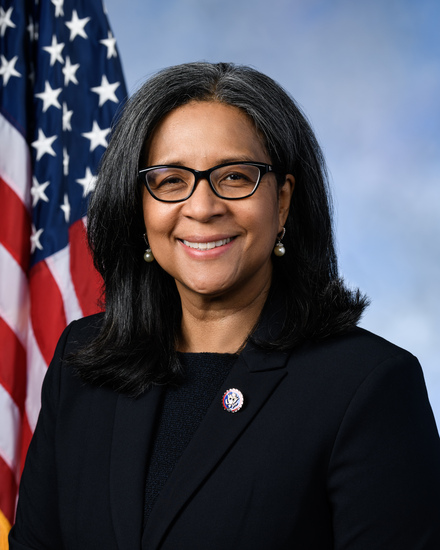
Photo of Marilyn Strickland
D United States House · District 10 · Washington On the 2026 ballot

Rep. Marilyn Strickland

Compare
Total votes
2,837
all sessions
Attendance
98%
62 missed
Near the chamber average
With party
98%
of cast votes
Near the chamber average
Bipartisan score
1%
crosses aisle rarely
Near the chamber average
Sponsored
1,357
bills & resolutions
Near the chamber average
Committees
6
assignments
1,357 bills and resolutions

Sponsored bills

Total
1,357
Primary
56
Co-sponsor
1,301
This page
1,357
matching current filters
Co-sponsor HR 349
In committee · United States House · Co-sponsor
Coronavirus Vaccine and Therapeutic Development Act of 2021

Coronavirus Vaccine and Therapeutic Development Act of 2021 This bill directs the Department of Health and Human Services (HHS) to increase the supply of vaccines and medical products that prevent or control COVID-19 (i.e., coronavirus disease 2019). To increase supplies, HHS must, as appropriate, award grants and enter other transactions to expand relevant research, procurement, and production activities. HHS must report to Congress on these actions. The report must assess and detail plans to enhance the supply chain and manufacturing capacity for the vaccines and products. It must also include plans to support domestic and international vaccination programs.

In committee Feb 5, 2021 1 co-sponsor
Co-sponsor HR 793
In committee · United States House · Co-sponsor
RESTAURANTS Act of 2021

Real Economic Support That Acknowledges Unique Restaurant Assistance Needed To Survive Act of 2021 or the RESTAURANTS Act of 2021 This bill temporarily establishes and provides funding for the Restaurant Revitalization Fund, from which the Department of the Treasury shall make grants to eligible food and beverage purveyors to cover specified costs such as payroll, operational expenses, and paid sick leave. For the grant program's initial period, Treasury must (1) prioritize awarding grants to marginalized and underrepresented communities, and (2) only award grants to eligible food and beverage purveyors with annual revenues of less than $1.5 million in 2019. For tax purposes, grant amounts are excluded from the recipient's gross income. An entity that received a loan under the Paycheck Protection Program established to support small businesses in response to COVID-19 (i.e., coronavirus disease 2019) may not apply for or use a restaurant revitalization grant for the same expenses for which the entity received the paycheck protection loan. Further, a grant applicant may request an additional amount to cover the cost of providing 10 days of paid sick leave to its employees. Treasury must report a list of grant recipients with the amount each recipient received, as well as demographics and other specified information.

In committee Feb 4, 2021 1 co-sponsor
Co-sponsor HR 804
In committee · United States House · Co-sponsor
FAMILY Act

Family and Medical Insurance Leave Act or the FAMILY Act This bill entitles every employee to a family and medical leave insurance (FMLI) monthly benefit payment of two-thirds of the employee's regular pay, limited to a maximum of $4,000, for not more than 60 days of qualified caregiving. The bill establishes the Office of Paid Family and Medical Leave within the Social Security Administration to administer the FMLI program. An FMLI benefit payment must be coordinated with any periodic benefits received under a state or local temporary disability insurance or family leave program. The bill imposes a tax on employers, employees, and self-employed individuals to fund FMLI benefits. It also establishes the Federal Family and Medical Leave Insurance Trust Fund to hold tax revenues.

In committee Feb 4, 2021 1 co-sponsor
Co-sponsor HR 848
In committee · United States House · Co-sponsor
GREEN Act of 2021

Growing Renewable Energy and Efficiency Now Act of 2021 or the GREEN Act of 202 1 This bill provides tax incentives for investment in renewable energy resources and energy efficiency programs. Among other provisions, the bill extends for five years the tax credit for production of electricity from certain renewable resources (e.g., wind facilities, biomass, landfill trash facilities), allows an election to treat certain tangible property as energy property for purposes of the energy tax credit, and modifies certain provisions of the energy tax credit and expands the credit for four years; expands the 30% energy tax credit to include energy storage technology or qualified biogas property; extends for one year the tax credit for carbon oxide sequestration; allows elective payments in lieu of certain energy-related tax credits; modifies the phaseout provisions of the income and excise tax credits for biodiesel and renewable diesel and alternative fuels and extends the termination date for such credits; extends and increases the tax credits for nonbusiness energy property and the new energy efficient home tax credit; extends for five years the residential energy efficient property tax credit; increases the tax deduction for energy efficient commercial buildings; modifies the limitations on new qualified plug-in electric drive motor vehicles tax credit and allows a new credit for such vehicles that are previously-owned; allows a new tax credit for zero emission heavy vehicles (vehicles with a gross weight rating of not less than 14,000 pounds and not powered by an internal combustion engine); extends for five years the tax credits for qualified fuel cell motor vehicles and alternative fuel cell refueling property; provides for additional allocations of the advanced energy project tax credit; allows a new tax credit for the labor costs of installing mechanical insulation property; allows a new tax credit to promote environmental justice programs (programs to improve health and economic outcomes of individuals residing in low-income areas or areas populated disproportionately by racial or ethnic minorities); and requires the Department of the Treasury to report on the utility of data from the Greenhouse Gas Reporting Program for determining the amount of greenhouse gases emitted by taxpayers for purposes of imposing a fee on them for such emissions.

In committee Feb 4, 2021 1 co-sponsor
Co-sponsor HR 849
In committee · United States House · Co-sponsor
Scientific Integrity Act

Scientific Integrity Act This bill revises provisions regarding the release of scientific research results by federal agencies. Each agency that funds, conducts, or oversees scientific research must (1) adopt and enforce a scientific integrity policy that includes requirements such as that scientific conclusions are not based on political considerations, and (2) submit such policy to the Office of Science and Technology Policy (OSTP) for approval. Each agency must make such policy available to the public and submit such policy to Congress. Agencies and the OSTP must periodically review the policies. The Government Accountability Office shall review implementation of the policies. Each agency shall (1) appoint a Scientific Integrity Officer, (2) establish a process for dispute resolution consistent with the scientific integrity policy, and (3) establish a specified training program for current and new employees.

In committee Feb 4, 2021 1 co-sponsor
Co-sponsor HR 762
In committee · United States House · Co-sponsor
SAFE TO DRIVE Act

States Afforded Funding Extensions To Oppose Driving Recklessly In Vehicular Engagements Act or the SAFE TO DRIVE Act This bill requires the Department of Transportation to use up to 25% of the amounts available for national priority safety program grants to award grants to any state that certifies it has enacted a distracted driving statute that (1) is applicable to drivers of all ages, (2) makes a violation of the statute a primary offense, and (3) prohibits texting or all non-navigational viewing of a personal wireless communications device.

In committee Feb 4, 2021 1 co-sponsor
Co-sponsor HR 476
In committee · United States House · Co-sponsor
Innovation Centers Acceleration Act

Innovation Centers Acceleration Act This bill establishes a program to advance economic development by designating nine cities as innovation centers and providing and modifying certain related grants. It also establishes the Innovation Center Selection Committee to designate these cities. The innovation center designation entitles selected cities—and the businesses, research institutions, and other organizations that operate within them—to various federal funding and benefits for research activities, business and workforce development, and transportation infrastructure projects. These benefits include expanding various tax credits and incentives for businesses. The bill also makes it easier for those businesses to access loans and other financial instruments to raise capital. In addition, the bill establishes a grant program for local and tribal governments that partner with innovation centers to develop and preserve affordable housing. It also modifies existing grants, loans, and other programs that support transportation infrastructure to specifically target initiatives in innovation centers.

In committee Feb 4, 2021 1 co-sponsor
Co-sponsor HR 749
In committee · United States House · Co-sponsor
Remote Seafood Employee Meals Tax Parity Act

Remote Seafood Employee Meals Tax Parity Act This bill provides that the 50% limitation on the tax deduction for business meals shall not apply to meals provided on certain fishing vessels or at certain fish processing facilities.

In committee Feb 3, 2021 1 co-sponsor
Co-sponsor HR 764
In committee · United States House · Co-sponsor
Keep Our PACT Act

Keep Our Promise to America's Children and Teachers Act or the Keep Our PACT Act This bill provides funding through FY2031 for grant programs operated by local educational agencies to provide supplementary educational and related services to low-achieving students and other students who attend elementary and secondary schools with relatively high concentrations of students from low-income families. Additionally, the bill permanently reauthorizes the grant program to assist states and outlying areas in providing special education and related services to children with disabilities.

In committee Feb 3, 2021 1 co-sponsor
Co-sponsor HR 708
In committee · United States House · Co-sponsor
TREAT Act

Temporary Reciprocity to Ensure Access to Treatment Act or the TREAT Act This bill temporarily authorizes the interstate provision of in-person and telehealth services. This authorization applies during, and for at least 180 days after, the COVID-19 (i.e., coronavirus disease 2019) emergency. Specifically, subject to scope of practice and other requirements, a health care professional may provide health services in any U.S. jurisdiction based on that individual's authorization to practice in any one state or territory. The bill also provides certain related powers to health care professional regulatory bodies, such as medical boards. Specifically, a regulatory body may investigate and take disciplinary actions against a professional who provides services pursuant to this bill to a patient in that body's jurisdiction.

In committee Feb 3, 2021 1 co-sponsor
Showing 1,331 to 1,340 of 1,357 bills