

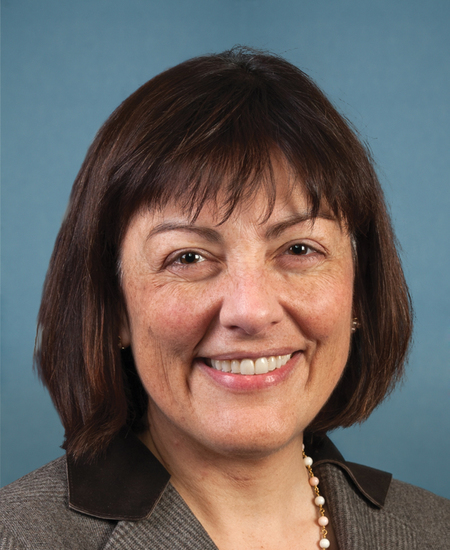
Photo of Suzan K. DelBene
D United States House · District 1 · Washington On the 2026 ballot

Rep. Suzan K. DelBene

Compare
Total votes
2,837
all sessions
Attendance
99%
16 missed
Near the chamber average
With party
98%
of cast votes
Higher than 89% of chamber peers
Bipartisan score
1%
crosses aisle rarely
Lower than 90% of chamber peers
Sponsored
1,712
bills & resolutions
Higher than 88% of chamber peers
Committees
4
assignments
1,712 bills and resolutions

Sponsored bills

Total
1,712
Primary
60
Co-sponsor
1,652
This page
1,712
matching current filters
Co-sponsor HR 1502
In committee · United States House · Co-sponsor
North Platte Canteen Congressional Gold Medal Act

Maddy summaryHR 1502 authorizes the creation of a Congressional Gold Medal to honor the volunteers and communities (primarily from Nebraska, Colorado, and Kansas) who supported the North Platte Canteen during World War II. The bill directs the Treasury Secretary to design and strike the medal, which will be presented to the individuals who contributed to the canteen’s operations and then permanently displayed at the Lincoln County Historical Museum in North Platte, Nebraska. It also permits the sale of bronze duplicates to cover production costs, with proceeds going to the U.S. Mint. This is a commemorative measure recognizing historical service, not a policy change affecting current laws or programs.

In committee Feb 21, 2025 1 co-sponsor
Co-sponsor HR 1464
In committee · United States House · Co-sponsor
MODERN WIC Act of 2025

More Options to Develop and Enhance Remote Nutrition in WIC Act of 2025 or the MODERN WIC Act of 2025 This bill permanently allows individuals to remotely certify their eligibility for, and receive benefits through, the Special Supplemental Nutrition Program for Women, Infants, and Children (WIC). Specifically, the bill requires that a state agency allow an individual seeking a WIC certification, recertification, or a nutritional risk evaluation to do so by phone or through video teleconference, in addition to the in-person option. A state agency has 90 days to collect data for a nutritional risk evaluation for a remotely certified individual. Further, a state agency may consider an applicant who meets the income eligibility standards to be temporarily eligible on an interim basis to participate in the program and may certify the individual for immediate participation without waiting for a nutritional risk evaluation. The bill also allows states to provide benefits on WIC electronic benefit transfer cards through mail or remote issuance instead of requiring participants to pick up or reload benefits in person at a WIC office. Further, the Department of Agriculture must report to Congress about the use of remote technologies and other digital tools in the WIC program. Currently, individuals are generally required to be physically present to certify their WIC eligibility and receive benefits, with exceptions. The Food and Nutrition Service  has temporarily waived these requirements and allowed remote certification and benefits using authorities that were provided by laws that were enacted to address COVID-19.

In committee Feb 21, 2025 1 co-sponsor
Co-sponsor HR 1505
In committee · United States House · Co-sponsor
Public Safety Employer-Employee Cooperation Act

Maddy summaryHR 1505, the Public Safety Employer-Employee Cooperation Act, establishes federal standards for collective bargaining rights for public safety officers (including police, firefighters, and emergency medical personnel) in states that do not meet minimum requirements. The Federal Labor Relations Authority (FLRA) will determine after 180 days whether a state law "substantially provides" key rights, such as forming unions, negotiating wages/hours, and using binding arbitration to resolve disputes. If a state fails this assessment, federal bargaining rules apply within two years, but existing state laws with stronger protections remain valid. The bill explicitly respects state laws that exceed its standards and exempts small jurisdictions (under 5,000 population or 25 full-time employees).

In committee Feb 21, 2025 1 co-sponsor
Co-sponsor HR 1488
In committee · United States House · Co-sponsor
To repeal the authorizations for use of military force against Iraq.

Maddy summaryHR 1488 repeals two laws that authorized U.S. military force against Iraq: the 1991 Gulf War authorization and the 2002 Iraq War authorization. This bill removes the legal basis for military operations under these specific resolutions, directly affecting how future U.S. military actions in Iraq could be justified. The key provision is the direct repeal of both resolutions from federal law, eliminating their continued legal effect. As a result, any new military action in Iraq would require fresh congressional authorization rather than relying on these repealed laws.

In committee Feb 21, 2025 1 co-sponsor
Co-sponsor HR 1509
In committee · United States House · Co-sponsor
Accelerating Kids’ Access to Care Act of 2025

Maddy summaryThis bill would require states to create a simplified process for out-of-state healthcare providers to join Medicaid and CHIP programs. Qualified providers (those already enrolled in Medicare or another state's program with low fraud risk) could enroll without excessive screening and would be approved for five years. It directly affects children under 21 enrolled in Medicaid or CHIP by expanding access to providers outside their state, particularly in underserved areas. The change applies to all states' Medicaid programs but takes effect three years after enactment.

In committee Feb 21, 2025 1 co-sponsor
Co-sponsor HR 1433
In committee · United States House · Co-sponsor
Kids’ Access to Primary Care Act of 2025

Maddy summaryHR 1433, the Kids’ Access to Primary Care Act of 2025, sets a minimum Medicaid payment rate of 100% of Medicare’s rate for primary care services provided to children. It directly affects Medicaid-covered children and expands eligibility for providers to include pediatricians, family medicine physicians, nurse practitioners, physician assistants, certified nurse-midwives, and rural health clinics or Federally-qualified health centers (FQHCs) under specific conditions. Key provisions require Medicaid managed care plans to pay these providers at the minimum rate, with documentation requirements to verify compliance, and exclude emergency department services from the definition of primary care. The bill also mandates a study to track enrollment and payment rate changes across states after implementation.

In committee Feb 18, 2025 1 co-sponsor
Co-sponsor HR 1410
In committee · United States House · Co-sponsor
9/11 Responder and Survivor Health Funding Correction Act of 2025

Maddy summaryHR 1410 expands access to mental health care for 9/11 responders and survivors by allowing licensed mental health providers (not just physicians) to conduct initial health evaluations and certifications under the World Trade Center Health Program. It adjusts the program’s funding formula to account for changing enrollment numbers by linking annual funding to the previous year’s enrollment ratio, and clarifies that deceased individuals are excluded from enrollment counts. The bill also extends the timeframe for adding new health conditions to the program’s list and requires a 2028 report assessing long-term funding needs through 2090. These changes aim to streamline eligibility, improve care access, and ensure sustainable funding for the program.

In committee Feb 18, 2025 1 co-sponsor
Co-sponsor HR 1389
In committee · United States House · Co-sponsor
Marriage Equality for Disabled Adults Act

Maddy summaryThis bill removes marriage restrictions that previously caused Disabled Adult Children (DACs) to lose Social Security disability benefits upon marriage. It amends Social Security rules to treat married DACs the same as unmarried ones for eligibility, ensuring they retain benefits for child's insurance based on a disability. Key provisions prevent states from counting a spouse's income/resources against a married DAC and guarantee Medicaid eligibility remains unchanged if the DAC would qualify as unmarried. The bill directly affects DACs receiving Social Security Disability Insurance (SSDI) through a parent's account who are married, ensuring they maintain access to Medicare, Medicaid, and SSDI benefits without geographic or marital status barriers.

In committee Feb 14, 2025 1 co-sponsor
Co-sponsor HR 349
In committee · United States House · Co-sponsor
Goldie’s Act

Goldie's Act This bill expands enforcement provisions under the Animal Welfare Act (AWA). Specifically, the bill directs the Department of Agriculture (USDA) to document and record detailed descriptions of violations of the act observed during inspections and investigations. USDA must provide a copy of all records documenting violations to state, local, and municipal animal control or law enforcement officials within 24 hours of such inspections or investigations. Inspections must be held at least once a year of each research facility, the premises of each animal dealer, and each exhibitor of animals. If violations are found during inspections, then USDA must conduct any necessary follow-up inspections until all the violations are corrected. Inspectors must confiscate or destroy in a humane manner animals found to be suffering physical or psychological harm as a result of failure to comply with the AWA. Violators are subject to civil penalties as outlined in the bill.

In committee Feb 14, 2025 1 co-sponsor
Co-sponsor HR 1314
In committee · United States House · Co-sponsor
TIPS Act

Maddy summaryThis bill (HR 1314, TIPS Act) requires employers to pay tipped workers the standard federal minimum wage instead of the current lower rate (currently $2.13/hour), directly affecting workers in hospitality, food service, and similar roles. It also creates a new tax deduction for cash tips received in qualifying jobs (e.g., restaurants, hotels), allowing workers to deduct these tips from taxable income up to $112,500 in adjusted gross income. The deduction applies only to tips from unrelated customers without business ownership stakes, excluding credit card tips. The tax provisions take effect for 2026 tax years.

In committee Feb 13, 2025 1 co-sponsor
Showing 531 to 540 of 1,712 bills
Previous 1 … 53 54 55 … 172 Next