

Advancing America's Interests Act This bill limits the ability of certain persons (e.g., patent or trademark holders) to bring complaints before the U.S. International Trade Commission (ITC), and it requires the ITC to consider the public interest when determining whether to exclude articles that are under investigation. A complainant before the ITC must satisfy a domestic industry requirement obliging them to have made significant investment in the United States related to the articles that are the subject of the matter. One method to establish domestic industry is through reliance on licensing activities. The bill requires a complainant attempting to demonstrate domestic industry through licensing activities to show that those activities led to the adoption and development of articles that incorporate the patent, copyright, trademark, mask work, or design at issue. Further, the bill prohibits a complainant from relying upon activities by a licensee to demonstrate domestic industry unless the license leads to the adoption and development of articles that incorporate the claimed patent, copyright, trademark, mask work, or design for sale in the United States. In addition, the bill requires the ITC to determine that any exclusion of articles pursuant to an investigation is in the public interest. The ITC must also identify at the beginning of an investigation whether the matter involves a dispositive issue that is appropriate for expedited initial determination and direct the assigned judge to issue such determination not later than 100 days after the investigation is instituted.
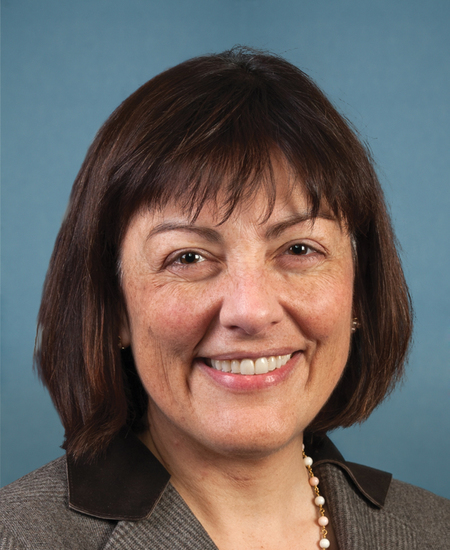
Rep. Suzan K. DelBene
Sponsored bills
Voices for Veterans Act This bill expands the membership of the Advisory Committee on Minority Veterans to include veterans who are lesbian, gay, bisexual, transgender, gender diverse, gender non-conforming, intersex, or queer. Among other responsibilities, the committee advises the Department of Veterans Affairs on the administration of benefits and provision of health care, benefits, and services to minority veterans.
Prohibition of Medicaid Funding for Conversion Therapy Act This bill prohibits state Medicaid programs from covering conversion therapy. The bill defines conversion therapy as any practice or treatment that seeks to change a person's sexual orientation or gender identity in exchange for monetary compensation.
Harlem Hellfighters Congressional Gold Medal Act This bill provides for the award of a Congressional Gold Medal to the 369th Infantry Regiment, commonly known as the Harlem Hellfighters, in recognition of their bravery and outstanding service during World War I.
Puppies Assisting Wounded Servicemembers for Veterans Therapy Act or the PAWS for Veterans Therapy Act This bill implements a program and a policy related to service dog therapy for veterans. Specifically, the bill requires the Department of Veterans Affairs (VA) to implement a five-year pilot program to provide canine training to eligible veterans diagnosed with post-traumatic stress disorder as an element of a complementary and integrative health program. Eligible veterans are those who are enrolled in the VA health care system and have been recommended for participation by a qualified mental health care provider or clinical team. The VA must seek to enter agreements containing specified elements with accredited nongovernmental entities that have demonstrated ability to provide canine training. Veterans who participate in the program are authorized to adopt the dog they assisted in training if their health provider determines it is in the best interest of the veteran. The VA must establish processes to document and track the progress of participating veterans with respect to health benefits and improvements. The Government Accountability Office must brief Congress and submit a report on the program. The bill also authorizes the VA to provide service dogs to veterans with mental illnesses, regardless of whether they have a mobility impairment.
Preserving Patient Access to Home Infusion Act This bill specifically includes pharmacy services as part of covered home infusion therapy under Medicare, and specifies that certain payment components still apply regardless of whether or not a qualified supplier is physically present in the beneficiary's home. The bill also allows nurses and physician assistants to establish and review the plan of care for home infusion therapy.
This resolution expresses the sense of the House of Representatives that policies concerning medication abortions should be grounded in science, be based on a review of medical evidence, and ensure equitable access for patients.
Migratory Bird Protection Act of 2021 This bill prohibits the incidental taking (e.g., capturing or killing) of migratory birds by commercial activities unless the activity is authorized under a permit or is identified as posing de minimis risk to migratory birds. The U.S. Fish and Wildlife Service (USFWS) must regulate such incidental taking, including by (1) issuing general permits for certain industries, (2) creating a mitigation fee for any incidental taking of migratory birds, and (3) identifying categories of de minimis risk activities that are exempt from liability for the taking of migratory birds. In addition, the USFWS must establish and maintain a research program (1) to evaluate the impacts of commercial activities on birds, (2) to evaluate the effectiveness of best management practices and technologies to avoid or minimize such impacts, and (3) to develop new or improved best management practices and technologies.
Automatic Relief for Taxpayers Affected by Major Disasters and Critical Events Act This bill modifies the mandatory extension of certain tax filing and other tax-related deadlines for taxpayers affected by federally declared disasters and rules for postponing certain tax filing or payment requirements due to service in a combat zone or a contingency operation. It also tolls the deadline for filing a petition in the Tax Court if the location for filing the petition is inaccessible.
Passenger Rail Pre clearance Implementation Act of 2021 This bill directs the Department of Homeland Security to implement a process for preclearance screening of passengers and baggage on rail service between the United States and Canada. The bill also reauthorizes through FY2026 funding for rail improvement grants and permits the Department of Transportation to expend a specified amount of that funding on the preclearance process.