

Maddy summaryThis bill updates Veterans Health Administration (VHA) anesthesia practice standards to align with Defense Health Agency (DHA) guidelines, directly affecting VA-employed anesthesia providers (including physician anesthesiologists and certified registered nurse anesthetists). It requires VHA to recognize certified registered nurse anesthetists as licensed independent practitioners under DHA’s 2023 standards and mandates certification from specific bodies for all anesthesia staff. Additionally, it sets a 25-hour minimum requirement for direct patient care experience for all VA anesthesia professionals and allows suspension for non-compliance. The bill also requires annual GAO reports comparing outcomes and costs across three anesthesia delivery models (anesthesiologist-led, CRNA-supervised, and CRNA-only) to be submitted to Congress.
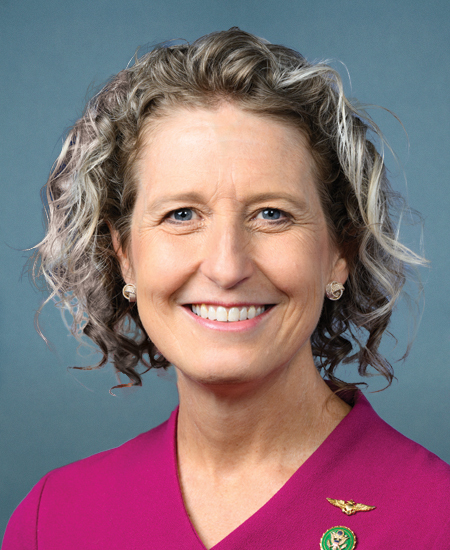
Rep. Jennifer A. Kiggans
Sponsored bills
Maddy summaryHR 3848, the CLOUD Aircraft Act, requires the Department of Defense to study equipping all military fixed-wing and rotary-wing aircraft operating in highly trafficked domestic airspaces (near commercial airports) with collision detection systems. The study must assess the feasibility and cost of adding both air-to-air systems (to prevent mid-air collisions with other aircraft) and air-to-ground systems (to avoid terrain collisions). The Secretary of Defense must submit a report with findings and recommendations to Congress within 180 days of the bill's enactment. This bill directly affects military aircraft operating in controlled airspace around major airports but does not mandate any equipment installation.
Maddy summaryHRES 483 is a House resolution recognizing the 250th anniversary of the U.S. Army's founding on June 14, 1775. It expresses appreciation for the Army's service over 250 years, honors soldiers' valor and core values, and calls for public observance through ceremonies and activities. The resolution has no policy impact or funding provisions - it is purely commemorative. It was introduced by 30 bipartisan House members and referred to the Armed Services Committee.
Maddy summaryThis bill expands Medicare coverage for diabetes self-management training. It requires Medicare to cover 10 initial hours of training plus 2 additional hours annually for beneficiaries with diabetes, eliminating cost-sharing (like copays) for these services. The policy directly affects Medicare beneficiaries with diabetes by making essential education and training fully covered. The changes apply to services provided on or after January 1, 2027.
Maddy summaryThis bill expands Medicare coverage for mental health services provided by clinical social workers to seniors in skilled nursing facilities. It removes an exclusion that previously prevented these services from being covered under Medicare's skilled nursing facility payment system. The bill specifically adds defined mental health service codes (including those for assessment and treatment) to Medicare's coverage, ensuring seniors can access these services without additional barriers. These changes will take effect for services provided on or after January 1, 2026.
Maddy summaryHR 3359, the Veterans’ Security and Pay Transparency Act, requires the Department of Veterans Affairs (VA) to publish an annual report on compensation for its police officers. The report must detail salaries, availability pay, recruitment bonuses, and other pay for specific VA police roles (like Chief of Police, Police Officer, and Dispatcher) broken down by VA facility. This law, effective six months after enactment, aims to increase transparency around how VA police officers are paid.
Maddy summaryThis bill directs the Department of Defense to study providing apartment or dormitory housing for civilian workers at four specific naval shipyards: Norfolk (VA), Pearl Harbor (HI), Portsmouth (ME), and Puget Sound (WA). The study must assess costs, recruitment/retention benefits, feasibility at each location, operational impacts, and rent deduction options. It requires a report to Congress within 18 months, but does not authorize or implement housing. The bill affects civilian shipyard workers at these facilities by triggering a federal review of potential housing solutions.
Maddy summaryHR 3694, the VALID Act of 2025, requires lenders to include specific information about VA loans in mortgage disclosures. It amends the National Housing Act to mandate that disclosures state the loan-to-value ratio and clarify that VA loans are available under Chapter 37 of Title 38 (veterans' benefits law), assuming prevailing interest rates. The bill also requires the Federal Housing Finance Agency to add a military service question to the Uniform Residential Loan Application form, placing it above the signature line within six months of enactment. This directly affects veterans and active-duty service members applying for VA-guaranteed mortgages, as well as the lenders processing those applications.
Maddy summaryThe FBI Animal Cruelty Taskforce Act of 2025 establishes a dedicated FBI unit to investigate federal animal cruelty crimes, specifically targeting dogfighting, cockfighting, and "crush videos." This taskforce will create training materials for local law enforcement to help them detect and investigate these offenses. It also requires the taskforce to coordinate with agencies like the Department of Agriculture and U.S. Customs, and to submit annual reports to Congress detailing filed charges, convictions, and unresolved investigations. The bill directly affects local police departments through new training resources and federal agencies through mandated coordination and reporting.
Maddy summaryHR 3689, the TREAT Youth Act, amends the SUPPORT for Patients and Communities Act to authorize specific annual funding for youth prevention and recovery programs. It sets mandatory funding levels from fiscal years 2026 through 2030, starting at $10 million in 2026 and increasing to $15 million by 2030. The bill does not create new programs but specifies exact funding amounts for existing youth-focused initiatives under the SUPPORT Act. It directly affects federal programs delivering prevention, recovery, education, and awareness services to young people. This is a procedural funding authorization, not a policy change altering program scope or eligibility.