This resolution expresses the House of Representatives' support for the celebration of Filipino American History Month as a testament to the advancement of Filipino Americans and a time to renew efforts toward researching and examining the history of Filipino Americans to give all people of the United States an opportunity to learn about their contributions.
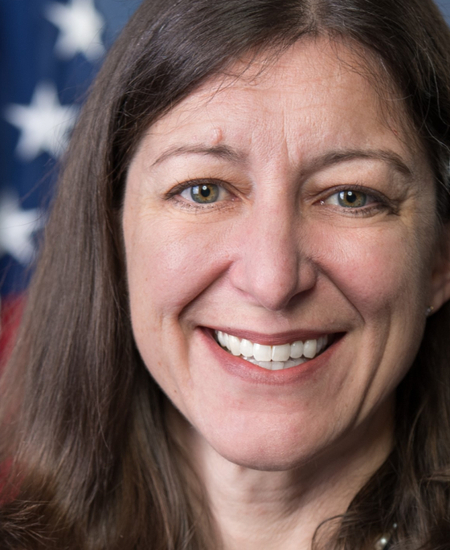
Rep. Elaine G. Luria
Sponsored bills
Cady Housh and Gemesha Thomas Student Suicide Prevention Act of 2021 This bill reauthorizes through FY2028, and otherwise revises, grants administered by the Substance Abuse and Mental Health Services Administration (SAMHSA) to support youth suicide early-intervention and prevention strategies. Specifically, the bill requires SAMHSA to award a portion of such grants for statewide training programs on emotional well-being, mental health, and suicide awareness and prevention for elementary and secondary school students and staff.
This bill designates the federal building and U.S. courthouse at 180 West Main Street in Abingdon, Virginia, as the H. Emory Widener, Jr., Federal Building and United States Courthouse.
Original National Domestic Violence Awareness Month Resolution of 2021 This resolution supports the goals and ideals of National Domestic Violence Awareness Month. Further, it expresses the sense of the House of Representatives that Congress should continue to raise awareness of and support programs to end domestic violence.
Public Service Freedom to Negotiate Act of 20 21 This bill provides minimum collective bargaining rights and procedures for public employees and prohibits strikes by certain public safety workers. The Federal Labor Relations Authority (FLRA) shall determine for each state whether the laws of such state substantially provide for each of the minimum standard collective bargaining rights and procedures specified by this bill, including the right of public employees and supervisory employees to self-organize, form or join a labor organization, or collectively bargain. The FLRA must issue rules and take actions to establish and administer bargaining rights and procedures for those states that do not substantially provide for them. No employers, emergency services employees, or law enforcement officers may engage in a lockout, strike, or any other organized job action that is likely to result in a measurable disruption of the delivery of emergency or public safety services. Furthermore, no labor organization may be the cause of a violation of such prohibition.
This resolution strongly disapproves of the escalation of political tensions between the government of Ethiopia and the Tigray People's Liberation Front into armed conflict, and it calls for the immediate cessation of hostilities in the Tigray region as well as an end to violence throughout Ethiopia. Further, the resolution urges all parties to work to protect human rights, and it calls on relevant U.S. agencies to take specified actions that encourage an end to the conflict and that provide humanitarian support.
United States Cadet Nurse Corps Service Recognition Act of 2021 This bill recognizes service as a member of the U.S. Cadet Nurse Corps between July 1, 1943, and December 31, 1948, as active duty service. The active duty designation entitles qualifying individuals to certain benefits afforded to veterans, such as burial benefits (not including interment or inurnment at Arlington National Cemetery) and honorary veteran status. Under the bill, the Department of Defense (DOD) must issue individuals who served in the corps during the specified period a discharge from their service under honorable conditions if such a discharge is warranted based on the duration and nature of the service. Such individuals are not entitled to Department of Veterans Affairs benefits aside from those related to burials and memorials. The bill also authorizes DOD to produce a service medal or other commendation, memorial plaque, or grave marker to honor the individuals.
Bipartisan Border Solutions Act of 2021 This bill establishes regional processing centers for conducting immigration-related activities and addresses other related issues. The Department of Homeland Security (DHS) shall establish at least four regional processing centers along the southern border in high-traffic Border Patrol sectors. These centers shall conduct processing activities such as criminal history checks, medical screenings, asylum interviews and credible fear determinations, and short-term detention of individuals. The bill imposes various requirements, such as requiring the centers to (1) allow nongovernmental entities access to detained individuals to provide humanitarian or legal assistance, and (2) provide detained aliens access to legal counsel for certain asylum proceedings. The bill also requires DHS and the Department of Justice (DOJ) to develop pilot programs to improve asylum decisions, credible fear determinations, access to counsel, and case management of aliens awaiting asylum hearings or decisions. DOJ shall, to the greatest extent practicable, prioritize removal cases involving aliens apprehended while entering the United States during an irregular migration influx. Before placing an unaccompanied alien child with an individual, the Department of Health and Human Services must conduct a criminal background check of each adult member of that individual's household. An alien child may not be placed in a household where an individual has been convicted of certain crimes, including offenses involving sex or domestic violence. The bill also makes it a crime to make a materially false statement or knowingly use a false document to obtain custody of an unaccompanied alien child.

Veterans Medical Marijuana Safe Harbor Act This bill provides guidance related to veterans and medical marijuana that shall be effective for five years. Specifically, the bill authorizes (1) a veteran to use, possess, or transport medical marijuana in accordance with applicable state or Native American tribal law; (2) a Department of Veterans Affairs (VA) physician to discuss with a veteran the use of medical marijuana as a treatment if the physician is in a state or on tribal land that authorizes such treatment; or (3) a VA physician to recommend, complete forms for, or register veterans for participation in a medical marijuana treatment program in accordance with applicable state or tribal law. The bill requires the VA to report on (1) the effects of medical marijuana on veterans in pain; and (2) the relationship between state-approved medical marijuana treatment programs, program access, and opioid use and abuse reduction.
Camp Lejeune Justice Act of 2021 This bill allows certain individuals to sue and recover damages for harm from exposure to contaminated water at Camp Lejeune in North Carolina between August 1, 1953, and December 31, 1987. This action is available only to individuals who were exposed to contaminated water for at least 30 days. The bill prohibits the U.S. government from asserting specified immunity from litigation in response to such a lawsuit. The bill also prohibits an individual who brings such an action from bringing a separate tort action against the United States based on the same harm.