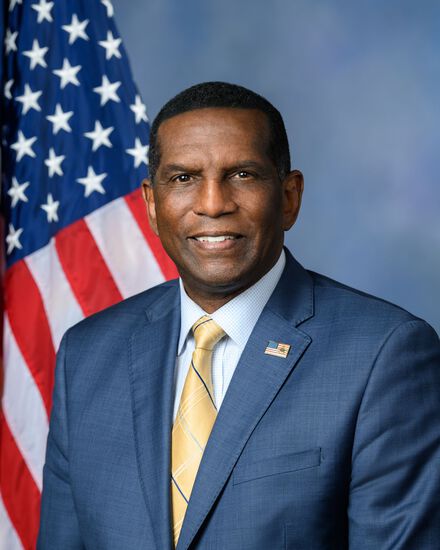
Photo of Burgess Owens
R United States House · District 4 · Utah

Rep. Burgess Owens

Compare
Total votes
2,837
all sessions
Attendance
99%
27 missed
Near the chamber average
With party
95%
of cast votes
Near the chamber average
Bipartisan score
3%
crosses aisle rarely
Near the chamber average
Sponsored
959
bills & resolutions
Near the chamber average
Committees
8
assignments
959 bills and resolutions

Sponsored bills

Total
959
Primary
63
Co-sponsor
896
This page
959
matching current filters
Primary HR 2516
In committee · United States House · Lead sponsor
Accreditation for College Excellence Act of 2025

Maddy summaryHR 2516, the Accreditation for College Excellence Act of 2025, prohibits accreditation agencies from requiring colleges to support specific political views, ideologies, or partisan positions. It explicitly prevents agencies from assessing institutions based on their commitment to any ideology or requiring adherence to statements of faith for religious institutions. The bill also limits federal criteria for accreditation to only what is necessary, ensuring colleges comply with their accreditor’s standards - not additional unrelated requirements. This directly affects all colleges seeking federal funding through accredited programs by clarifying permissible accreditation standards.

In committee Jan 13, 2026 0 co-sponsors
Co-sponsor HR 909
Passed · United States House · Co-sponsor
Crime Victims Fund Stabilization Act of 2025

Maddy summaryHR 909, the Crime Victims Fund Stabilization Act of 2025, modifies how funds from the False Claims Act are deposited into the Crime Victims Fund. It specifies that from 2025 through 2029, certain False Claims Act proceeds (specifically those for qui tam plaintiff payments and government damage reimbursements) cannot be deposited into the fund. This change directly affects the composition of the Crime Victims Fund by excluding these specific revenue streams during the specified period. The bill does not create new benefits or alter victim services; it only adjusts fund allocation rules for existing False Claims Act revenues.

Passed Jan 13, 2026 1 co-sponsor
Co-sponsor HRES 984
In committee · United States House · Co-sponsor
Supporting the recognition of January 9, 2026, as "National Law Enforcement Appreciation Day".

Maddy summaryHRES 984 is a symbolic resolution designating January 9, 2026, as "National Law Enforcement Appreciation Day." It directly honors all federal, state, local, and tribal law enforcement officers across the United States for their service and sacrifices. The resolution expresses the House's support and gratitude, encourages public observance through ceremonies, and recognizes officers who have made the ultimate sacrifice. As a non-binding resolution, it does not create new laws or policies but serves as a formal expression of appreciation.

In committee Jan 9, 2026 1 co-sponsor
Co-sponsor HR 6976
In committee · United States House · Co-sponsor
Duty Status Reform Act

Maddy summary# Summary of Reserve Component Duty Consolidation Legislation This legislation is a comprehensive revision of military reserve component terminology and definitions throughout the U.S. Code. The primary purpose is to replace the outdated term "inactive duty training" with the more accurate and consistent term "reserve component duty" across all relevant sections of federal law. ## Key Provisions: 1. **Terminology Change**: - Replaces "inactive duty training" with "reserve component duty" in over 50 sections of the U.S. Code (primarily Titles 10, 32, and 37) - Also replaces related terms like "inactive duty" and "inactive duty for training" with "reserve component duty" 2. **Repeals**: - Repeals Chapter 13 of Title 10 - Repeals Sections 10147, 10148, 12406, 12503, 12552 of Title 10 - Repeals Sections 114, 115, and 328 of Title 32 3. **Definition Updates**: - Creates new definitions for "reserve component duty" and "remote assignment" in Title 10 - Defines "Active Guard and Reserve functions" more precisely - Clarifies that reserve component duty includes: * Training as described in sections 552(a) and 553(a) of Title 32 * Support activities authorized for members of the reserve components * Duty prescribed under sections 543 of Title 32 4. **Transition Provisions**: - Establishes a 10-year transition period from the date of enactment - Allows for earlier implementation if all relevant departments (Defense, Homeland Security, Veterans Affairs) certify readiness - Provides for early TRICARE eligibility for members ordered to active duty or full-time National Guard duty 5. **Conforming Amendments**: - Makes numerous technical changes to ensure consistent terminology throughout the U.S. Code - Updates references to training requirements, pay, and benefits to reflect the new terminology This legislation represents a significant effort to modernize military reserve component terminology, eliminate confusing and outdated references, and create a more consistent framework for understanding and managing reserve component service obligations and benefits.


In committee Jan 9, 2026 1 co-sponsor
Co-sponsor HR 178
In committee · United States House · Co-sponsor
To require the Secretary of Agriculture to carry out activities to suppress wildfires, and for other purposes.

Maddy summaryHR 178 requires the U.S. Forest Service (under the Secretary of Agriculture) to put out wildfires on specific National Forest lands within 24 hours of detection. It directly affects National Forest System lands in areas experiencing severe drought (D2-D4 ratings), high fire risk (National Wildland Fire Preparedness Level 5), or in the top 10% of wildfire exposure risk. Key provisions mandate using all available resources for rapid suppression, prohibiting interference with state/local firefighting efforts, and strictly limiting the use of planned controlled burns or backfires (only allowed under specific safety orders or to protect personnel). The bill does not create new funding but sets operational requirements for wildfire response on defined high-risk lands.

In committee Jan 8, 2026 1 co-sponsor
Co-sponsor HR 5593
In committee · United States House · Co-sponsor
To amend title 38, United States Code, to include eyeglass lens fittings in the category of medical services authorized to be furnished to veterans under the Veterans Community Care Program, and for other purposes.

Maddy summaryThis bill expands the Veterans Community Care Program to cover eyeglass lens fittings as an authorized medical service, directly affecting veterans who receive care through non-VA providers under the program. It amends the law to explicitly include "fittings for eyeglass lenses" in the list of covered services, allowing eligible veterans to schedule these appointments at nearby community providers. The Department of Veterans Affairs must establish regulations to implement this change, ensuring veterans can access these fittings without needing to go through VA facilities. A report on implementation progress, challenges, and veteran benefits must be submitted to Congress within 180 days of the bill's enactment.

In committee Dec 19, 2025 1 co-sponsor
Co-sponsor HR 4837
In committee · United States House · Co-sponsor
Written Informed Consent Act

Maddy summaryHR 4837, the Written Informed Consent Act, requires the Veterans Health Administration (VHA) to update its existing directive on informed consent to include additional medication classes. Specifically, it mandates that written informed consent must be obtained before prescribing antipsychotics, stimulants, antidepressants, anti-anxiety medications (anxiolytics), and narcotics (opioids) to veterans. This expansion directly affects veterans receiving these medications through the VA system, ensuring they are informed about specific treatment risks and alternatives. The key mechanism is amending VHA Directive 1005 to broaden its application beyond long-term opioid therapy to cover the newly listed medication types.

In committee Dec 19, 2025 1 co-sponsor
Primary HR 6809
In committee · United States House · Lead sponsor
Alyssa’s Act of 2025

Maddy summaryAlyssa's Act of 2025 expands the Federal Clearinghouse on School Safety Evidence-based Practices to collect and analyze school safety data, including information on school shootings and emergency response effectiveness. The bill creates a National School Safety Data Center to track incidents, injuries, and response methods, while requiring emergency response maps for schools to meet specific digital standards for accessibility and real-time updates. It also establishes a program to develop and test panic alarm technology for schools, and mandates annual reports on school safety master plans developed by states and local educational agencies. The legislation requires coordination with the U.S. Secret Service's National Threat Assessment Center to align school safety practices with evidence-based approaches.

In committee Dec 18, 2025 0 co-sponsors
Co-sponsor HR 6086
In committee · United States House · Co-sponsor
Aviation Funding Solvency Act

Aviation Funding Solvency Act This bill provides continuing appropriations to the Federal Aviation Administration (FAA) if (1) an appropriations bill for the FAA has not been enacted before a fiscal year begins, or (2) a law making continuing appropriations for the FAA is not in effect. Specifically, the bill provides appropriations from the Aviation Insurance Revolving Fund at the rate of operations that was provided for the prior fiscal year to continue programs, projects, and activities that were funded in the preceding fiscal year. The FAA may use the balance of the fund, minus $1 billion. If the FAA determines that the amounts from the fund are insufficient to continue all programs, projects, or activities, then the FAA must prioritize compensation payments for employees of the Air Traffic Organization (e.g., air traffic controllers). The bill provides the appropriations until the date on which either (1) specified appropriations legislation for the fiscal year becomes law, or (2) a bill making continuing appropriations becomes law. Finally, the bill permanently extends the FAA Non-premium War Risk Insurance Program. This program provides aviation insurance without a premium to eligible air carriers at the request of the Department of Defense or another federal agency, provided that the agency agrees to indemnify the FAA from all losses covered under the insurance. Eligible air carriers include those whose operations are under a federal contract and are necessary for national security or to carry out U.S. foreign policy.

In committee Dec 18, 2025 1 co-sponsor
Co-sponsor HR 3492
Passed · United States House · Co-sponsor
Protect Children’s Innocence Act

Maddy summaryHR 3492, the Protect Children’s Innocence Act, makes it a federal crime to perform genital or bodily mutilation or chemical castration on minors under 18, except for specific medical reasons. The bill broadly defines prohibited procedures to include gender transition-related surgeries (like hysterectomies or mastectomies) and medical treatments such as puberty blockers or cross-sex hormones administered to minors. It criminalizes these acts when they occur across state lines, involve payments, or use interstate commerce, while explicitly banning religious tradition as a defense. Exceptions include medically necessary procedures for health emergencies, childbirth, or conditions certified by a physician.

Passed Dec 18, 2025 1 co-sponsor
Showing 101 to 110 of 959 bills
Previous 1 … 10 11 12 … 96 Next