

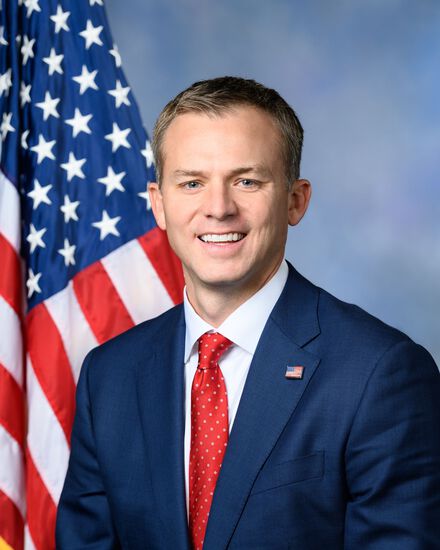
Photo of Blake D. Moore
R United States House · District 1 · Utah On the 2026 ballot

Rep. Blake D. Moore

Compare
Total votes
2,837
all sessions
Attendance
99%
30 missed
Higher than 89% of chamber peers
With party
93%
of cast votes
Near the chamber average
Bipartisan score
4%
crosses aisle rarely
Near the chamber average
Sponsored
725
bills & resolutions
Near the chamber average
Committees
5
assignments
725 bills and resolutions

Sponsored bills

Total
725
Primary
95
Co-sponsor
630
This page
725
matching current filters
Co-sponsor HR 991
In committee · United States House · Co-sponsor
Cost Estimates Improvement Act

Maddy summaryHR 991, the Cost Estimates Improvement Act, requires the Congressional Budget Office (CBO) and Joint Committee on Taxation (JCT) to include debt servicing costs (interest payments on the national debt) in their budget estimates "to the extent practicable." This change directly affects how Congress evaluates the fiscal impact of proposed legislation, as these estimates determine whether bills qualify for budget reconciliation and influence funding decisions. The key mechanism amends the 1974 Congressional Budget Act to mandate this inclusion within existing cost estimation processes. The bill does not alter spending or tax policy but aims to make budget scoring more comprehensive by accounting for ongoing interest costs.

In committee Feb 5, 2025 1 co-sponsor
Co-sponsor HR 987
In committee · United States House · Co-sponsor
Fair Access to Banking Act

Fair Access to Banking Act This bill places restrictions on certain banks, credit unions, and payment card networks if they refuse to do business with a person who complies with the law. Restrictions include prohibiting the use of electronic funds transfer systems and lending programs, termination of an institution's depository insurance, and specified civil penalties. Banks and other specified financial institutions are allowed to deny financial services to a person only if the denial is justified by a documented failure of that person to meet quantitative, impartial, risk-based standards established in advance by the institution. This justification may not be based upon reputational risks to the institution. The bill establishes the right for a person to bring a civil action for a violation of this bill.

In committee Feb 5, 2025 1 co-sponsor
Co-sponsor HR 1024
In committee · United States House · Co-sponsor
US-Kazakhstan Trade Modernization Act

Maddy summaryHR 1024, the US-Kazakhstan Trade Modernization Act, terminates the application of Title IV of the Trade Act of 1974 to Kazakhstan. This means the U.S. will no longer apply special trade restrictions tied to Kazakhstan's emigration policies, as Kazakhstan has been found compliant since 1997. The bill allows the President to determine that Title IV no longer applies and extend normal trade relations (NTR) treatment to Kazakhstan's products. As a result, Kazakhstan's exports to the U.S. will be subject to standard U.S. trade rules rather than the specific Title IV provisions.

In committee Feb 5, 2025 1 co-sponsor
Co-sponsor HRES 106
In committee · United States House · Co-sponsor
Expressing the sense of the House of Representatives that the United Nations Security Council should immediately impose an arms embargo against the military of Burma.

Maddy summaryHRES 106 is a non-binding resolution calling on the United Nations Security Council to immediately impose an arms embargo on Burma’s military (the Tatmadaw). It directly targets the military junta responsible for the 2021 coup, ongoing human rights abuses, and violence against civilians, including ethnic minorities like the Rohingya. The resolution specifies that lifting the embargo would require the military to end violence, release detained leaders, allow humanitarian access, restore internet, and transition power to a civilian government. It also urges the international community to support affected civilians and promote peace dialogues. This resolution expresses congressional support for UN action but does not create new U.S. policy.

In committee Feb 4, 2025 1 co-sponsor
Co-sponsor HR 925
In committee · United States House · Co-sponsor
Dismantle DEI Act of 2025

Maddy summaryHR 925, the "Dismantle DEI Act of 2025," would eliminate diversity, equity, and inclusion (DEI) programs across federal government operations. The bill requires federal agencies to close DEI offices, rescind related executive orders, and prohibit the use of federal funds for DEI training, offices, or initiatives. It defines "prohibited diversity, equity, or inclusion practice" as any activity that discriminates based on race, ethnicity, religion, biological sex, or national origin, or requires employees to complete training asserting that certain groups are inherently superior or inferior. The legislation also prohibits requiring employees to sign statements about race, ethnicity, or gender, and establishes private lawsuits for violations with potential damages of $1,000 per violation per day. This bill would directly affect federal agencies, contractors, grantees, and advisory committees receiving federal funding.

In committee Feb 4, 2025 1 co-sponsor
Primary HR 955
In committee · United States House · Lead sponsor
HOPE Act of 2025

Maddy summaryThe HOPE Act of 2025 creates tax-advantaged "HOPE Accounts" for individuals to pay qualified medical expenses. These accounts allow tax-free savings with annual contribution limits of $4,000 for self-only coverage or $8,000 for family coverage, and employers can contribute up to 50% of these limits. Distributions for qualified medical expenses are tax-free, but amounts used for non-medical purposes are taxed at ordinary rates plus a 30% penalty. The bill would take effect for taxable years beginning after December 31, 2025, and applies to individuals with minimum essential health coverage who don't participate in other similar accounts like HSAs or FSAs.

In committee Feb 4, 2025 0 co-sponsors
Co-sponsor HR 960
In committee · United States House · Co-sponsor
Protect Our Clothes from PFAS Act

Maddy summaryThis bill is procedural and modifies a tariff classification note. It amends U.S. Note 2 to Chapter 62 of the Harmonized Tariff Schedule by removing the second sentence regarding water-resistant garment requirements. The bill does not create new regulations or directly affect consumers, manufacturers, or PFAS chemicals. Its sole purpose is to adjust the wording in the tariff schedule for administrative clarity. (1 sentence as it is procedural)

In committee Feb 4, 2025 1 co-sponsor
Co-sponsor HR 833
In committee · United States House · Co-sponsor
Educational Choice for Children Act of 2025

Maddy summaryHR 833 creates a federal tax credit for individuals and corporations that contribute to scholarship granting organizations (SGOs) providing scholarships for elementary and secondary education. The credit allows taxpayers to deduct up to 10% of their adjusted gross income or $5,000 (whichever is less) for contributions to SGOs serving students from households with income up to 300% of the area median income. The bill establishes a $10 billion annual cap on the tax credit program, requires SGOs to verify student eligibility and maintain separate accounts, and prohibits government control over SGOs or private schools. It ensures scholarships can be used at public, private, or religious schools without discrimination based on religious character. The tax credit would be available for contributions made after December 31, 2025, with annual volume cap increases based on usage.

In committee Jan 31, 2025 1 co-sponsor
Co-sponsor HCONRES 4
In committee · United States House · Co-sponsor
Expressing the sense of Congress that tax-exempt fraternal benefit societies have historically provided and continue to provide critical benefits to the people and communities of the United States.

Maddy summaryHCONRES 4 is a symbolic resolution expressing Congress's support for tax-exempt fraternal benefit societies (like mutual aid organizations). It recognizes these groups, which have over 7 million members nationwide, as historically and currently providing critical community benefits - including life/health insurance, charitable work, and volunteer services - valued at over $3.8 billion annually. The resolution affirms that their tax-exempt status under Section 501(c)(8) of the Internal Revenue Code remains beneficial and should continue to be promoted. This is a non-binding expression of congressional sentiment, not a policy change.

In committee Jan 28, 2025 1 co-sponsor
Co-sponsor HR 783
In committee · United States House · Co-sponsor
Sustainable Cardiopulmonary Rehabilitation Services in the Home Act

Sustainable Cardiopulmonary Rehabilitation Services in the Home Act This bill permanently allows services relating to cardiac rehabilitation programs, intensive cardiac rehabilitation programs, and pulmonary rehabilitation programs to be furnished via telehealth at a beneficiary's home under Medicare.

In committee Jan 28, 2025 1 co-sponsor
Showing 251 to 260 of 725 bills
Previous 1 … 25 26 27 … 73 Next