

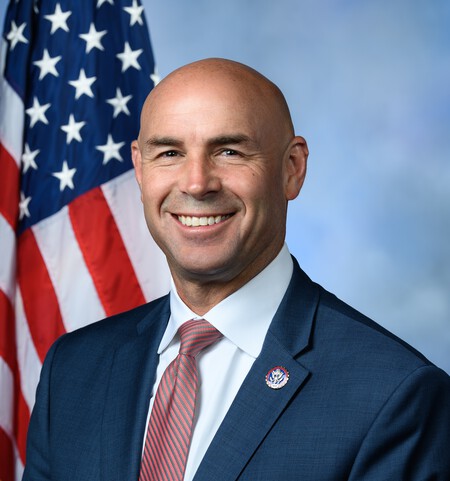
Governing Unaccredited Representatives Defrauding VA Benefits Act or the GUARD VA Benefits Act This bill imposes criminal penalties and/or fines on individuals for directly or indirectly soliciting, contracting for, charging, or receiving any unauthorized fee or compensation with respect to the preparation, presentation, or prosecution of any claim for Department of Veterans Affairs benefits. The attempted commission of such offenses is also punishable by fine or imprisonment.
Rep. Jake Ellzey
Sponsored bills
Maddy summaryHR 8563, the Sunset Act of 2022, requires most federal agency rules to automatically expire 10 years after issuance unless Congress passes a specific extension. Agencies must submit reports to Congress 180 days before expiration and identify rules for annual review, with 10% of rules reviewed each year for 9 years. Congress can extend rules only through a joint resolution introduced within 3 days of receiving the agency report, requiring bipartisan leadership sponsorship. This law directly affects federal agencies (who create rules) and Congress (who must vote on extensions), changing how long regulations remain in effect without renewal.
Protecting an Alien child's Reasonable Expectation of No Trafficking Act of 2022 or the PARENT Act of 2022 This bill requires U.S. Customs and Border Protection to transfer custody of an unaccompanied alien child only to the Department of Health and Human Services or the child's parent or legal guardian.
Flores Settlement Update and Establishment Act of 2022 This bill modifies and provides statutory authority for certain policies pertaining to the treatment of minors without lawful immigration status under the Flores settlement and revises certain human trafficking laws. For example, the bill requires each member of a family unit seeking asylum to take a DNA test to verify familial relationships within 72 hours of the family encountering U.S. Customs and Border Protection.
Closing Loopholes and Ending Asylum Abuse Act of 2022 This bill imposes restrictions on noncitizens ( aliens under federal law) applying for asylum, authorizes asylum seekers to apply for asylum abroad, and requires applicants to apply abroad in certain instances. For example, the bill requires a refugee's persecution or well-founded fear of persecution to stem from a government (or affiliated entity), whereas currently the persecution does not have to stem from a government. The bill also requires an applicant who passes through another country with a U.S. diplomatic mission that processes asylum claims to apply for asylum while physically in that country.
Lone Star Reimbursement Act This bill requires the Department of Defense to provide approximately $1.43 billion to the state of Texas as reimbursement for the costs of Operation Lone Star incurred in FY2021 and FY2022. (Operation Lone Star is a border security operation initiated and carried out by the state of Texas.)
Biometric Verification for Entry and Reconfirming Identity with Forensics Act of 2022 or the B-VERIFY Act of 2022 This bill addresses various issues pertaining to immigration, such as (1) requiring any applicant for an immigration benefit, including a U.S. national applying for a noncitizen beneficiary, to provide biometric information, including DNA; (2) permanently barring a noncitizen from becoming a U.S. citizen if the noncitizen is the parent of an unaccompanied alien child who arrives at the U.S. border; and (3) prohibiting the Department of Health and Human Services from expending government funds to provide counsel to detained unaccompanied alien children in legal proceedings.
Border Safety and Security Act of 2022 This bill requires the Department of Homeland Security (DHS) to suspend the entry of any non-U.S. nationals ( aliens under federal law) without valid entry documents during any period when DHS cannot detain such an individual or return the individual to a foreign country contiguous to the United States. A state may sue DHS to enforce this requirement. (Under current law, non-U.S. nationals who arrive at the border without entry documents are generally subject to expedited removal. However, if such an individual is found to have a credible fear of persecution, they are typically subject to detention while their asylum claim is being considered.) The bill also authorizes DHS to suspend the entry of non-U.S. nationals without entry documents at the border if DHS determines that such a suspension is necessary to achieve operational control over such a border.
Unborn Protection Act This bill creates new federal crimes related to the performance of an abortion on an unborn child based on the results of a laboratory developed prenatal test. The term laboratory developed prenatal test means a type of in vitro diagnostic test that is designed, developed, manufactured, validated, or performed within a single laboratory and is not cleared or approved by the Food and Drug Administration It subjects a violator to criminal penalties—a fine, a prison term of up to five years, or both. It also authorizes civil remedies, including damages and injunctive relief. A woman who undergoes such an abortion may not be prosecuted or held civilly liable.
Protecting Innocence in Education Act This bill prohibits federally mandated sex education in elementary schools. Specifically, the bill prohibits the Department of Education (ED) from (1) requiring states, local educational agencies, or elementary schools to implement federal policies relating to sex education in elementary schools; or (2) punishing these entities (e.g., withholding federal funds or levying fines) for failing to implement or carry out these federal policies. Additionally, the bill prohibits the Task Force on Sexual Violence in Education from (1) developing recommendations for these entities with respect to sex education in elementary schools; or (2) assessing ED's ability to levy intermediate fines for noncompliance with Title IX of the Education Amendments of 1972, which prohibits discrimination on the basis of sex in federally funded education programs or activities.