

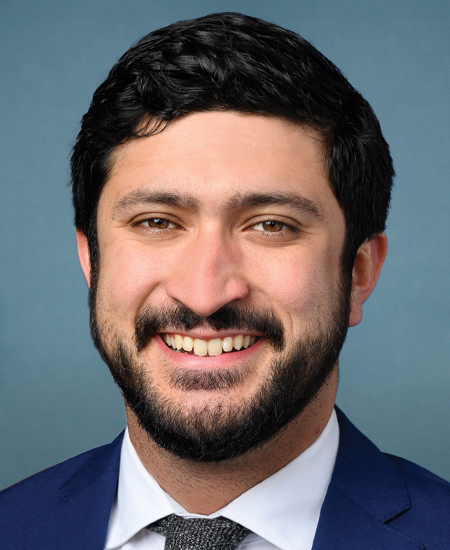
Photo of Greg Casar
D United States House · District 35 · Texas On the 2026 ballot

Rep. Greg Casar

Compare
Total votes
1,879
all sessions
Attendance
94%
118 missed
Lower than 96% of chamber peers
With party
94%
of cast votes
Near the chamber average
Bipartisan score
3%
crosses aisle rarely
Near the chamber average
Sponsored
740
bills & resolutions
Near the chamber average
Committees
7
assignments
740 bills and resolutions

Sponsored bills

Total
740
Primary
17
Co-sponsor
723
This page
740
matching current filters
Co-sponsor HR 6244
Signed into law · United States House · Co-sponsor
To designate the facility of the United States Postal Service located at 1535 East Los Ebanos Boulevard in Brownsville, Texas, as the "1st Lieutenant Andres Zermeno Post Office Building".

Maddy summaryThis bill (HR 6244) designates the U.S. Postal Service facility at 1535 East Los Ebanos Boulevard in Brownsville, Texas, as the "1st Lieutenant Andres Zermeno Post Office Building." It updates all federal references to the building to reflect this new name. The bill has no policy provisions or funding changes - it solely honors 1st Lieutenant Andres Zermeno through a commemorative name designation. The building will now be officially referred to by this name in all government documents and records.

Signed into law Jan 2, 2025 1 co-sponsor
Co-sponsor HR 1097
Signed into law · United States House · Co-sponsor
Everett Alvarez, Jr. Congressional Gold Medal Act of 2023

Maddy summaryThis bill, HR 1097 (Everett Alvarez, Jr. Congressional Gold Medal Act of 2023), authorizes the award of a Congressional Gold Medal to Everett Alvarez, Jr., in recognition of his service as a U.S. Navy pilot and Vietnam War prisoner of war. It directly honors Alvarez, who was the first U.S. pilot shot down in the Vietnam War, spent over 8.5 years in captivity, and later served in the Peace Corps and Veterans Administration. The bill’s key mechanism is directing the U.S. Mint to strike a gold medal bearing his name and image, with bronze duplicates available for sale to cover costs. It does not create new policies or affect any group beyond the honoree.

Signed into law Dec 23, 2024 1 co-sponsor
Co-sponsor HR 9156
In committee · United States House · Co-sponsor
Health Over Wealth Act

Maddy summaryThe Health Over Wealth Act requires private equity firms that own or control health care entities (including hospitals, clinics, nursing facilities, and mental health providers) to submit detailed annual reports to the government about their financial structure, staffing practices, political spending, and patient care metrics. It establishes a task force to monitor private equity's impact on health care access and quality, and creates new requirements for hospitals planning to close or discontinue services, including advance notice and mitigation plans. The bill also prohibits certain real estate transactions that could weaken health care entities and mandates licensing for private equity firms investing in health care, with penalties for non-compliance.

In committee Dec 17, 2024 1 co-sponsor
Co-sponsor HR 8796
In committee · United States House · Co-sponsor
Stop Comstock Act.

Maddy summaryHR 8796, the "Stop Comstock Act," removes outdated restrictions from federal law that previously banned the distribution of materials related to contraception and abortion as "obscene" or "indecent." The bill amends Title 18 and the Tariff Act by deleting references to "indecent," "immoral," "unlawful abortion," and "procuring abortion" from provisions governing obscene materials. It clarifies that the law only prohibits "obscene materials" in commerce, eliminating broad restrictions on reproductive health information. This directly affects internet platforms, healthcare providers, and individuals sharing reproductive health resources by removing legal barriers to their distribution.

In committee Dec 17, 2024 1 co-sponsor
Co-sponsor HR 8554
In committee · United States House · Co-sponsor
End Polluter Welfare Act of 2024

Maddy summaryThe End Polluter Welfare Act of 2024 eliminates numerous subsidies and tax benefits for fossil fuel companies by repealing provisions that provide royalty relief, reducing royalty rates, and ending tax incentives for oil, natural gas, and coal production. The bill prohibits federal funding for fossil fuel projects by restricting international financial institutions, the Export-Import Bank, and the Department of Transportation from supporting fossil fuel infrastructure. It also repeals recent legislation that provided fossil fuel subsidies, including parts of the Fiscal Responsibility Act and Inflation Reduction Act. This comprehensive approach directly affects oil, gas, and coal producers by removing financial benefits that have historically supported the fossil fuel industry, while directing studies to identify and eliminate additional fossil fuel subsidies.

In committee Dec 17, 2024 1 co-sponsor
Co-sponsor HR 7325
In committee · United States House · Co-sponsor
Community Housing Act of 2024

Maddy summaryThe Community Housing Act of 2024 significantly increases federal investment in affordable housing through major funding boosts, including $44.5 billion for the Housing Trust Fund and $1.5 billion for the Capital Magnet Fund over the next decade. It repeals the Faircloth amendment, which had limited public housing construction since 1992, allowing public housing authorities to build new units without the previous cap. The bill establishes a permanent emergency rental assistance program providing $3 billion annually through 2029 to help low-income households with rent payments and creates the Unlocking Possibilities program to fund local efforts to streamline housing regulations and reduce zoning barriers. These provisions directly affect low- and moderate-income households, community land trusts, and rural communities facing housing insecurity and affordability challenges.

In committee Dec 17, 2024 1 co-sponsor
Co-sponsor HR 6063
In committee · United States House · Co-sponsor
Empowering Striking Workers Act of 2023

Maddy summaryHR 6063, the Empowering Striking Workers Act of 2023, modifies unemployment insurance rules to provide benefits for workers unable to work due to strikes or lockouts. It directs that unemployment compensation begins 14 days after a strike starts, or earlier if permanent replacements are hired, a lockout begins, or the dispute ends. The bill directly affects workers participating in labor disputes by making them eligible for benefits under these specific conditions, rather than requiring them to meet standard job search requirements. This change is implemented through amendments to the Internal Revenue Code and Social Security Act.

In committee Dec 17, 2024 1 co-sponsor
Co-sponsor HR 5760
In committee · United States House · Co-sponsor
Climate Resilience Workforce Act

Maddy summaryThe Climate Resilience Workforce Act establishes a coordinated federal system to build a workforce for climate resilience, directly affecting workers in climate-related sectors and prioritizing frontline communities (low-income, communities of color, Tribal communities) and populations facing employment barriers (undocumented individuals, formerly incarcerated people). Key mechanisms include grant programs for state and local climate resilience planning, job creation grants requiring 40% of jobs to go to frontline communities and populations facing barriers, and minimum labor standards including $15/hour wages (increasing annually), employer-paid health insurance, and protections against discrimination. The bill creates an Office of Climate Resilience, a Climate Resilience Equity Advisory Board, and a Center for the Climate Resilience Workforce to define climate resilience sectors and ensure equitable hiring practices. It also removes employment barriers through immigration status protections, criminal record reforms, and drug testing policy changes for climate resilience workers.

In committee Dec 17, 2024 1 co-sponsor
Co-sponsor HR 5601
In committee · United States House · Co-sponsor
MORE Act

Maddy summaryThe MORE Act (HR 5601) would federally decriminalize cannabis by removing it from the Schedule I list of controlled substances under the Controlled Substances Act. It requires federal courts to expunge non-violent cannabis convictions and associated arrests, with a focus on addressing racial disparities in cannabis enforcement. The bill creates an Opportunity Trust Fund that would allocate 50% of funds to criminal justice programs, 20% to small business assistance for minority cannabis entrepreneurs, and 20% to community reinvestment grants for individuals impacted by the War on Drugs. It also prohibits federal agencies from denying benefits or security clearances based on cannabis use or past cannabis convictions, and establishes a Cannabis Justice Office to administer these programs.

In committee Dec 17, 2024 1 co-sponsor
Co-sponsor HR 5159
In committee · United States House · Co-sponsor
Preserving Access to Home Health Act of 2023

Maddy summaryThe Preserving Access to Home Health Act of 2023 repeals a 2018 payment adjustment for Medicare home health agencies, restoring prior payment rates for 2024 and subsequent years. It requires the Medicare Payment Advisory Commission (MedPAC) to analyze how home health agencies' financial performance affects access to care, including reviewing spending and utilization data across Medicare, Medicaid, and other payers. Starting in 2025, the bill mandates home health agencies to report detailed data on visit volumes and payments by payer source (Medicare, Medicaid, private insurers) through updated cost reports. This data will help MedPAC assess payment policy impacts on access to home health services for Medicare beneficiaries.

In committee Dec 17, 2024 1 co-sponsor
Showing 351 to 360 of 740 bills
Previous 1 … 35 36 37 … 74 Next