FAIR Leave Act or the Fair Access for Individuals to Receive Leave Act This bill repeals the limit on the aggregate number of workweeks of family and medical leave that spouses employed by the same employer may be entitled to during any 12-month period. The current limit is 12 aggregate workweeks.
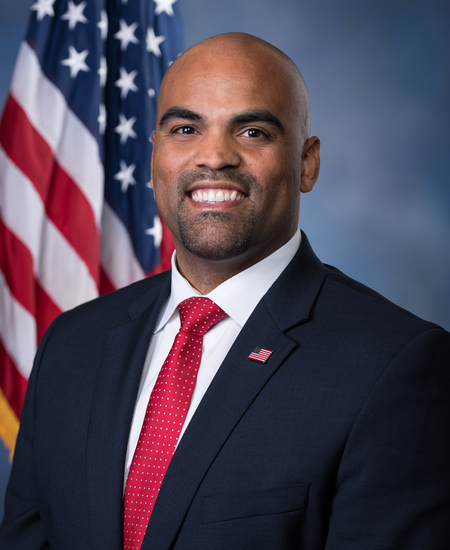
Rep. Colin Z. Allred
Sponsored bills
Paycheck Fairness Act This bill addresses wage discrimination on the basis of sex, which is defined to include pregnancy, sexual orientation, gender identity, and sex characteristics. Specifically, it limits an employer's defense that a pay differential is based on a factor other than sex to only bona fide job-related factors in wage discrimination claims, enhances nonretaliation prohibitions, and makes it unlawful to require an employee to sign a contract or waiver prohibiting the employee from disclosing information about the employee's wages. The bill also increases civil penalties for violations of equal pay provisions. Additionally, the Equal Employment Opportunity Commission (EEOC) and the Office of Federal Contract Compliance Programs must train EEOC employees and other affected parties on wage discrimination. The bill directs the Department of Labor to (1) establish and carry out a grant program to provide training in negotiation skills related to compensation and equitable working conditions, (2) conduct studies to eliminate pay disparities between men and women, and (3) make available information on wage discrimination to assist the public in understanding and addressing such discrimination. The bill establishes the National Award for Pay Equity in the Workplace for an employer who has made a substantial effort to eliminate pay disparities between men and women. It also establishes the National Equal Pay Enforcement Task Force to address compliance, public education, and enforcement of equal pay laws. Finally, the bill requires the EEOC to issue regulations for collecting from employers compensation and other employment data according to the sex, race, and national origin of employees for use in enforcing laws prohibiting pay discrimination.
Hamas International Financing Prevention Act This bill imposes sanctions targeting Hamas, the Palestinian Islamic Jihad, and any affiliate or successor groups. The President shall periodically report to Congress a list of each foreign person or instrumentality that knowingly assists, provides significant support or services to, or is involved in a significant transaction with a senior member or supporter of any of the targeted groups. The President shall impose two or more sanctions on the named persons. Specifically, the person may be (1) denied credit and services from the Export-Import Bank, (2) barred from purchasing certain controlled defense articles, (3) denied exports of items on the U.S. Munitions List, (4) prevented from receiving exports of certain goods or technology controlled for national security reasons, (5) prohibited from receiving financing of more than $10 million from any U.S. financial institution, or (6) subject to property-blocking restrictions. The President shall periodically report to Congress a list of foreign governments that have repeatedly provided material support for the targeted groups' terrorist activities. The President shall bar these governments from receiving for one year (1) U.S. assistance, or (2) exports of controlled munitions. The Department of Treasury shall instruct U.S. leadership of international financial institutions to oppose the provision of assistance to an identified government for one year. The bill provides for certain exceptions and waivers, such as for transactions that would serve U.S. national interests. The President shall report to Congress and periodically provide briefings on other specified topics related to the targeted groups, such as where these groups secure financing and surveillance equipment.
Revitalizing American Priorities for Infrastructure Development Act or the RAPID Act This bill revises the transportation infrastructure finance and innovation (TIFIA) program to (1) require program applicants to obtain investment grade ratings from at least two credit rating agencies, unless the federal credit instrument is less than $150 million (currently, less than $75 million), in which case one rating will suffice; (2) require the Department of Transportation (DOT) to implement an expedited decision time line for public agency borrowers seeking secured loans; and (3) require DOT to publish status reports on program applications on the TIFIA website.
Army Security Agency Monument Act This bill directs the Department of the Army to place in Arlington National Cemetery a monument honoring Army Security Agency veterans if the National Army Security Agency Association agrees to certain requirements, including that the association pay the monument's site preparation, construction, and maintenance costs.
United States Army Rangers Veterans of World War II Congressional Gold Medal Act This bill provides for the award of a single Congressional Gold Medal to the U.S. Army Rangers Veterans of World War II in recognition of their dedicated service during World War II.
Veteran Education Empowerment Act This bill reauthorizes through FY2029 and otherwise revises a Department of Education (ED) grant program for student veteran centers. Specifically, ED must make grants to institutions of higher education (IHEs) or consortia of IHEs to establish, maintain, improve, or operate a student veteran center. A student veteran center is a dedicated space on a campus that provides students who are veterans or members of the Armed Forces with (1) a lounge or meeting space for themselves, their spouses or partners, their children, and veterans in the community; and (2) a centralized office for student veteran services that serves as a single point of contact to coordinate comprehensive support services for student veterans.
John Lewis Every Child Deserves a Family Act This bill prohibits discrimination on the basis of sexual orientation, gender identity, marital status, or religion in the provision of child welfare programs and services by entities receiving federal funding. The Department of Health and Human Services (HHS) must provide technical assistance to help states follow this requirement, including (1) guidance for bringing state laws into compliance, (2) developing training to increase cultural competency related to social identity, and (3) training for judges and attorneys involved in child welfare cases, among other supports. Additionally, HHS must establish the National Resource Center on Safety, Well-Being, Placement Stability, and Permanency for LGBTQ Children and Youth Involved with Child Welfare Services to provide training, technical assistance, and guidance to applicable state and local agencies and service providers. Further, the Religious Freedom Restoration Act may not be the basis for challenging the application or enforcement of this bill. The Government Accountability Office must study and report on states' compliance with the requirements of the bill no later than three years after enactment.

Increasing Access to Osteoporosis Testing for Medicare Beneficiaries Act of 2021 This bill specifies that certain Medicare payment rules applicable to imaging services shall apply to dual-energy x-ray absorptiometry services used in bone mass scans beginning in 2022. The Centers for Medicare & Medicaid Services must establish national minimum payment amounts for such services.
Documenting Adversarial Trade Aggression Act or the DATA Act This bill requires the Department of Commerce to establish a China Economic Data Coordination Center within the Bureau of Economic Analysis. The center must collect, synthesize, and report on specified Chinese economic data regarding developments in China's financial markets and U.S. exposure to risks and vulnerabilities in China's financial system.