

Maddy summaryH.J.Res. 14 proposes amending the U.S. Code to require the President to issue an annual proclamation designating a day as "Democracy Day." The proclamation would call on state and local governments, educational institutions, and the public to observe the day with programs and activities promoting democratic values. It does not fix a specific date (though the preamble references January 6 as a potential day), leaving the annual designation to the President's discretion. The bill directly affects the President and state/local authorities by establishing a formal mechanism for nationwide civic observance of democracy.
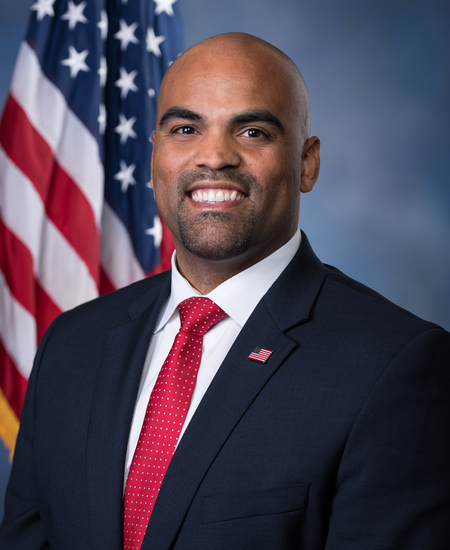
Rep. Colin Z. Allred
Sponsored bills
This joint resolution proposes a constitutional amendment authorizing Congress and the states to (1) regulate and impose reasonable viewpoint-neutral limitations on the raising and spending of money by candidates and others to influence elections; and (2) regulate and enact public campaign financing systems, including those designed to restrict the influence of private wealth by offsetting the raising and spending of money by candidates and others with increased public funding. The amendment grants Congress and the states the power to implement and enforce this amendment by legislation. They are allowed to distinguish between natural persons and corporations or other artificial entities created by law, including by prohibiting such entities from spending money to influence elections.
Maddy summaryHR 51, the Washington, D.C. Admission Act, would admit Washington, D.C. as the 51st state, named "Washington, Douglass Commonwealth," granting its residents full representation in Congress with two Senators and one Representative. The bill establishes procedures for admission, including elections for state officials, with the state initially having one Representative until the next congressional apportionment. It would create a "Capital" area (including the White House, Capitol, and other key federal buildings) that remains under federal jurisdiction as the seat of the U.S. government, while the rest of the District becomes the new state. The bill also includes provisions to ensure continuity of federal services, property management, and legal procedures during the transition to statehood.
Maddy summaryThis bill amends the federal tax code to create a "safe harbor" for certain Texas school trust funds. It specifies that these state-created funds - which hold nonfinancial assets (like land or buildings) and are used solely to support public schools or essential government functions - will not be classified as "investment property" under tax law. The provision applies to funds already meeting strict criteria as of 1986, ensuring their tax-exempt status remains intact. It directly affects existing Texas perpetual trust funds that support public elementary and secondary schools. The bill does not address new construction costs or funding mechanisms, but rather clarifies the tax treatment of pre-existing school funding structures.
Cover Outstanding Vulnerable Expansion-eligible Residents Now Act or the COVER Now Act This bill establishes a demonstration program to allow local governments to provide health benefits to the Medicaid expansion population in states that have not expanded Medicaid. Under the program, local governments may provide coverage for individuals who are newly eligible for Medicaid under the Patient Protection and Affordable Care Act (i.e., the Medicaid expansion population) for a maximum of 10 years, or until their respective states expand Medicaid. The bill provides a 100% federal matching rate for the first three years of program participation. The bill prohibits states from taking certain actions against participating localities, such as withholding funding, increasing taxes, or restricting provider participation. States that violate these requirements are subject to certain funding penalties.
Hazard Eligibility and Local Projects Act This act makes an entity seeking assistance under a hazard mitigation assistance program eligible to receive such assistance for certain projects already in progress. Specifically, this act covers a project that is an acquisition and demolition project for which an entity began implementation, including planning or construction, before or after requesting assistance for the project under a hazard mitigation assistance program; and qualifies for a categorical exclusion under the National Environmental Policy Act of 1969. The Federal Emergency Management Agency (FEMA) must have determined that the project qualifies for a categorical exclusion, is compliant with applicable floodplain management and protection of wetland regulations and criteria, and does not require consultation under any other environmental or historic preservation law or regulation or involve any extraordinary circumstances. FEMA must report to Congress, within 180 days of enactment and annually thereafter for three years, on use of the authority under this act. Such authority terminates three years after enactment.
This act designates the facility of the United States Postal Service located at 651 Business Interstate Highway 35 North Suite 420 in New Braunfels, Texas, as the Bob Krueger Post Office.
This act designates the facility of the United States Postal Service located at 4110 Bluebonnet Drive in Stafford, Texas, as the Leonard Scarcella Post Office Building.
This act designates the facility of the United States Postal Service located at 4020 Broadway Street in Houston, Texas, as the Benny C. Martinez Post Office Building.
This resolution condemns the actions of a White supremacist mob that drove Black residents out of Atlanta, Georgia in 1906 and supports the designation of a national day of remembrance for the victims of forced migrations of Black Americans.