

Maddy summaryThe ACCESS Act of 2024 creates a federal grant program to help clinics and health care providers expand abortion and reproductive health services in states where abortion is legal (outside of life or health exceptions). It authorizes $200 million annually for fiscal years 2024-2028 to fund specific capacity-building activities, including facility expansions, hiring clinical staff, telehealth services, and culturally appropriate patient resources. Priority is given to providers in states experiencing the highest increases in out-of-state patients seeking abortion care. The bill directly supports health care entities serving patients who travel across state lines for services, aiming to reduce wait times and improve access for vulnerable communities.
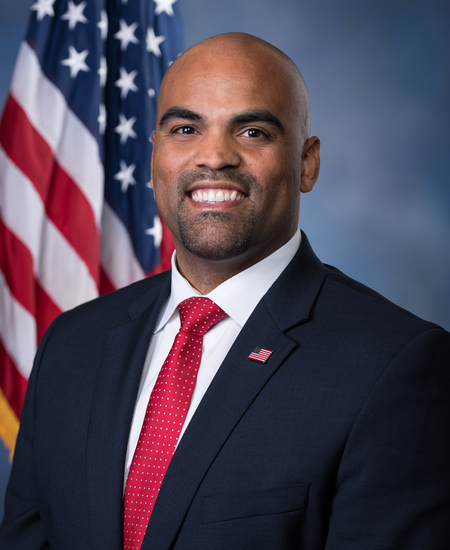
Rep. Colin Z. Allred
Sponsored bills
Maddy summaryThe Servicemember Apprenticeship Act (HR 7098) directs the Secretary of Defense to study private companies offering registered apprenticeships to military members eligible for the Skillbridge program (Section 1143(e) of Title 10). It requires the Department of Defense to consult with the Department of Labor to create agreements with companies in areas where few apprenticeship opportunities exist for these members. The bill aims to expand access to registered apprenticeship programs by identifying participating entities and facilitating partnerships. This directly affects transitioning service members seeking civilian career training through Skillbridge.
Maddy summaryHR 7097, the College Opportunities for Servicemembers Act, expands educational opportunities for active-duty service members transitioning to civilian careers and veterans. The bill directs the Secretary of Defense to increase agreements with colleges and universities to provide job training and internships through the Skillbridge program, and to support creating dedicated centers at these institutions for military members and veterans seeking job skills. It specifically targets members eligible for Skillbridge under existing law and veterans, using existing higher education institutions defined by the Higher Education Act of 1965. The key mechanism involves federal outreach to colleges to formalize more training partnerships and establish on-campus support centers. This policy directly connects military service members and veterans to civilian career pathways through existing educational infrastructure.
Maddy summaryThe HOME Investment Partnerships Reauthorization and Improvement Act of 2024 reauthorizes and updates the HOME Investment Partnerships Program, which provides federal funds to states and local governments to develop affordable housing. The bill increases annual funding from $5 billion in 2024 to $6.08 billion in 2028, modifies eligibility requirements for participating jurisdictions, and eliminates a deadline for committing funds. It reforms homeownership resale restrictions, establishes a home loan guarantee program with $2 billion in initial funding (increasing with inflation), and enhances protections for tenants in small-scale affordable housing (defined as housing with no more than 4 rental units). These changes aim to make the program more flexible and effective in creating and preserving affordable housing options for low- and moderate-income households.
Maddy summaryHR 7056, the Access to Family Building Act, establishes federal rights for individuals to access assisted reproductive technology (ART) like IVF without unreasonable restrictions, directly affecting patients seeking fertility treatments and health care providers offering ART services. The bill prohibits states from imposing limitations on ART that are more burdensome than those for comparable medical procedures, fail to advance safety, or unduly restrict access, while allowing health and safety regulations that are necessary and least restrictive. It creates federal enforcement mechanisms, including lawsuits by the Attorney General or affected individuals to challenge violating state laws, and preempts conflicting state regulations. The bill explicitly preserves state authority over health/safety regulations and does not alter existing state insurance coverage laws for ART.
Maddy summaryThe Nurse Faculty Shortage Reduction Act of 2024 creates a new federal grant program to address nursing faculty shortages. It authorizes $28.5 million annually (2024-2028) to help nursing schools supplement faculty salaries, covering the gap between clinical nurse pay and teaching salaries. Schools must submit detailed salary data and plans to sustain higher pay after the 3-year grant period. The program prioritizes schools in high-need areas, serving vulnerable populations, or recruiting underrepresented faculty, with a report required to Congress after 3 years.
Maddy summaryHRES 882 is a non-binding resolution passed by the U.S. House of Representatives on November 21, 2023, declaring support and gratitude to food banks, food pantries, and community-based organizations addressing food insecurity. It recognizes these groups' work in serving over 5 billion meals annually, rescuing wasted food (nearly 118 billion pounds yearly), and supporting vulnerable populations including 44.2 million people in food-insecure households in 2022. The resolution specifically acknowledges their role in providing emergency aid, nutrition education, and disaster response, while highlighting that 55% of food-insecure households did not access federal nutrition programs. It does not create new policies or funding but formally commends these organizations' contributions to reducing food insecurity and improving community health.
Maddy summaryHRES 962 is a ceremonial resolution honoring Reverend Dr. Martin Luther King, Jr.'s legacy, specifically celebrating his 95th birthday on January 15, 2024. It symbolically affirms his teachings by condemning hate, discrimination, and prejudice against Black Americans, Indigenous people, Jewish, Asian-American/Pacific Islander, Muslim, Hispanic/Latino communities, and LGBTQ+ individuals. The resolution does not create new laws or affect any policies - it solely expresses the House's support for Dr. King's values of diversity, tolerance, and equality through non-binding statements. As a symbolic gesture, it has no legal effect or direct impact on any group or individual.
Maddy summaryHRES 963 is a symbolic resolution honoring Korean American Day, which commemorates the January 13, 1903 arrival of the first large wave of Korean immigrants to the U.S. It recognizes Korean Americans' contributions to U.S. society, including their economic, cultural, and military impacts, and marks the 121st anniversary of this historic migration. The resolution urges all Americans to observe Korean American Day to appreciate these contributions. As a commemorative measure, it does not create new policies or affect specific groups beyond this ceremonial recognition.
Maddy summaryHRES 955 is a resolution commending Taiwan for its democratic election history and supporting Taiwan's democratic institutions. It recognizes Taiwan's transition to democracy since the late 1980s, including 7 presidential and 9 legislative elections held since then, all deemed free and fair. The resolution specifically expresses support for Taiwan's upcoming January 13, 2024, elections and condemns interference by the Chinese Communist Party. It affirms U.S. commitment to a strong partnership with Taiwan across multiple domains and supports Taiwan's self-defense and liberty. As a procedural resolution, it does not create new law but formally expresses congressional support for Taiwan's democratic development.