Support UNFPA Funding Act This bill authorizes annual contributions to support the core functions and programs of the United Nations Population Fund for the five fiscal years following the bill's enactment.
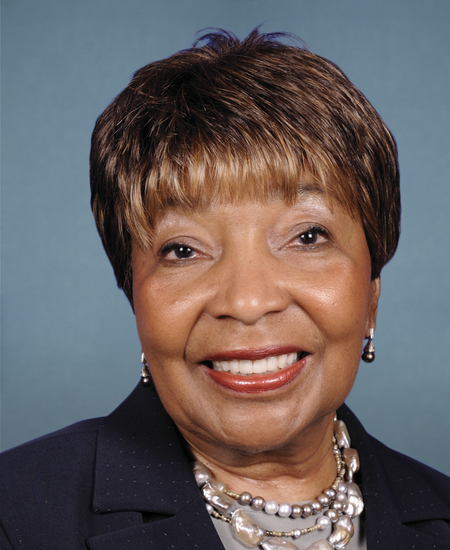
Rep. Eddie Bernice Johnson
Sponsored bills
Pell Grant Preservation and Expansion Act of 2021 This bill makes various changes to the Federal Pell Grant program, including by expanding student eligibility for Pell Grants. The bill also revises student eligibility for federal student-aid programs. Specifically, the bill provides funding to increase the maximum Pell Grant award for each eligible student. Further, the bill requires the award amount to be adjusted for inflation. Next, the bill allows students who receive means-tested federal benefits (e.g., Medicaid) to automatically qualify for the maximum Pell Grant award plus an additional award amount. In addition, the bill moves the Iraq and Afghanistan Service Grant program into the Pell Grant program. Next, the bill raises from 12 to 18 the total number of semesters during which a student may receive a Pell Grant. The bill makes Dreamer students (i.e., students who have been granted Deferred Action for Childhood Arrivals status) who entered the United States before the age of 18 and who meet certain educational criteria eligible for federal financial aid. The bill also revises satisfactory academic progress requirements for federal student-aid programs, including by allowing a student who has not been enrolled in an institution of higher education for two years to regain eligibility for federal student aid.

Sustainable Skies Act This bill allows a business-related tax credit through 2031 for each gallon of sustainable aviation fuel used by a taxpayer in the production of a qualified mixture (i.e., a mixture of sustainable aviation fuel and kerosene that is sold for use in certain U.S. aircraft). The bill generally defines sustainable aviation fuel as liquid fuel that consists of synthesized hydrocarbons, meets certain recognized international standards, is derived from biomass, waste streams, renewable energy sources, or gaseous carbon oxides, is not derived from palm fatty acid distillates, and achieves at least a 50% life cycle greenhouse gas emissions reduction in comparison with petroleum-based jet fuel. To be eligible for such credit, a taxpayer must meet certification requirements showing that the sustainable aviation fuel conforms with one of the life cycle greenhouse gas emissions reduction tests set forth in this bill.
Shark Fin Sales Elimination Act of 20 21 This bill addresses the sale of shark fins and the inclusion of rays and skates in the Seafood Traceability Program. The Seafood Traceability Program has data reporting and recordkeeping requirements at the time of entry for imported fish or fish products entered into U.S. commerce. The bill makes it illegal to possess, buy, or sell shark fins or any product containing shark fins, except for certain dogfish fins. A person may possess a shark fin that was lawfully taken consistent with a license or permit under certain circumstances. Penalties are imposed for violations under the Magnuson-Stevens Fishery Conservation and Management Act. The Department of Commerce must revise its regulations to include rays and skates as species that are subject to the Seafood Traceability Program.
This bill establishes the Alzheimer's Research and Caregiving Trust Fund to pay for research regarding the treatment or cure of Alzheimer's disease and for education, counseling, respite, and other supportive services for individuals with Alzheimer's disease and their families, caregivers, and health care professionals. The bill allows taxpayers an election to contribute a whole dollar amount to the trust fund when they file their tax returns.
This resolution expresses support for the goals and ideals of PCOS Awareness Month. Polycystic ovary syndrome (PCOS) is caused by a hormone imbalance. Symptoms can include infertility, weight gain, excess hair growth, and acne.
Innovations in Informal STEM Learning Act This bill requires the National Science Foundation to provide competitive grants to institutions of higher education or nonprofit organizations for research on programming that engages students in prekindergarten through 8th grade in the fields of science, technology, engineering, and mathematics (STEM) to prepare students for STEM degrees or careers.
Basic Assistance for Students In College Act or the BASIC Act This bill directs the Department of Education (ED) to award planning and implementation grants to institutions of higher education in order to identify and meet the basic needs of students, including food, housing, transportation, and health care. ED must also implement an agreement to (1) share data with other federal agencies in order to identify students who may be eligible for certain federal benefits; and (2) coordinate efforts to enroll those students in federal benefits programs, including Medicaid and the Supplemental Nutrition Assistance Program.
Fellowships and Traineeships for Early-Career AI Researchers Act This bill directs the National Science Foundation (NSF) to award grants and fellowships to support students and researchers in fields related to artificial intelligence. Specifically, the NSF must award grants to institutions of higher education to establish traineeship programs for graduate students who pursue artificial intelligence-related research leading to a masters or doctorate degree. Among other things, an institution of higher education shall use such grant funds to (1) provide traineeships to students who are pursuing research in artificial intelligence leading to a masters or doctorate degree; and (2) establish scientific internship programs for students receiving traineeships in artificial intelligence at for-profit institutions, nonprofit research institutions, or government laboratories. The NSF shall award fellowships to masters and doctoral students and postdoctoral researchers at institutions of higher education who are pursuing degrees or research in artificial intelligence and related fields, including in the field of technology ethics.
Strengthening MSI Competitiveness in Research and Innovation Act This bill directs the National Science Foundation (NSF) to establish a program to make competitive awards to eligible institutions to support the mission of the NSF and to build institutional research capacity at eligible institutions. To be eligible to receive an award, an institution shall be a historically Black college or university; a Tribal College or University; a minority-serving institution; or an institution of higher education with an established science, technology, engineering, and mathematics (STEM) capacity building program focused on traditionally underrepresented populations in STEM, including Native Hawaiians, Alaska Natives, and Indians. Each eligible institution shall have not more than $50 million in annual federally-financed research and development expenditures for science and engineering as reported through the National Science Foundation Higher Education Research and Development Survey.