

United States Call Center Worker and Consumer Protection Act of 2021 This bill establishes restrictions on businesses that relocate call centers or redirect customer service calls to locations outside the United States. Specifically, a business must notify the Department of Labor that it intends to move its customer service call center overseas and Labor must maintain a publicly available list of such businesses. Subject to narrow exceptions, a business appearing on such list is ineligible to receive federal grants or guaranteed loans for five years after the business is added to the list. Further, agencies must condition the awarding of government contracts on the requirement that any call center activity pursuant to the contract must be performed in the United States. Additionally, the bill requires call center employees to disclose their physical location at the beginning of each call initiated or received, unless all employees of the business participating in the communication are located in the United States, among other exceptions.
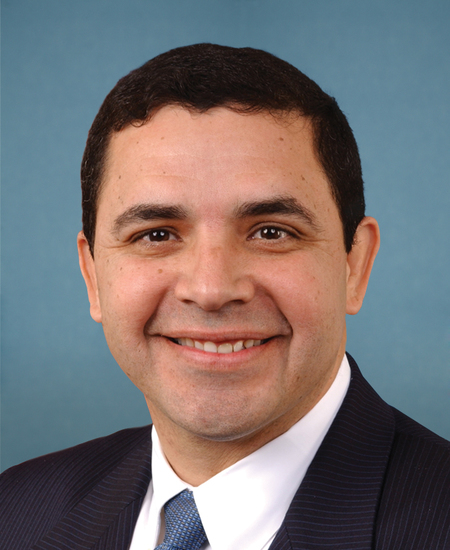
Rep. Henry Cuellar
Sponsored bills
National Infrastructure Development Bank Act of 2021 This bill establishes the National Infrastructure Development Bank as a government corporation to finance energy, environmental (e.g., drinking water or waste facilities), telecommunications, and transportation infrastructure projects. The bill establishes the National Infrastructure Development Bank Board, which must oversee the infrastructure projects. The board may make loans and loan guarantees to assist in financing infrastructure projects. Further, the board must establish an executive committee, a risk management committee, an audit committee, and a compliance office. To be eligible for financial assistance from the bank, an infrastructure project (1) must have a public benefit, as determined by the board; and (2) may not have a sole use or purpose that is private. An infrastructure project must use iron, steel, and manufactured products that are made in the United States. The bill also establishes accounting and reporting requirements. In particular, the Government Accountability Office must, within five years of this bill's enactment, submit a report to Congress evaluating the bank's activities.
Veterans Burn Pits Exposure Recognition Act of 2021 This bill requires the Department of Veterans Affairs (VA) to concede, for the purposes of health care benefits and wartime disability compensation, that a veteran was exposed to certain toxic substances, chemicals, and hazards from burn pits if such veteran served on active duty in a covered location during a specified time frame (unless there is affirmative evidence to establish that the veteran was not exposed during such service). A burn pit is an area used for burning solid waste in open air without equipment. Specifically, the bill covers the following locations and corresponding time periods: Iraq between August 2, 1990, and February 28, 1991, as well as from March 19, 2003, until burn pits are no longer used in this location; Somalia and Southwest Asia (including Kuwait, Saudi Arabia, Oman, and Qatar) from August 2, 1990, until burn pits are no longer used in these locations; and Afghanistan, Syria, Jordan, Egypt, Lebanon, Yemen, Uzbekistan, the Philippines, and Djibouti from September 11, 2001, until burn pits are no longer used in these locations. Under the bill, if an exposed veteran submits insufficient evidence to establish a service-connection for purposes of disability compensation, the VA shall provide a medical examination and request a medical opinion regarding a causal link between the disability and a toxin, chemical, or hazard.
Broadband for Rural America Act This bill modifies and consolidates Department of Agriculture (USDA) programs for expanding broadband internet in rural areas. Specifically, the bill modifies a program that provides grants, loans, and loan guarantees to support broadband expansion in rural areas. Modifications include revising the criteria used to prioritize applications and projects and changing the name of the program to the ReConnect Rural Broadband Program. Additionally, the bill terminates on June 30, 2022, a Department of Agriculture (USDA) COVID-19 response program that supports broadband expansion in rural areas for distance learning and telemedicine. Any remaining program funds available after the termination date shall be used for the ReConnect Rural Broadband Program. The bill also expands coordination requirements that apply to the Department of Commerce, USDA, the Federal Communications Commission (FCC), and the National Telecommunications and Information Administration. This includes requiring the use of specified FCC maps when assessing a community's access to broadband.
Medicare Dental, Vision, and Hearing Benefit Act of 2021 This bill provides for Medicare coverage of dental, vision, and hearing care. Coverage includes (1) routine dental cleanings and exams, basic and major dental services, emergency dental care, and dentures; (2) routine eye exams, eyeglasses, and contact lenses; and (3) routine hearing exams, hearing aids, and exams for hearing aids. With respect to such care, the bill establishes special payment rules, limitations, and coinsurance requirements.
Supply Chain Vulnerability Assessment Act of 2021 This bill requires the Office of the Director of National Intelligence and the Central Intelligence Agency to jointly report to Congress on vulnerabilities in supply chains that are critical to U.S. national security, economic security, or public health. The report shall also contain recommendations for addressing those vulnerabilities.
LPOE Modernization Trust Fund Act This bill establishes the Land Port of Entry Modernization Trust Fund and addresses other issues related to U.S. ports of entry. The bill transfers specified amounts, including a portion of certain collected customs fees, to the trust fund each year. It also requires the Department of Homeland Security (DHS) and the Department of State to collect certain surcharges related to immigration and land border inspections, with a portion of the surcharges to be deposited into the trust fund. DHS may not seek to increase fees to offset the amounts transferred into the trust fund. The amounts in the trust fund may be used without further appropriation to (1) construct new ports of entry, (2) expand and improve existing ports of entry, (3) procure technology for inspecting and processing traffic passing through ports of entry, and (4) hiring U.S. Customs and Border Protection staff. In order to use the trust fund, DHS must annually report to Congress certain information about the trust fund. DHS must also establish the Border Port of Entry Modernization Oversight Board to advise DHS on how to use the trust fund and to review the trust fund's expenditures.
Federal Retirement Fairness Act This bill modifies the federal civilian service that is creditable service under the Federal Employees Retirement System (FERS). Specifically, it expands the nondeduction service that may be creditable under FERS. Nondeduction service is federal service where an employee's pay is not subject to retirement deductions (e.g., service under a temporary appointment). Currently, nondeduction service performed before January 1, 1989, is creditable under FERS so long as a deposit is made into the retirement fund to cover the period of nondeduction service. This bill allows nondeduction service performed on or after January 1, 1989, to be creditable under FERS so long as a deposit is made into the retirement fund.
This resolution calls on the Russian government to immediately release Trevor Reed, a U.S. citizen, and all other political prisoners. It also condemns the Russian government's use of politically motivated imprisonment.
Expanding Health Care Options for Early Retirees Act This bill establishes a Medicare buy-in option for certain qualifying first responders. Specifically, the bill allows first responders aged 50 to 64 to enroll in Medicare if they are retired or otherwise separated from service due to a disability. The Centers for Medicare & Medicaid Services (CMS) must determine enrollment periods and set premiums for the buy-in option established under the bill, in accordance with specified requirements. The CMS must also award grants to states and nonprofit organizations for outreach and enrollment activities relating to the buy-in option.