Prevent Exposure to Narcotics and Toxics Act of 2021 or the PREVENT ACT of 2021 This bill requires the U.S. Customs and Border Protection to make containment devices available to its officers, agents, and other personnel and to provide mandatory and recurrent training on the use of containment devices to prevent secondary exposure to fentanyl and other lethal substances.
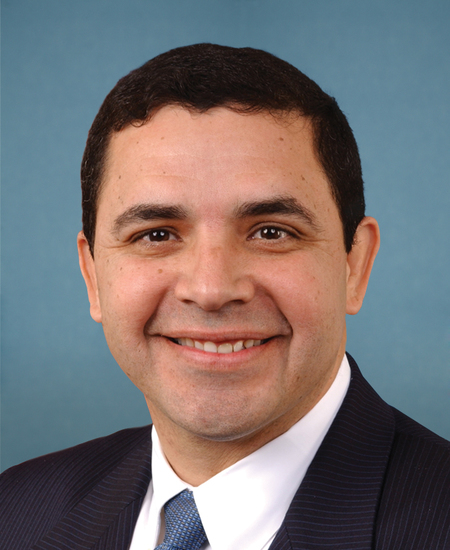
Rep. Henry Cuellar
Sponsored bills
Recovering America’s Wildlife Act of 2022 This bill provides funding for the conservation or restoration of wildlife and plant species of greatest conservation need, including endangered or threatened species, and establishes related requirements. TITLE I--WILDLIFE CONSERVATION AND RESTORATION (Sec. 101) This title establishes and funds a subaccount of the Wildlife Conservation and Restoration Account, which was established under the Pittman-Robertson Wildlife Restoration Act. The subaccount must be used to support efforts of states, territories, or the District of Columbia to recover and manage wildlife and plant species of greatest conservation need. The Department of the Interior must use a portion of the funding from the subaccount for grants to state fish and wildlife departments, the District of Columbia fish and wildlife department, fish and wildlife departments of territories, nonprofit organizations, or regional associations of fish and wildlife departments. The grants must be used for innovative recovery efforts for species of greatest conservation need, species listed as endangered or threatened species, or the habitats of such species. Funding for the subaccount must supplement existing funds available to the states from funds distributed under the Dingell-Johnson Sport Fish Restoration Act and the Wildlife Conservation and Restoration Account. Recipients of the funding from the subaccount must match federal funds as specified by the title. The Government Accountability Office must study and report on the progress of states, territories, the District of Columbia, and Indian tribes in protecting species of greatest conservation need, endangered species, and threatened species. TITLE II--TRIBAL WILDLIFE CONSERVATION AND RESTORATION (Sec. 201) This title establishes and funds a Tribal Wildlife Conservation and Restoration Account to support Indian tribes' efforts to recover and manage wildlife and plant species of greatest conservation need. Indian tribes are not required to provide matching funds. TITLE III--ENDANGERED SPECIES RECOVERY AND HABITAT CONSERVATION LEGACY FUND (Sec. 301) This title establishes and funds through FY2026 the Endangered Species Recovery and Habitat Conservation Legacy Fund. The U.S. Fish and Wildlife Service must use the fund to (1) implement an Endangered Species Recovery Grant Program; (2) address its interagency consultation responsibilities under the Endangered Species Act of 1973; (3) work with nonfederal entities to conserve wildlife habitat and at-risk species, threatened or endangered species, or species proposed to be listed as threatened or endangered species; or (4) address the development and permitting of voluntary conservation agreements under such act. Amounts made available under the fund must supplement other federal amounts made available to carry out such activities. The President must annually submit to Congress, together with the annual budget of the United States, a list of threatened species and endangered species for which recovery plans will be developed or implemented with amounts from the Endangered Species Recovery and Habitat Conservation Legacy Fund. TITLE IV--REPORT (Sec. 401) Interior must also report on information concerning the amount of grants and contracts that were awarded or are allocated under this bill to Historically Black Colleges and Universities, Hispanic-serving educational institutions, tribally controlled colleges and universities, minority-serving educational institutions, minority-owned business enterprises, women-owned business enterprises, and community-based organizations that are principally administered by, operated by, or serving minority communities.

Butcher Block Act This bill authorizes the Department of Agriculture (USDA) to make (or guarantee) loans and award grants for establishing, expanding, and otherwise supporting livestock and poultry processing and related activities. In awarding grants and making or guaranteeing loans, USDA shall prioritize applicants that have experience in livestock and poultry processing and can quickly scale-up to increase overall processing capacity in the region involved.
Critical Minerals Classification Improvement Act of 2022 This bill permits the inclusion of fuel minerals (e.g., uranium) on a list of mineral commodities that are critical to the U.S. economy and national security. (Fuel minerals are currently excluded from the list.) Additionally, the U.S. Geological Survey must revise the list to add critical fuel minerals if it determines the revisions are necessary.
Military Spouse Hiring Act This bill expands the Work Opportunity Tax Credit (WOTC) to include the hiring of a qualified military spouse. (The WOTC permits employers who hire individuals who are members of a targeted group such as qualified veterans, ex-felons, or long-term unemployment recipients to claim a tax credit equal to a portion of the wages paid to those individuals.) A qualified military spouse is any individual who is certified by the designated local agency as being (as of the hiring date) a spouse of a member of the Armed Forces.
Maddy summaryHRES 1166 is a symbolic House resolution condemning the May 24, 2022, mass shooting at Robb Elementary School in Uvalde, Texas, which killed 19 students and 2 teachers. It honors the victims, expresses support for the injured and affected families, and thanks first responders, without enacting new policies or requiring government action. The resolution was introduced by Texas representatives and passed unanimously by the House on June 9, 2022, as a formal expression of solidarity with the Uvalde community. As a procedural resolution, it has no legal effect but serves to publicly acknowledge the tragedy.
Getting Over Lengthy Delays in Care As Required by Doctors Act of 2022 or the GOLD CARD Act of 2022 This bill exempts physicians from prior authorization requirements under Medicare Advantage plans with respect to specific items and services if at least 90% of the physician's requests for such items and services were approved during the previous plan year.
Freight Rail Assistance and Investment to Launch Coronavirus-Era Activity and Recovery Act of 2022 or the Freight RAILCAR Act of 2022 This bill provides a new tax credit through 2024 for 10% of freight railcar fleet modernization expenses (i.e., railcar replacement and modernization expenses for meeting fuel efficiency and performance standards). The bill provides that no more than 2,000 freight railcars per taxpayer may be taken into account for purposes of determining the credit in a taxable year. The Department of the Treasury must report to Congress on the credit to provide information on the number of times the credit was claimed and the number of railcars scrapped or built as a result of the credit.
Domestic Terrorism Prevention Act of 2022 This bill establishes new requirements to expand the availability of information on domestic terrorism, as well as the relationship between domestic terrorism and hate crimes. It authorizes domestic terrorism components within the Department of Homeland Security (DHS), the Department of Justice (DOJ), and the Federal Bureau of Investigation (FBI) to monitor, analyze, investigate, and prosecute domestic terrorism. The domestic terrorism components of DHS, DOJ, and the FBI must jointly report on domestic terrorism, including white-supremacist-related incidents or attempted incidents. DHS, DOJ, and the FBI must review the anti-terrorism training and resource programs of their agencies that are provided to federal, state, local, and tribal law enforcement agencies. Additionally, DOJ must make training on prosecuting domestic terrorism available to its prosecutors and to assistant U.S. attorneys. It creates an interagency task force to analyze and combat white supremacist and neo-Nazi infiltration of the uniformed services and federal law enforcement agencies. Finally, it directs the FBI to assign a special agent or hate crimes liaison to each field office to investigate hate crimes incidents with a nexus to domestic terrorism.
Targeting Resources to Communities in Need Act of 2022 This bill addresses funding for areas of persistent poverty. Specifically, the bill requires the Bureau of the Census to publish a list of all areas of persistent poverty and annually update the list; the Office of Management and Budget (OMB) to implement guidance to increase the share of federal investments targeted to areas of persistent poverty and other areas with high and persistent poverty, and to report annually to Congress; and the Government Accountability Office to report on the measures implemented by the OMB under this bill, including an assessment regarding the impact of the measures on increasing federal investments spent in the affected areas.