

Ports-to-Plains Highway Act of 202 1 This bill expands and designates certain route segments on the National Highway System. Specifically, the bill (1) designates the portion of the Heartland Expressway (relating solely to the portion from Limon, Colorado to Interstate Route I-76 in the vicinity of Brush, Colorado) and the Ports-to-Plains Corridor as future parts of the Interstate System; and (2) permits the continued operation of vehicles on any segment of the Heartland Expressway (relating solely to the portion from Limon, Colorado to I-76 in the vicinity of Brush, Colorado) and the Ports-to-Plains Corridor that is designated as a route on the Interstate System in Texas, Oklahoma, Colorado, and New Mexico, without regard to vehicle weight limitation requirements.
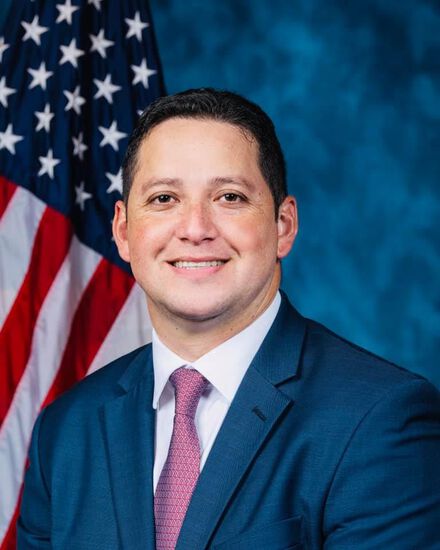
Rep. Tony Gonzales
Sponsored bills
Dismemberment Abortion Ban Act of 2021 This bill restricts the performance of dismemberment abortions. It defines the term dismemberment abortion . Specifically, the bill prohibits a physician from knowingly performing a dismemberment abortion. It provides an exception for a dismemberment abortion that is necessary to save the life of a mother whose life is endangered by a physical disorder, illness, or condition. The bill establishes criminal penalties—a fine, a prison term of up to two years, or both—for a physician who performs a prohibited dismemberment abortion. It also authorizes civil remedies for a woman or parent of a minor who undergoes a dismemberment abortion. A woman who undergoes a dismemberment abortion may not be prosecuted or held civilly liable.
This joint resolution proposes a constitutional amendment limiting Representatives to three terms and Senators to two terms. Terms beginning before the ratification of this amendment do not count towards these term limits.
Binational Health Strategies Act of 2021 This bill requires the President and the United States-Mexico Border Health Commission to take certain actions related to COVID-19. Specifically, the bill directs the President to seek to begin negotiations with Mexico to address infectious disease preparedness in the U.S.-Mexico border area with respect to COVID-19 and other infectious diseases. The bill further requires the United States-Mexico Border Health Commission to (1) report on the border area's response to COVID-19 in both the United States and Mexico, (2) submit a binational strategic plan with respect to COVID-19, and (3) submit a plan to prepare and respond to future infectious diseases within the border area.
Qualified Immunity Act of 2021 This bill codifies the defense of qualified immunity for law enforcement officers in any case under provisions regarding civil actions for deprivation of rights under color of law. Specifically, a law enforcement officer subject to such an action in his or her individual capacity shall not be found liable if the officer establishes that the right, privilege, or immunity secured by the Constitution or federal law was not clearly established at the time of the deprivation, or that at this time, the state of the law was not sufficiently clear that every reasonable law enforcement officer would have understood that the conduct alleged constituted a violation of the Constitution or federal law; or a court of competent jurisdiction had issued a final decision on the merits holding, without reversal, vacatur, or preemption, that the specific conduct alleged to be unlawful was consistent with the Constitution and federal laws. A law enforcement agency or unit of local government that employed a law enforcement officer subject to such an action shall not be liable if the officer is found not liable and to have been acting within the scope of his or her employment.
Concealed Carry Reciprocity Act This bill establishes a federal statutory framework to regulate the carry or possession of concealed firearms across state lines. Specifically, an individual who is eligible to carry a concealed firearm in one state may carry or possess a concealed handgun (other than a machine gun or destructive device) in another state that allows its residents to carry concealed firearms. It sets forth requirements for the lawful concealed carry across state lines. The bill preempts most state and local laws related to concealed carry and establishes a private right of action for a person adversely affected by interference with a concealed-carry right established by this bill.
Keystone XL Pipeline Construction and Jobs Preservation Act This bill authorizes the TransCanada Keystone Pipeline to construct, connect, operate, and maintain the pipeline facilities in Phillips County, Montana, for the import of oil from Canada to the United States.
Living Donor Protection Act of 2021 This bill prohibits certain insurance carriers from discriminating against, and provides other protections for, living organ donors. Specifically, carriers may not deny, cancel, or otherwise impose conditions on policies for life insurance, disability insurance, or long-term care insurance based on an individual's status as a living organ donor. The bill also expressly specifies that recovery from organ-donation surgery constitutes a serious health condition that entitles eligible employees to job-protected medical leave. In addition, the Department of Health and Human Services must update educational materials on live organ donation to include information about the benefits of live organ donation and about access to insurance for living organ donors.
Saving America's Energy Future Act This bill prohibits the Department of Agriculture and the Department of the Interior from declaring a moratorium on issuing new oil and gas leases and drill permits on certain federal lands. In addition, the bill prohibits the departments from declaring a moratorium on renewals of such permits.
Constraining Human Rights Offenders in the Middle East Act or the CHROME Act This bill prohibits the President from taking any action relating to the reentry of the United States into the Joint Comprehensive Plan of Action (JCPOA) unless the President makes specified certifications. The JCPOA is an agreement, signed by Iran and several other world powers (including the United States), that places restrictions on Iran's nuclear program in exchange for certain sanctions relief. The United States withdrew from the JCPOA in 2018. The bill prohibits the President from taking action to rejoin the JCPOA unless the President certifies to Congress that no sanctions waived or suspended pursuant to that reentry will operate to the benefit of (1) a designated foreign terrorist organization or its members, or (2) any individual or entity of the Iranian government that has engaged in gross violations of human rights.