

H-2B Returning Worker Exception Act of 2021 This bill modifies the H-2B (temporary nonagricultural workers) nonimmigrant visa program, including by exempting certain workers from an annual numerical limit on such visas and requiring civil penalties for program violations. Under this bill, if a worker seeking a H-2B visa has been counted toward the 66,000 annual cap on such visas in one of the three preceding fiscal years, that worker shall not be counted against the cap again. Furthermore, the Department of Homeland Security (DHS) must impose a civil monetary penalty on an employer for (1) failing to meet requirements related to an H-2B visa petition, or (2) making a willful misrepresentation of material fact in such a petition. DHS must also ensure the establishment of an electronic platform (1) for employers to submit and request approval of an H-2B petition, and (2) to act as a single point of access for applicants and the relevant government agencies. The Department of Labor must maintain a publicly available online database of all job orders by H-2B employers. Furthermore, Labor may take certain actions to enforce program requirements, such as imposing penalties and seeking injunctions. The bill provides statutory authority for the current practice of limiting the program to workers who are nationals of countries approved by DHS. DHS may make exceptions to this limitation in individual cases if it is in the U.S. interest to do so. DHS shall select approved countries based on various factors, such as the rate of overstay by H-2B visa holders from each country.
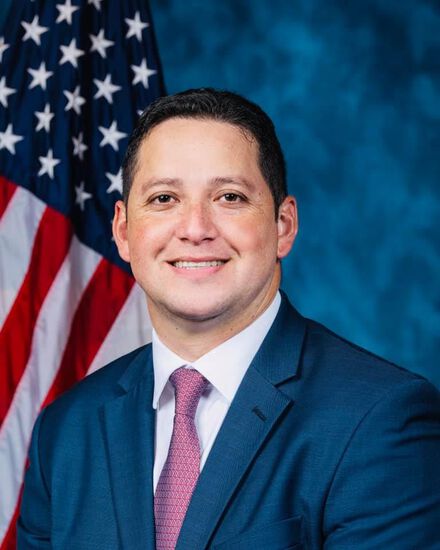
Rep. Tony Gonzales
Sponsored bills
Firearm Due Process Protection Act This bill expands the grounds for pursuing judicial remedies related to certain firearm transfers. Additionally, the bill establishes procedural rules applicable to actions for judicial remedies. Current law authorizes judicial remedies for an individual who is erroneously denied a firearm (e.g., an individual is denied a firearm but the individual is eligible to receive or possess a firearm). This bill authorizes remedies for an individual who experiences an extended delay (i.e., a delay of more than 60 days) on a firearm transfer. Additionally, the bill requires an expedited hearing on an action for judicial remedies and places the burden of proof on the respondent to show by clear and convincing evidence that the individual was ineligible to receive or possess a firearm.
Fire Grants and Safety Act This bill reauthorizes through FY2030 the U.S. Fire Administration, the Assistance to Firefighters Grants Program, and the Staffing for Adequate Fire and Emergency Response Grant Program.
This resolution calls on President Biden to stop the sale of petroleum products from the Strategic Petroleum Reserves and instead prioritize the replenishment of the Strategic Petroleum Reserves.
Strengthening Public Undertakings for Retaining Sports Act or the SPURS Act This bill establishes requirements and conditions with respect to the relocation of professional sports teams. A professional team may not relocate unless specified conditions apply, including that a party to the stadium or arena lease agreement (other than the team) has failed to comply with a provision of material significance and the failure to comply cannot be remedied within a reasonable period; the stadium or arena in which the team plays regular season and playoff home games is inadequate and the entity that owns or operates the stadium or arena has failed to demonstrate intent to remedy the inadequacy within a reasonable period; the team has incurred an annual net loss for not fewer than five years prior to the proposed relocation; and the government authority that is party to the agreement has not made a formal objection to the proposed relocation within a specified period. The bill sets forth requirements for (1) petition for relocation and for government review; and (2) reimbursement to state and local government for the value of financial assistance received, with an exception. The bill grants a state or local government a private right of action against a team that violates this bill.
Stop Our Scourge Act of 2022 or the SOS Act of 2022 This bill directs the Department of Homeland Security to designate illicit fentanyl as a weapon of mass destruction and requires the Office of National Drug Control Policy to conduct an assessment regarding that substance. Specifically, the office must assess foreign manufacturing of illicit fentanyl, the tools and capabilities across federal agencies to address trafficking of that substance, the capabilities of the Mexican military to conduct counterdrug missions with respect to that substance, the capacities and willingness of China to take specified actions with respect to that substance, and illicit fentanyl being trafficked into the United States from Mexico.
This bill designates the facility of the United States Postal Service located at 3900 Crown Road Southwest in Atlanta, Georgia, as the John R. Lewis Post Office Building.
Maddy summaryThis bill designates the Department of Veterans Affairs clinic in Mishawaka, Indiana, as the "Jackie Walorski VA Clinic" to honor former U.S. Representative Jackie Walorski, who served on the House Committee on Veterans' Affairs and advocated for veterans. The law requires all federal references - including laws, documents, and maps - to use the new name for the clinic, effective upon enactment. It does not change the clinic’s services, funding, or operations, as it is a purely commemorative naming resolution.
Protect Farmers from the SEC Act This bill prohibits the Securities and Exchange Commission from requiring the disclosure of greenhouse gas emissions related to agricultural products.
Educational Choice for Children Act This bill allows individuals and corporations a new tax credit after 2022 for charitable contributions to tax-exempt organizations that provide scholarships to elementary and secondary school students. Such students must be members of a household with incomes not greater 300% of the area median gross income and be eligible to enroll in a public elementary or secondary school. The bill excludes from the gross income of taxpayer dependents any scholarship amount for the elementary or secondary education expenses of eligible students. It also prohibits governmental control over scholarship granting organizations.