

Maddy summaryHR 389, the Southern Border Farmers and Ranchers Protection Act, creates a new program to provide annual payments to agricultural producers in specific Texas counties along the southern border. It directs the Secretary to fund conservation practices that repair damage to farmland and farming infrastructure caused by natural resource issues in those counties. The program applies to producers in 35 designated border counties (including El Paso, Hidalgo, and Webb) and requires one-year contracts for payments. This bill directly affects farmers and ranchers in these counties by offering financial support for land restoration through conservation efforts.
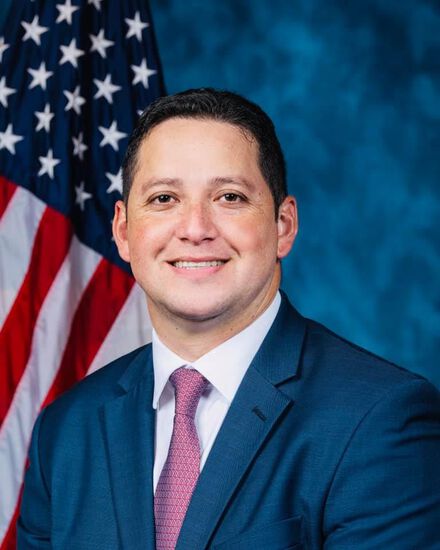
Rep. Tony Gonzales
Sponsored bills
This concurrent resolution declares that Congress should not impose any new performance fee, tax, royalty, or other charge relating to the public performance of sound recordings on a local radio station for broadcasting sound recordings over the air, or on any business for such public performance of sound recordings.
Maddy summaryHR 1301, the Death Tax Repeal Act, would eliminate the federal estate tax and generation-skipping transfer tax for estates of individuals dying on or after its enactment date. It directly affects individuals inheriting significant assets, as it removes taxes on estates exceeding $10 million (adjusted for inflation) and repeals taxes on large transfers between generations. The bill modifies the gift tax by establishing a $10 million lifetime exemption with annual inflation adjustments, replacing previous tax brackets. It applies to estates, gifts, and transfers occurring on or after the bill's effective date.
Maddy summaryHR 1330 establishes the Smithsonian National Museum of the American Latino, authorizing its location within the National Mall's "Reserve" area. The bill requires the Smithsonian Board to coordinate with federal agencies managing potential museum sites, including notifying relevant congressional committees before land transfers. It mandates that the museum's exhibits and programs accurately represent the diverse cultures, histories, and viewpoints of Hispanic and Latino communities in the U.S., seeking input from a broad range of community experts. The Smithsonian must also submit regular reports to Congress detailing compliance with these representation requirements.
Maddy summaryThe SASS Act (HR 1334) creates a single application process for two federal school safety grant programs: one administered by the COPS Office and the other by the Bureau of Justice Assistance (BJA). Schools and school districts seeking funding for safety improvements will no longer need to submit separate applications for these programs. The bill requires the COPS Office and BJA to provide technical assistance to help applicants complete the unified application. This change reduces administrative burden for schools applying for safety grants under these programs.
LPOE Modernization Trust Fund Act This bill establishes the Land Port of Entry Modernization Trust Fund and addresses other issues related to U.S. ports of entry. The bill transfers specified amounts, including a portion of certain collected customs fees, to the trust fund each year. It also requires the Department of Homeland Security (DHS) and the Department of State to collect certain surcharges related to immigration and land border inspections, with a portion of the surcharges to be deposited into the trust fund. DHS may not seek to increase fees to offset the amounts transferred into the trust fund. Subject to appropriations, the amounts in the trust fund may be used to (1) construct new ports of entry, (2) expand and improve existing ports of entry, (3) procure technology for inspecting and processing traffic passing through ports of entry, and (4) hiring U.S. Customs and Border Protection staff. DHS must also establish the Land Port of Entry Modernization Oversight Board to advise DHS on how to use the trust fund and to review the trust fund's expenditures.
Maddy summaryHR 35, the Agent Raul Gonzalez Officer Safety Act, creates a new federal crime for operating a motor vehicle while intentionally fleeing U.S. Border Patrol agents or assisting law enforcement officers within 100 miles of the U.S. border. It imposes penalties of up to 2 years in prison for the basic offense, 5-20 years if serious injury occurs, and 10 years to life if death results. The bill also makes individuals convicted of this crime inadmissible to the U.S., deportable, and ineligible for immigration relief like asylum. Additionally, it requires annual reports from the Attorney General and Homeland Security Secretary detailing arrests, charges, and penalties related to this offense.
United States-Israel Defense Partnership Act of 2025 This bill requires or authorizes certain actions to increase defense-related cooperation between the United States and Israel. Specifically, the bill requires the Department of Defense (DOD) to establish a cooperative program, with the concurrence of Israel's Ministry of Defense (MOD), to develop and deploy advanced technologies for countering unmanned systems that threaten the United States and Israel; establish in Israel an office of the Defense Innovation Unit (an organization that focuses on rapidly fielding and scaling commercial technology across the U.S. military); and seek to engage Israel's MOD on the ascension of Israel into the national technology and industrial base (currently defined in law as the persons and organizations engaged in research, development, production, integration, services, or information technology activities conducted within the United States, the United Kingdom, Australia, New Zealand, and Canada). The bill authorizes DOD, upon request of Israel's MOD, to jointly conduct research, development, test, and evaluation (RDT&E) of emerging technologies such as artificial intelligence and robotics to meet defense challenges. Additionally, the bill extends the authority for DOD to (1) carry out RDT&E on a joint basis with Israel to establish anti-tunnel and counter unmanned aerial systems capabilities through 2028, and (2) transfer defense articles intended for use as reserve stocks for Israel through January 1, 2029.
Maddy summaryHR 1232, the National Right-to-Work Act, would make union membership voluntary for workers in most private-sector jobs by removing legal requirements for employees to join a union or pay dues as a condition of employment. It directly affects workers in unionized workplaces covered by the National Labor Relations Act (including most private employers) and railroad workers covered by the Railway Labor Act. The key change eliminates provisions that allowed "union security agreements" (requiring dues or membership), meaning workers could no longer be forced to pay union fees to keep their jobs. This bill does not change other labor rights or create new programs - it only modifies existing laws to allow workers to opt out of union membership and financial obligations.
Maddy summaryThis bill expands eligibility for death and disability benefits under the public safety officers' death benefits program to include retired law enforcement officers who die or become permanently disabled from targeted attacks directly related to their past service. It specifically covers officers who retired in good standing from public agencies, including those who served without compensation. The policy change applies retroactively to cases occurring since August 28, 2012, and amends the Omnibus Crime Control and Safe Streets Act of 1968. This provides financial support to retired officers and their families affected by violence targeting their law enforcement careers.