

Working for Immigrant Safety and Empowerment Act or the WISE Act This bill expands eligibility for U nonimmigrant visas (victims of criminal activity) and prohibits immigration enforcement activities in specified areas. Generally, U visas are for victims of specified crimes (e.g., rape, trafficking, or domestic violence) who assist with the investigation or prosecution of the crime. The bill adds hate crimes, child abuse, and elder abuse as crimes that may qualify a victim for a U visa and removes criteria related to the victim's assistance with the investigation or prosecution of the crime. Furthermore, the Department of Homeland Security (DHS) must provide work authorization to U visa applicants, whereas currently DHS may grant work authorization but is not required to do so. The bill also eliminates the annual numerical cap on U visas. The bill establishes a rebuttable presumption that certain individuals, including U visa applicants and T visa (victims of human trafficking) applicants, shall not be detained while the application is pending. Additionally, the bill provides immigration-related protections, such as by extending the admission period and providing work authorization, to the spouse or child of a nonimmigrant visa holder who subjected that spouse or child to battery or extreme cruelty. Further, the bill prohibits, with some exceptions for exigent circumstances, U.S. Immigration and Customs Enforcement or U.S. Customs and Border Protection from conducting immigration enforcement actions within 1,000 feet of a school, health care facility, place of worship, or other location specified in the bill.
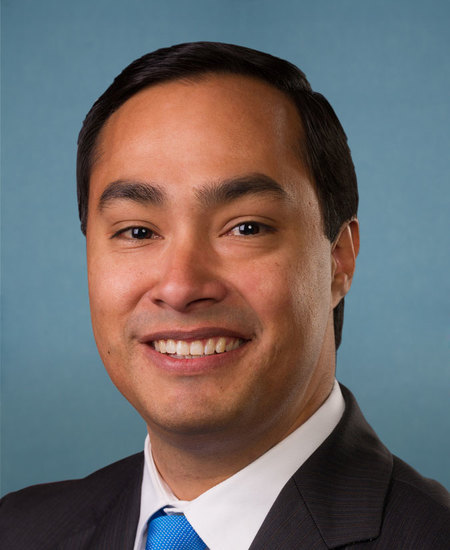
Rep. Joaquin Castro
Sponsored bills
Maddy summaryThis bill requires the U.S. Postal Service to maintain certain mailbox units (called "covered cluster box units") that have been primarily maintained by the Postal Service for at least 20 years. It applies to private property owners (not government entities) who own these units and want the Postal Service to continue maintenance. Property owners must apply to the Postal Service with proof of 20+ years of USPS maintenance and permission to maintain the unit; the Postal Service must decide within one month. The Postal Service must maintain the units but is not responsible for damage caused intentionally by the owner or for structural changes.
Maddy summaryHR 2818, the Early Childhood Nutrition Improvement Act, updates federal child care nutrition program rules to improve administration and reduce burdens. It requires annual eligibility reviews for for-profit child care centers (Section 2), overhauls how "serious deficiency" findings are handled (Section 3), and allows up to 3 meals per day for children in extended care (Section 4), including a study on third-meal reimbursement. The bill also creates an advisory committee (Section 6) to reduce paperwork for providers, parents, and states, focusing on streamlining applications, digital documentation, and eliminating duplicative State requirements. These changes directly affect child care centers, family day care homes, and state agencies administering the program.
Maddy summaryH.J. Res. 91 terminates the national emergency declared by the President on April 2, 2025, under Executive Order 14257. The resolution ends this emergency status by invoking Section 202 of the National Emergencies Act (50 U.S.C. 1622). This action would halt the use of emergency powers associated with the declaration, such as special authorities or funding mechanisms. The bill directly affects federal agencies and the executive branch by removing the legal basis for operating under the emergency framework.
Maddy summaryThe American Family Act (HR 2763) establishes a new refundable child tax credit that provides monthly payments to eligible families with children. It would pay $300 per month for each child under age 6 and $360 per month (120% of $300) for each child age 6 or older, with income limits of $150,000 for joint filers and $112,500 for other filers. The bill creates a "period of presumptive eligibility" to determine eligibility for monthly payments, allowing families to receive advance payments based on information from previous tax returns. This would directly affect millions of families with children who meet the income requirements, providing more consistent financial support throughout the year rather than an annual tax credit.
Maddy summaryHR 2753, the Hands Off Medicaid and SNAP Act of 2025, is a procedural bill that would prevent Congress from using budget reconciliation to cut Medicaid or SNAP benefits. It amends the Congressional Budget Act to block reconciliation bills or amendments that reduce Medicaid enrollment/benefits (under Social Security Act Title XIX) or SNAP eligibility/benefits (under the Food and Nutrition Act of 2008). This rule would apply until January 20, 2029, and only affects the budget reconciliation process, not the programs themselves. The bill does not change current benefit levels or eligibility rules for Medicaid or SNAP recipients.
Maddy summaryThe Raise the Wage Act of 2025 gradually increases the federal minimum wage from $9.50 to $17.00 per hour over six years, with annual adjustments based on median wage growth. It raises the base wage for tipped workers from $6.00 to $17.00 per hour, phasing out their separate minimum wage structure by 2029. The bill also eliminates special minimum wage certificates for disabled workers after 2029, requiring employers to pay the standard minimum wage. These changes apply to most covered workers, including tipped employees and those under 20, with specific transition timelines for each group.
Maddy summaryHR 2672, the Religious Workforce Protection Act, extends temporary nonimmigrant status for religious workers whose applications for permanent residency (green cards) are delayed due to visa backlogs. It directly affects religious workers (such as pastors or missionaries) who are principal or derivative beneficiaries of pending immigrant petitions under specific visa categories, allowing them to maintain their work status beyond the usual 5-year limit while their green card applications are processed. Key provisions include granting extensions until a final decision is made on their adjustment of status application, modifying rules to allow limited job flexibility for these workers, and exempting them from a 1-year foreign residence requirement if they left the U.S. due to the prior 5-year cap. The bill aims to prevent religious workers from losing their legal status during lengthy immigration processing.
Maddy summaryThe Tax Fairness for Workers Act (HR 2671) would allow certain employees to deduct work-related expenses directly from their gross income. Specifically, it creates an above-the-line deduction for union dues (amending IRC Section 62(a)(1)) and reinstates a deduction for other out-of-pocket work costs like uniforms or tools (amending IRC Section 67(g)), effective for 2025 tax years. This directly affects union members and workers with significant job-related expenses who previously could not deduct these costs. The bill removes the prior limitation that barred these deductions, making them available without needing to itemize. The policy change simplifies tax filing for affected workers by treating these expenses as deductible business costs.
Maddy summaryThis bill, HR 2253 (Puppy Protection Act of 2025), sets new federal standards for commercial dog dealers who sell puppies to the public. It requires specific housing sizes based on dog size (e.g., 12-30 square feet per dog), daily exercise in safe outdoor areas, clean water and nutritious food twice daily, and annual veterinary exams including dental checks. The bill also limits breeding frequency (max 2 litters in 25 months), sets age minimums for breeding (18 months for small dogs, 2 years for large dogs), and mandates health screenings to prevent genetic diseases. These requirements apply directly to commercial dealers, with final regulations to be issued within 18 months of enactment.