

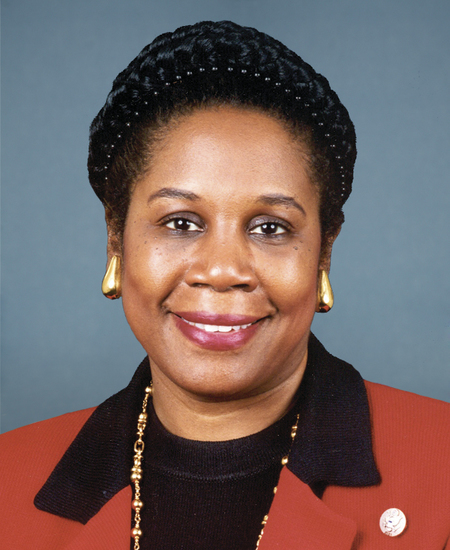
Photo of Sheila Jackson Lee
D United States House · District 18 · Texas

Rep. Sheila Jackson Lee

Compare
Total votes
2,006
all sessions
Attendance
79%
419 missed
Lower than 99% of chamber peers
With party
98%
of cast votes
Higher than 86% of chamber peers
Bipartisan score
1%
crosses aisle rarely
Lower than 87% of chamber peers
Sponsored
1,479
bills & resolutions
Higher than 87% of chamber peers
Committees
0
assignments
1,479 bills and resolutions

Sponsored bills

Total
1,479
Primary
114
Co-sponsor
1,365
This page
1,479
matching current filters
Co-sponsor HR 1105
Signed into law · United States House · Co-sponsor
Debbie Smith Act of 2023

Maddy summaryThis bill reauthorizes the Debbie Smith DNA Backlog Grant Program, which provides federal funding to state and local law enforcement agencies to reduce backlogs in processing DNA evidence from crime scenes. It extends the program's funding period from fiscal years 2024 through 2029 (previously ending in 2024). The bill also updates audit requirements to ensure grant funds are used properly through 2029. This directly affects law enforcement agencies that receive these grants to accelerate DNA analysis for criminal investigations.

Signed into law Jul 30, 2024 1 co-sponsor
Co-sponsor HR 3019
Signed into law · United States House · Co-sponsor
Federal Prison Oversight Act

Maddy summaryThe Federal Prison Oversight Act establishes a new inspections regime for federal prisons, requiring the Justice Department's Inspector General to conduct regular assessments of Bureau of Prisons facilities. These inspections will evaluate conditions of confinement, medical care, staffing levels, safety protocols, and policies related to visitation and programming. The bill also creates a new Ombudsman position within the Department of Justice to receive and address complaints from incarcerated people, their families, and staff about health, safety, and rights concerns. The Inspector General must submit public reports with recommendations, and the Bureau must respond with corrective action plans within 60 days. The law includes protections against retaliation for those filing complaints and requires the Bureau to provide multiple confidential channels for submitting complaints.

Signed into law Jul 25, 2024 1 co-sponsor
Co-sponsor HR 6362
In committee · United States House · Co-sponsor
Protecting Benefits for Disabled Veterans Act of 2023

Maddy summaryHR 6362, the Protecting Benefits for Disabled Veterans Act of 2023, allows the VA to assign a total disability rating to veterans with service-connected disabilities who cannot work due to those conditions. It specifies that veterans qualify if they have one disability rated at least 60% or multiple disabilities totaling 70% (with at least one at 40%), and the VA must consider certain disability combinations as a single condition. The bill prohibits the VA from considering a veteran’s age or Social Security benefits when making this determination, and clarifies that veterans maintaining marginal employment (below the poverty threshold) may still qualify for total disability. This change directly affects disabled veterans seeking full benefits by providing clearer pathways to qualify for total disability ratings based on employment impact.

In committee Jul 23, 2024 1 co-sponsor
Co-sponsor HR 1631
Failed · United States House · Co-sponsor
Pro Codes Act

Maddy summaryHR 1631, the Pro Codes Act, requires standards development organizations (like ANSI or IEEE) to make technical standards publicly accessible online for free if those standards are referenced in federal, state, or local laws or regulations. This directly affects the organizations that create these standards and government agencies that incorporate them into rules. The key provision mandates that organizations must provide free, online access to all referenced standards within a reasonable time after learning they’re incorporated, without charging users or requiring payment. It ensures the public can access current standards used in government rules while allowing organizations to maintain revenue models through paid subscriptions for other users. The law balances public access with the need for standards organizations to fund their work through copyright licensing.

Failed Jul 22, 2024 1 co-sponsor
Primary HR 9042
In committee · United States House · Lead sponsor
Civilian Agency AI Watermark Act

Maddy summaryThis bill requires the Secretary of Homeland Security to develop a watermark system identifying AI tools approved for use by federal civilian agencies (like departments handling public services). Within eight months of enactment, the Secretary must consult with NIST and the U.S. Patent and Trademark Office to create this system. The bill authorizes annual funding to support this effort, ensuring only agency-approved AI applications are marked for identification.

In committee Jul 15, 2024 0 co-sponsors
Primary HR 9044
In committee · United States House · Lead sponsor
To provide for citizen engagement on the development and adoption of Federal civilian agency use of artificial intelligence, and for other purposes.

Maddy summaryHR 9044 requires the Secretary of Homeland Security to host virtual and in-person listening sessions with diverse groups - including states, tribes, civil rights organizations, farmers, labor unions, and academia - to gather public input on how federal civilian agencies develop and use artificial intelligence. The bill mandates that the Secretary also encourage these groups to hold similar sessions and report back on the process. Within 240 days of enactment and annually thereafter, the Secretary must submit a report to Congress detailing public attitudes toward federal AI use. This is a procedural bill focused solely on collecting public input, not on changing AI policies or regulations.

In committee Jul 15, 2024 0 co-sponsors
Co-sponsor HR 9051
In committee · United States House · Co-sponsor
Compassionate Assault Response and Empathy Act of 2024

Maddy summaryHR 9051, the Compassionate Assault Response and Empathy Act of 2024, requires state, tribal, and local law enforcement agencies to implement trauma-informed training for officers handling sexual assault cases. The bill provides federal grants to fund this training, mandating at least eight hours for new officers during academy training and four hours annually for existing officers. Training must focus on preventing retraumatization, supporting victims, and include diverse trainers with inclusive representation. Agencies must report annually to Congress on grant usage and program effectiveness, with the Department of Health and Human Services maintaining an online directory of qualified trainers.

In committee Jul 15, 2024 1 co-sponsor
Primary HR 9043
In committee · United States House · Lead sponsor
To provide for Federal civilian agency laboratory development for testing and certification of artificial intelligence for civilian agency use, and for other purposes.

Maddy summaryThis bill establishes federal laboratories under the Department of Homeland Security to test and certify AI systems used by civilian government agencies. It requires agencies to develop AI training centers focused on protecting privacy, preventing discrimination against vulnerable groups (including children, minorities, and the elderly), and banning automated decisions that deny benefits or services. The bill mandates a $20 billion fund for implementation, requires agencies to share AI incident reports, and prohibits AI from making automatic decisions on benefit denials. It directly affects all federal civilian agencies using AI for public services, ensuring systems align with constitutional rights and transparency standards.

In committee Jul 15, 2024 0 co-sponsors
Co-sponsor HCONRES 119
In committee · United States House · Co-sponsor
Expressing the sense of Congress that wrongfully or unjustly deported people who have established significant ties through years of life in the United States deserve a chance to come home to reunite with loved ones through a fair and central process within the Department of Homeland Security.

Maddy summaryHCONRES 119 is a non-binding congressional resolution expressing that people wrongfully or unjustly deported after establishing long-term ties in the U.S. (such as DACA recipients, veterans, or those with expunged convictions) deserve a fair process to return. It proposes creating a centralized unit within the Department of Homeland Security (DHS), modeled after DHS’s existing ImmVets program for veterans, to review applications for re-entry. The resolution does not change immigration law but urges DHS to establish this dedicated process to address systemic barriers like lengthy delays, complex procedures, and limited access to legal help. It specifically targets individuals separated from families after years in the U.S., including those deported due to errors, protests, or outdated convictions. The resolution emphasizes repairing past injustices without altering current legal frameworks.

In committee Jul 10, 2024 1 co-sponsor
Co-sponsor HR 8981
In committee · United States House · Co-sponsor
Supporting Trauma-Informed Education Practices Act of 2024

Maddy summaryHR 8981, the Supporting Trauma-Informed Education Practices Act of 2024, provides $50 million annually (2025-2029) to fund grants for schools and tribal educational agencies. It directly supports students, teachers, and school staff by connecting them with community mental health services through evidence-based programs. Key provisions require grantees to develop trauma-informed school environments, offer culturally competent professional development, engage families, and establish partnerships with mental health agencies. The bill mandates that federal funds supplement - not replace - existing local or state funding for these services.

In committee Jul 10, 2024 1 co-sponsor
Showing 71 to 80 of 1,479 bills
Previous 1 … 7 8 9 … 148 Next