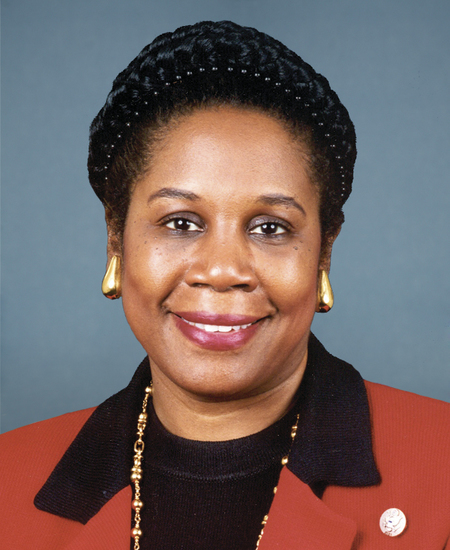
Photo of Sheila Jackson Lee
D United States House · District 18 · Former member · Texas

Rep. Sheila Jackson Lee

Compare
Total votes
2,006
all sessions
Attendance
79%
419 missed
Among the lowest in the chamber
With party
98%
of cast votes
Higher than 86% of chamber peers
Bipartisan score
1%
crosses aisle rarely
Lower than 87% of chamber peers
Sponsored
1,479
bills & resolutions
Higher than 87% of chamber peers
Committees
0
assignments
1,479 bills and resolutions

Sponsored bills

Total
1,479
Primary
114
Co-sponsor
1,365
This page
1,479
matching current filters
Co-sponsor HR 4019
In committee · United States House · Co-sponsor
Justice for Exonerees Act

Justice for Exonerees Act This bill increases the maximum amount of damages that an individual who was unjustly convicted and incarcerated may be awarded and requires that this amount be adjusted annually for inflation.

In committee Nov 1, 2022 1 co-sponsor
Co-sponsor HR 3929
In committee · United States House · Co-sponsor
Disarm Hate Act

Disarm Hate Act The bill expands the categories of persons who are prohibited from receiving or possessing a firearm. Specifically, it prohibits firearm sale or transfer to and receipt, possession, shipment, or transport by a person (1) who has been convicted of a misdemeanor hate crime, or (2) who has received an enhanced hate crime misdemeanor sentence.

In committee Nov 1, 2022 1 co-sponsor
Co-sponsor HR 3897
In committee · United States House · Co-sponsor
H–2B Returning Worker Exception Act of 2021

H-2B Returning Worker Exception Act of 2021 This bill modifies the H-2B (temporary nonagricultural workers) nonimmigrant visa program, including by exempting certain workers from an annual numerical limit on such visas and requiring civil penalties for program violations. Under this bill, if a worker seeking a H-2B visa has been counted toward the 66,000 annual cap on such visas in one of the three preceding fiscal years, that worker shall not be counted against the cap again. Furthermore, the Department of Homeland Security (DHS) must impose a civil monetary penalty on an employer for (1) failing to meet requirements related to an H-2B visa petition, or (2) making a willful misrepresentation of material fact in such a petition. DHS must also ensure the establishment of an electronic platform (1) for employers to submit and request approval of an H-2B petition, and (2) to act as a single point of access for applicants and the relevant government agencies. The Department of Labor must maintain a publicly available online database of all job orders by H-2B employers. Furthermore, Labor may take certain actions to enforce program requirements, such as imposing penalties and seeking injunctions. The bill provides statutory authority for the current practice of limiting the program to workers who are nationals of countries approved by DHS. DHS may make exceptions to this limitation in individual cases if it is in the U.S. interest to do so. DHS shall select approved countries based on various factors, such as the rate of overstay by H-2B visa holders from each country.

In committee Nov 1, 2022 1 co-sponsor
Co-sponsor HR 3887
In committee · United States House · Co-sponsor
Foreign Corruption Accountability Act

Foreign Corruption Accountability Act This bill temporarily authorizes the President to impose visa-blocking sanctions against any foreign person that engages in public corruption activities (e.g., soliciting or accepting bribes or engaging in extortion) against the United States. The President may terminate the sanctions by making a determination that the person (1) is no longer engaged in (or has taken significant verifiable steps to cease) the sanctionable conduct, or (2) will not knowingly engage in sanctionable conduct in the future. In addition, the President may also terminate the sanctions if it is in U.S. national security interests. The President must notify Congress at least 15 days before terminating the sanctions. The President must annually report to Congress on the imposition and termination of sanctions on foreign persons for engaging in public corruption. The authority to impose the sanctions terminates six years after this bill's enactment.

In committee Nov 1, 2022 1 co-sponsor
Co-sponsor HR 3876
In committee · United States House · Co-sponsor
Ketamine Restriction Act

Ketamine Restriction Act This bill restricts the administration of ketamine to individuals during arrests and detentions. Specifically, the bill prohibits the administration of ketamine to an individual during an arrest or detention for a federal offense other than in a hospital for medical purposes. Additionally, a state or local government must have in place a law or policy prohibiting the administration of ketamine to an individual during an arrest or detention other than in a hospital for medical purposes as a condition of receiving grant funds under the Edward Byrne Memorial Justice Assistance Grant program and the Community Oriented Policing Services program.

In committee Nov 1, 2022 1 co-sponsor
Co-sponsor HR 3781
In committee · United States House · Co-sponsor
Justice for Victims of Kleptocracy Act of 2021

Justice for Victims of Kleptocracy Act of 2021 This bill requires the Department of Justice to publish and regularly update its website with an accounting of property that is forfeited to the United States as a result of foreign government corruption. It also expresses the sense of Congress that recovered assets shall be returned for the benefit of the people harmed by the corruption.

In committee Nov 1, 2022 1 co-sponsor
Co-sponsor HR 3732
In committee · United States House · Co-sponsor
Enhancing Oversight To End Discrimination in Policing Act

Enhancing Oversight to End Discrimination in Policing Act This bill expands the capacity to enforce a law that prohibits patterns or practices of misconduct by state and local law enforcement agencies. Current law prohibits state and local law enforcement agencies from engaging in patterns or practices of conduct that violate constitutional or federal rights. Further, current law authorizes the Department of Justice (DOJ) to file civil cases to eliminate the pattern or practice of misconduct. Typically, DOJ's Civil Rights Division conducts pattern-or-practice investigations and resolves any misconduct through a consent decree instead of a trial. This bill provides statutory authority for state attorneys general to bring pattern-or-practice cases in federal court. The bill also authorizes grants to help states pursue pattern-or-practice investigations and cases. Additionally, the bill authorizes additional amounts for DOJ's Civil Rights Division and requires a certain portion to be used for enforcement and technical assistance related to pattern-or-practice cases. Finally, the bill requires DOJ's Civil Rights Division to modify the procedures for consent decrees and settlement agreements to ensure that the consent decrees and settlement agreements (1) foster the creation and use of alternative remedies such as mental health support or community-based restorative justice mechanisms; and (2) incorporate community oversight requirements, such as a community oversight body.

In committee Nov 1, 2022 1 co-sponsor
Co-sponsor HR 3669
In committee · United States House · Co-sponsor
COVID–19 Safer Detention Act of 2021

COVID-19 Safer Detention Act of 2021 This bill expands statutory authority for federal prisoners to be released before completing their sentences or to be placed in the community to serve the final portion of their sentences. First, the bill makes changes to the early release pilot program. The early release pilot program authorizes the Bureau of Prisons to release early and place on home confinement elderly offenders and terminally ill offenders who meet eligibility criteria. This bill expands eligibility to offenders serving time for an offense under the laws of the District of Columbia, expands eligibility to offenders who have served at least one-half (currently, two-thirds) of their prison term, reduces the amount of time an offender must serve by the good time credits earned by the offender, and creates a judicial review process for prisoners and shortens the waiting period for judicial review during the COVID-19 pandemic. Second, the bill modifies the compassionate release process. The compassionate release process authorizes federal courts to reduce a prisoner's sentence and impose a term of probation or supervised released in certain circumstances. This bill expands eligibility to prisoners sentenced before November 1, 1987, specifies that vulnerability to COVID-19 is a basis for compassionate release, and shortens the waiting period for judicial review during the COVID-19 pandemic.

In committee Nov 1, 2022 1 co-sponsor
Co-sponsor HR 3664
In committee · United States House · Co-sponsor
SMART Act

Save Money on Auto Repair Transportation Act or the SMART Act This bill limits design patent infringement liability for component parts used to repair the exterior of a motor vehicle. Specifically, the bill limits liability for infringement of a design patent that claims the appearance of a component part of a motor vehicle's exterior, such as a hood or fender. The act of making, offering to sell within the United States, or importing into the United States an article of manufacture (such as an exterior component part from an aftermarket manufacturer) that would otherwise infringe such a design patent shall not constitute infringement if the purpose of the article of manufacture is to repair and restore a motor vehicle to its original appearance. In addition, 30 months after a motor vehicle with an exterior component part covered by a design patent is offered for sale in any country, it shall not constitute design patent infringement to use or sell within the United States an otherwise-infringing article of manufacture if the purpose of that article of manufacture is to repair and restore the motor vehicle to its original appearance.


In committee Nov 1, 2022 1 co-sponsor
Co-sponsor HR 3580
In committee · United States House · Co-sponsor
Eviction Prevention Act of 2021

Eviction Prevention Act of 2021 This bill authorizes the Department of Justice to provide grants to state and local governments to make legal counsel available to eligible tenants undergoing eviction proceedings. An eligible tenant is an individual whose income is less than 125% of the federal poverty level. The bill also requires the Department of Housing and Urban Development to establish a national database of evictions. The Government Accountability Office must report on the national status of legal representation of tenants in eviction proceedings, including the effects of access to representation on case outcomes.

In committee Nov 1, 2022 1 co-sponsor
Showing 771 to 780 of 1,479 bills
Previous 1 … 77 78 79 … 148 Next