U.S.-Israel Cooperation Expansion Act This bill states U.S. policy concerning U.S. and Israeli law enforcement training and threats to U.S. and Israeli security and embassy protection. Specifically, the bill provides that it is U.S. policy to (1) support bilateral training between U.S. and Israeli law enforcement for sharing best practices related to anti-terrorism, community policing, and managing mass casualties; and (2) continue to counter threats to U.S. and Israeli security and embassy protection posed by illicit cross-border tunneling and unmanned aerial systems.
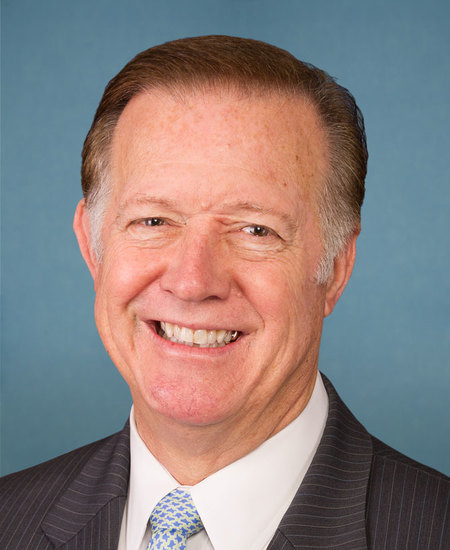
Rep. Randy K. Weber, Sr.
Sponsored bills
United States Capitol Police Wellness Promotion Act This bill prohibits the chief of the U.S. Capitol Police from retaliating or imposing any disciplinary action against officers for seeking or receiving trauma counseling or other wellness services. It also requires the chief to investigate the feasibility and desirability of using vendors to provide trauma counseling and other mental health counseling and evaluation services to officers.
No Vaccine Passports Act This bill prohibits certain actions related to vaccine passports and proof of COVID-19 (i.e., coronavirus disease 2019) vaccination. Specifically, a federal agency may not issue a vaccine passport, vaccine pass, or other standardized documentation for the purpose of certifying the COVID-19 vaccination status of a U.S. citizen to a third party, or otherwise publish or share any COVID-19 vaccination record of a U.S. citizen or similar health information. Additionally, proof of COVID-19 vaccination shall not be required to access federal or congressional property or services.
This resolution condemns Iranian state-sponsored terrorist attacks against U.S. citizens and officials and Iranian dissidents and expresses support for the people of Iran who are engaged in legitimate and peaceful protests against the Iranian regime.
Freight Rail Assistance and Investment to Launch Coronavirus-era Activity and Recovery Act of 2021 or the Freight RAILCAR Act of 2021 This bill provides a new tax credit for 50% of freight railcar fleet modernization expenses. The bill defines freight railcar fleet modernization expenses to include amounts for railcar replacement and modernization, railcar scrap amounts, and for railcar facility and technology modernization. The Department of the Treasury must report to Congress on the credit to provide information on the number of times the credit was claimed and the number of railcars scrapped or built as a result of the credit.
This resolution recognizes the efforts of the Trump Administration and Operation Warp Speed in the development of the COVID-19 (i.e., coronavirus disease 2019) vaccine. Operation Warp Speed is an interagency partnership that coordinates federal efforts to accelerate the development, acquisition, and distribution of medical countermeasures for COVID-19.
Redirecting Resources to the Border Act This bill addresses the relocation of personnel and fencing deployed in the National Capital Region in response to the January 6, 2021, attacks on the U.S. Capitol building and grounds. Specifically, the bill requires all fencing installed in response to the attacks to be relocated to the southern land border of the United States. The Department of Defense must reassign National Guard members who were deployed in response to the attacks to the National Capital Region on or after January 6, 2021, to the southern land border of the United States to assist U.S. Customs and Border patrol.
Securing American Leadership in Science and Technology Act of 2021 This bill extends through FY2031 the Office of Science and Technology Policy (OSTP), the Office of Science of the Department of Energy, the Advanced Research Projects Agency-Energy, the National Institute of Standards and Technology (NIST), the National Oceanic and Atmospheric Administration (NOAA), and the National Science Foundation (NSF). The bill authorizes programs, projects, and activities, including those regarding (1) federal research security; (2) a National Supply Chain Database; (3) basic energy sciences research and advanced scientific computing research; (4) establishment and operation of Regional Energy Innovation Centers; (5) establishment of a carbon sequestration research initiative; (6) establishment of a NIST Foundation; (7) establishment of a technology transfer office in NOAA; (8) science, technology, engineering, and mathematics, including computer science (STEM) workforce development; and (9) establishment of an Energy Foundation. The OSTP shall submit a comprehensive national science and technology strategy, and complete a review of U.S. science and technology enterprise. The Office of Science shall continue to leverage U.S. participation in the Large Hadron Collider, prioritize international partnerships and investments in the Long-Baseline Neutrino Facility/Deep Underground Neutrino Experiment, and prioritize international collaboration that would provide U.S. researchers access to the most advanced accelerator facilities in the world. The Government Accountability Office shall evaluate NIST's Center for Neutron Research. The NSF shall contract the National Academy of Public Administration to study the organizational and management structure of the NSF.

Providing Americans with LNG Safely Act or the PALS Act This bill prohibits the Department of Transportation (DOT) from issuing any regulation or order that (1) prohibits the transportation of liquefied natural gas (LNG) by rail, or (2) restricts the transportation of LNG by rail in DOT-113 tank cars. The bill does not limit the authority of DOT to issue short-term emergency orders related to the transportation of LNG by rail.
This bill prohibits the use of federal funds (1) 15 days after its enactment, to support the mission of the National Guard in the District of Columbia in response to the attacks on the U.S. Capitol buildings and grounds on January 6, 2021; or (2) to install permanent fencing around the perimeter of any U.S. Capitol buildings or grounds. On January 7, 2021, in response to the attacks, razor wire fencing was erected to secure the perimeter of the U.S. Capitol; the fencing was initially to remain in place for 30 days and was kept in place through periodic extensions.