

One Federal Decision Act of 202 1 This bill provides statutory authority for the policy that requires federal agencies to coordinate environmental reviews and authorization decisions for major infrastructure projects. It also sets a goal for completing environmental reviews within two years. The Department of Transportation (DOT) must review existing practices, procedures, programmatic agreements, and applicable laws to identify potential changes that would facilitate an efficient environmental review process for projects. All authorization decisions for construction of a major project must be completed within 90 days of the issuance of a record of decision for the project, although the lead agency could extend the deadline in some cases. The lead agency must develop an environmental review schedule with the project sponsor that is consistent with an agency average of not more than two years for the completion of the environmental review process for major projects. DOT must also (1) establish a performance accountability system to track each major project, and (2) provide other relevant federal agencies with a list of categorical exclusions under the National Environmental Policy Act that are applicable to highway projects and that would accelerate project delivery. The bill also eliminates the two-year limitation on filing claims seeking judicial review of permits, licenses, or approvals issued by a federal agency for railroad projects.
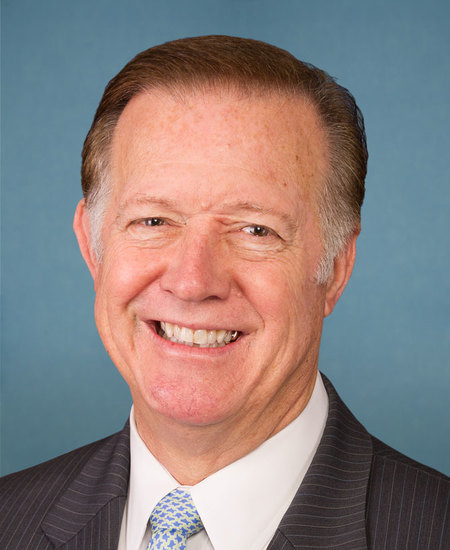
Rep. Randy K. Weber, Sr.
Sponsored bills
Get Americans Back To Work Act This bill makes an individual ineligible for federal pandemic unemployment compensation (FPUC) after June 30, 2021. It also reduces the amount of FPUC to $150.00 for weeks of unemployment ending after May 31, 2021, and ending on or before June 30, 2021. Under current law, an individual is eligible for FPUC for weeks of employment ending on or before September 6, 2021 in the amount of $300.
Repealing Illegal Freedom and Liberty Excises Act or the RIFLE Act This bill repeals the excise tax on the transfer of firearms. The bill shall not be construed as placing any regulated firearms under the jurisdiction of the U.S. Consumer Product Safety Commission.
This bill prohibits the use of federal funds for the provision of training or education based on critical race theory at the U.S. service academies (e.g., the Air Force Academy).
This bill expands a provision that prohibits China from participating in certain naval exercises until specified conditions are met. In addition to the already existing conditions, China may not participate in the naval exercises until the Department of State certifies that China's government has (1) stopped committing any ongoing genocide, (2) apologized for such genocide, and (3) engaged in a credible justice and accountability process for the victims.
Computing Advancements for Materials Science Act or the CAMS Act This bill directs the Department of Energy (DOE) Office of Science to support a program of fundamental research for the application of advanced computing practices to foundational and emerging research problems in chemistry and materials science. The DOE Office of Science shall select and establish up to four computational materials and chemistry science centers to develop open-source, robust, and validated computational codes and user-friendly software, coupled with innovative use of experimental and theoretical data, to enable the design, discovery, and development of new materials and chemical systems including chemical catalysis research and development. The DOE Office of Science shall support the development of a web-based platform to provide access to a database of computed information on known and predicted materials properties and computational tools to accelerate breakthroughs in materials discovery and design.
This resolution recognizes that federal law enforcement, federal property, and citizens' rights must be protected. It also urges political leaders to condemn violent protests and criminal behavior associated with rioting and supports the prosecution of individuals who actively engaged in rioting.
Informed Consent Act This bill establishes new federal criminal offenses related to the performance of abortions and sterilization procedures. First, the bill prohibits knowingly performing an abortion or sterilization procedure without obtaining informed consent. It provides exceptions, including for an abortion or sterilization procedure that is necessary to save a mother whose life is endangered by a physical (but not psychological or emotional) disorder, illness, or condition. An individual who performs a prohibited abortion or sterilization procedure is subject to criminal penalties—a fine, a prison term of up to 10 years, or both. Second, the bill requires federal employees and contractors, as well as employees and contractors of certain federally funded entities, who know about a prohibited abortion or sterilization procedure to report it as soon as possible. An individual who knows about a prohibited abortion or sterilization procedure but fails to report it is subject to a fine, a prison term of up to three years, or both.
LEOSA Reform Act This bill broadens the authority for certain law enforcement officers to carry concealed firearms across state lines. Specifically, the bill allows qualified active and retired law enforcement officers to carry concealed firearms and ammunition (including magazines) in school zones; in national parks; on state, local, or private property that is open to the public; and in certain federal facilities that are open to the public. Further, the bill permits states to reduce the frequency with which retired law enforcement officers must meet certain qualification standards.
Return Excessive Migrants and Asylees to International Neighbors in Mexico Act of 2021 or the REMAIN in Mexico Act of 2021 This bill requires the Department of Homeland Security (DHS) to implement the Migrant Protection Protocols as outlined in the January 25, 2019, memo titled Policy Guidance for Implementation of the Migrant Protection Protocols . (The protocols generally required aliens who are not clearly admissible, including those seeking asylum, arriving by land along the U.S.-Mexico border to be returned to Mexico while their immigration proceedings are pending, rather than remain in the United States. On January 21, 2021, DHS stopped applying the protocols to newly-arrived individuals.)