

Maddy summaryThis bill establishes a "quantum sandbox" program to accelerate near-term quantum applications. It requires the Commerce Secretary and NIST to create a public-private partnership where U.S. businesses and developers can test quantum computing, communication, and sensing solutions for real-world problems within 24 months. The program will engage industry groups and national labs to develop and pilot applications, focusing on practical uses like optimizing supply chains or materials science. It directly affects businesses and researchers working on quantum technologies seeking to deploy solutions faster.
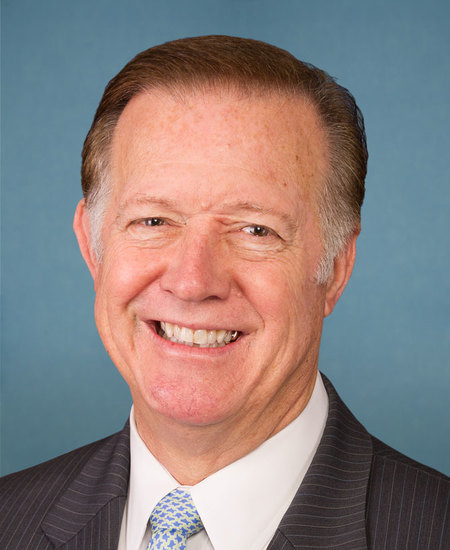
Rep. Randy K. Weber, Sr.
Sponsored bills
This bill directs the President to withdraw the United States from the United Nations Framework Convention on Climate Change (the entity tasked with supporting the global response to climate change). The bill also prohibits the use of funds to carry out U.S. obligations under the framework following this withdrawal.
Ukraine Lend-Lease Accountability Act This bill imposes certain requirements on the President's authority to lend or lease defense articles to Ukraine and other Eastern European countries affected by Russia's invasion of Ukraine. Specifically, the bill removes two exemptions from the Ukraine Democracy Defense Lend-Lease Act of 2022. (The act, which authorizes lending or leasing of defense articles to Ukraine and other countries affected by the invasion, exempts from such transactions certain requirements that typically apply to lend-lease transactions.) By removing these exemptions, the bill subjects the act's lend-lease authority to certain statutory requirements including that (1) the loan period be of a fixed duration not exceeding five years, during which the defense article may be recalled for any reason; and (2) the recipient country agrees to pay all costs incurred in leasing such defense articles, including costs associated with replacing lost or destroyed articles.
Maddy summaryHJRES 27 is a congressional resolution seeking to block a federal rule that redefined which waterways fall under the Clean Water Act's protections. It targets a rule submitted by the Army Corps of Engineers, Department of Defense, and Environmental Protection Agency (EPA) on January 18, 2023, which aimed to revise the "Waters of the United States" definition. The resolution would formally disapprove this rule under a specific federal procedure (Chapter 8 of Title 5), preventing it from taking effect. This would directly affect how federal agencies regulate pollution and development near water bodies, including wetlands and smaller streams.
Maddy summaryHR 2665 delays Medicaid payment reductions for safety net hospitals by two years, changing the effective date from 2024 to 2026 under Section 1923(f)(7)(A) of the Social Security Act. This bill directly affects hospitals that serve high numbers of low-income and uninsured patients, providing them with additional time before facing reduced federal Medicaid payments. The key mechanism is a technical amendment to existing law, postponing an already scheduled payment adjustment without altering funding levels or eligibility. As a procedural bill, it does not create new programs or change hospital requirements.
Capital Loss Inflation Fairness Act This bill increases the allowance for capital losses and adjusts the increased allowance amount for inflation after 2023.
Maddy summaryThe Securing Our Schools Act of 2023 authorizes $360 million for fiscal year 2023 and $480 million annually through 2029 for school security grants to nonprofit organizations, requiring detailed explanations for denied applications. It mandates that 50% of funds from the Elementary and Secondary Education Act be used for security measures including metal detectors, access control systems, surveillance cameras, and other infrastructure improvements. The bill establishes a $10 billion Student Access to Mental Health Program Fund to support mental health professionals in schools serving grades 6-12, with requirements that schools not teach Critical Race Theory or advocate for abortion services. It also prohibits using funds for abortion services except in cases of rape, incest, or life-endangering conditions.
Maddy summaryHR 2584, the SAVE Act, creates a new federal criminal offense for assaulting or intimidating hospital employees while they're performing their duties, punishable by up to 10 years in prison, with enhanced penalties for using weapons, causing injury, or during public emergencies. The bill authorizes $25 million annually in federal grants to hospitals for violence prevention programs, including staff training, security technologies like panic buttons and video surveillance, and coordination with law enforcement. It defines "hospital" broadly to include various medical facilities such as long-term care hospitals, rehabilitation facilities, and critical access hospitals. The legislation directly affects hospital workers and medical facilities by establishing federal criminal penalties for violence against employees and providing funding to improve workplace safety. The law aims to address the rising problem of workplace violence against healthcare workers, which the bill states has increased since 2011.
Maddy summaryHR 2630, the Safe Step Act, requires group health plans and health insurance issuers to establish a clear, transparent process for patients or their doctors to request exceptions to medication step therapy protocols. These protocols typically force patients to try cheaper drugs first before covering more expensive alternatives. The bill mandates that plans must approve exceptions when prior treatments failed, delay would cause serious harm, a treatment is unsafe, or a patient is stable on a previously approved drug, with strict 72-hour (or 24-hour in emergencies) decision timelines. It also requires plans to publish the exception process online and limit documentation requests to only necessary medical information. This law directly affects health insurers, employers offering health plans, and patients using step therapy for prescription drugs.
Ensuring United Families at the Border Act This bill addresses the treatment of children who are non-U.S. nationals ( aliens under federal law), including by statutorily establishing that there is no presumption that such a child (other than an unaccompanied child) should not be detained for immigration purposes. Specifically, the bill states that the detention of such minors shall be governed by specified sections of the Immigration and Nationality Act and not any other provision of law, judicial ruling, or settlement agreement. (A 1997 settlement agreement, commonly known as the Flores agreement, imposes requirements relating to the treatment of detained alien minors, including requiring such minors to be released or placed in a nonsecure facility after a certain amount of time in detention.) If an adult enters the United States unlawfully with their child, DHS must detain the adult and child together if the only criminal charge against the adult is a misdemeanor for unlawful entry. This bill also prohibits states from imposing licensing requirements on immigration detention facilities used to detain minors or families with minors.