

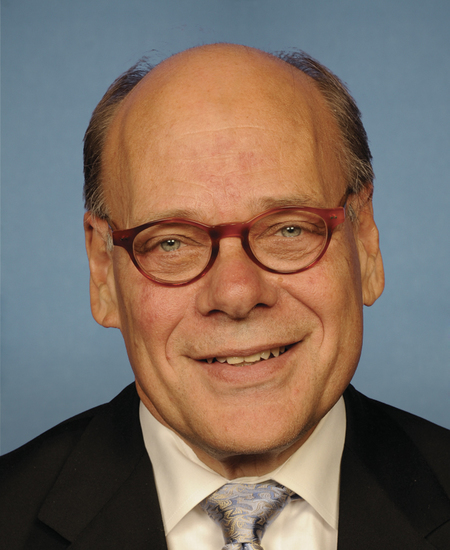
Photo of Steve Cohen
D United States House · District 9 · Tennessee

Rep. Steve Cohen

Compare
Total votes
2,837
all sessions
Attendance
97%
97 missed
Lower than 82% of chamber peers
With party
98%
of cast votes
Near the chamber average
Bipartisan score
1%
crosses aisle rarely
Near the chamber average
Sponsored
2,770
bills & resolutions
Higher than 96% of chamber peers
Committees
7
assignments
2,770 bills and resolutions

Sponsored bills

Total
2,770
Primary
198
Co-sponsor
2,572
This page
2,770
matching current filters
Co-sponsor HR 2743
In committee · United States House · Co-sponsor
Raise the Wage Act of 2025

Maddy summaryThe Raise the Wage Act of 2025 gradually increases the federal minimum wage from $9.50 to $17.00 per hour over six years, with annual adjustments based on median wage growth. It raises the base wage for tipped workers from $6.00 to $17.00 per hour, phasing out their separate minimum wage structure by 2029. The bill also eliminates special minimum wage certificates for disabled workers after 2029, requiring employers to pay the standard minimum wage. These changes apply to most covered workers, including tipped employees and those under 20, with specific transition timelines for each group.

In committee Apr 8, 2025 1 co-sponsor
Co-sponsor HR 2741
In committee · United States House · Co-sponsor
PEER Support Act

Maddy summaryThe PEER Support Act creates a new federal job classification for peer support specialists - individuals with lived experience in mental health or substance use recovery who provide support to others - by 2026. It establishes an Office of Recovery within the Substance Abuse and Mental Health Services Administration (SAMHSA) to lead training, certification, and career development for these specialists, including sharing best practices with states. The bill also requires a federal report analyzing state criminal background check laws for peer support specialists and recommending ways to reduce barriers to certification. This legislation directly affects peer support specialists, state certification programs, and federal agencies managing mental health services.

In committee Apr 8, 2025 1 co-sponsor
Primary HR 2704
In committee · United States House · Lead sponsor
Fair Debt Collection Improvement Act

Maddy summaryHR 2704, the Fair Debt Collection Improvement Act, prohibits debt collectors from attempting to collect debts that have passed their legal time limit under state law. This directly affects debt collectors who try to recover old debts and consumers who receive collection attempts for debts no longer legally collectible. The bill adds a specific provision to the Fair Debt Collection Practices Act, making it illegal for collectors to pursue or attempt to collect any debt after the statute of limitations expires. This change clarifies and strengthens existing protections for consumers against unfair debt collection practices.

In committee Apr 8, 2025 0 co-sponsors
Co-sponsor HR 2736
In committee · United States House · Co-sponsor
Public Service Freedom to Negotiate Act of 2025

Maddy summaryThis bill establishes federal minimum standards for collective bargaining rights for public employees and supervisors. The Federal Labor Relations Authority would determine if state laws provide these rights, and if not, would establish them for affected employees. The bill guarantees public employees the right to form unions, bargain collectively, and engage in concerted activities, while requiring public employers to recognize unions and put agreements in writing. It also prohibits strikes or lockouts that would disrupt emergency services. This would apply to public employees in states that don't meet the federal standards for collective bargaining rights.

In committee Apr 8, 2025 1 co-sponsor
Co-sponsor HR 2703
In committee · United States House · Co-sponsor
Advancing GETs Act of 2025

Maddy summaryHR 2703, the Advancing GETs Act of 2025, creates a shared savings program for developers who install grid-enhancing technologies (GETs) on existing or new transmission infrastructure. Developers can receive 10-25% of the savings from these technologies over three years, provided the savings exceed four times the installation cost. The bill also requires transmission operators to report annual congestion costs and creates a public map of grid constraints, while directing the Energy Secretary to establish an annual guide for utilities on implementing GETs. This directly affects utilities, developers, and grid operators by incentivizing infrastructure upgrades that boost grid efficiency, reliability, and capacity.

In committee Apr 8, 2025 1 co-sponsor
Co-sponsor HR 2672
In committee · United States House · Co-sponsor
Religious Workforce Protection Act

Maddy summaryHR 2672, the Religious Workforce Protection Act, extends temporary nonimmigrant status for religious workers whose applications for permanent residency (green cards) are delayed due to visa backlogs. It directly affects religious workers (such as pastors or missionaries) who are principal or derivative beneficiaries of pending immigrant petitions under specific visa categories, allowing them to maintain their work status beyond the usual 5-year limit while their green card applications are processed. Key provisions include granting extensions until a final decision is made on their adjustment of status application, modifying rules to allow limited job flexibility for these workers, and exempting them from a 1-year foreign residence requirement if they left the U.S. due to the prior 5-year cap. The bill aims to prevent religious workers from losing their legal status during lengthy immigration processing.

In committee Apr 7, 2025 1 co-sponsor
Co-sponsor HR 2680
In committee · United States House · Co-sponsor
Expanding Access to School Meals Act of 2025

Maddy summaryHR 2680, the Expanding Access to School Meals Act of 2025, ends reduced-price breakfast and lunch programs under federal law and expands free meal eligibility. It raises the income threshold for free lunch eligibility from 130% to 224% of the federal poverty level (Sec. 201) and allows schools to directly certify children receiving Medicaid benefits as eligible for free meals without additional applications (Sec. 202). The bill also permits schools to request retroactive reimbursement for meals served to eligible children starting the first day of the school year (Sec. 203) and increases the community eligibility program multiplier to 2.5 for schools serving high-poverty areas (Sec. 204). These changes directly affect public school students from low-income families and school districts receiving federal meal reimbursement funds.

In committee Apr 7, 2025 1 co-sponsor
Co-sponsor HR 2671
In committee · United States House · Co-sponsor
Tax Fairness for Workers Act

Maddy summaryThe Tax Fairness for Workers Act (HR 2671) would allow certain employees to deduct work-related expenses directly from their gross income. Specifically, it creates an above-the-line deduction for union dues (amending IRC Section 62(a)(1)) and reinstates a deduction for other out-of-pocket work costs like uniforms or tools (amending IRC Section 67(g)), effective for 2025 tax years. This directly affects union members and workers with significant job-related expenses who previously could not deduct these costs. The bill removes the prior limitation that barred these deductions, making them available without needing to itemize. The policy change simplifies tax filing for affected workers by treating these expenses as deductible business costs.

In committee Apr 7, 2025 1 co-sponsor
Co-sponsor HR 2253
In committee · United States House · Co-sponsor
Puppy Protection Act of 2025

Maddy summaryThis bill, HR 2253 (Puppy Protection Act of 2025), sets new federal standards for commercial dog dealers who sell puppies to the public. It requires specific housing sizes based on dog size (e.g., 12-30 square feet per dog), daily exercise in safe outdoor areas, clean water and nutritious food twice daily, and annual veterinary exams including dental checks. The bill also limits breeding frequency (max 2 litters in 25 months), sets age minimums for breeding (18 months for small dogs, 2 years for large dogs), and mandates health screenings to prevent genetic diseases. These requirements apply directly to commercial dealers, with final regulations to be issued within 18 months of enactment.

In committee Apr 4, 2025 1 co-sponsor
Co-sponsor HR 2264
In committee · United States House · Co-sponsor
Service-Connected Suicide Compensation Act

Maddy summaryThis bill automatically provides dependency and indemnity compensation to survivors of veterans who died by suicide and had a service-connected mental disorder. It directly affects surviving spouses, children, and parents of these veterans. The key change requires the Veterans Affairs Secretary to pay compensation without needing additional proof that the suicide was directly linked to the mental disorder, as long as the veteran had a service-connected mental health condition. This streamlines the process for families who previously faced complex claims.

In committee Apr 4, 2025 1 co-sponsor
Showing 561 to 570 of 2,770 bills
Previous 1 … 56 57 58 … 277 Next