

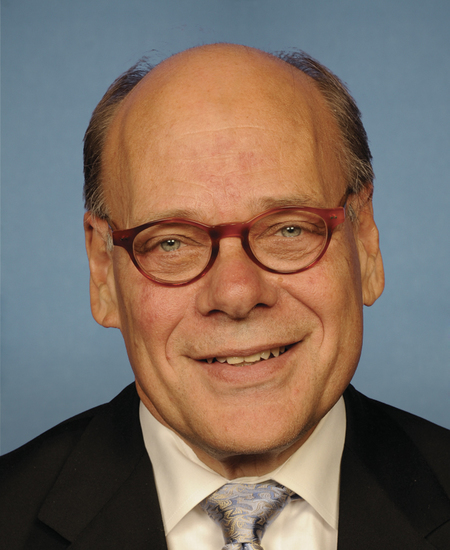
Photo of Steve Cohen
D United States House · District 9 · Tennessee

Rep. Steve Cohen

Compare
Total votes
2,837
all sessions
Attendance
97%
97 missed
Lower than 82% of chamber peers
With party
98%
of cast votes
Near the chamber average
Bipartisan score
1%
crosses aisle rarely
Near the chamber average
Sponsored
2,762
bills & resolutions
Higher than 96% of chamber peers
Committees
7
assignments
2,762 bills and resolutions

Sponsored bills

Total
2,762
Primary
196
Co-sponsor
2,566
This page
2,762
matching current filters
Co-sponsor HR 2549
In committee · United States House · Co-sponsor
Tax Fairness for Workers Act

Tax Fairness for Workers Act This bill allows an above-the-line tax deduction for union dues and expenses. (An above-the-line deduction is subtracted from gross income and is available whether or not a taxpayer itemizes other deductions.) The bill also reinstates the miscellaneous itemized tax deduction for unreimbursed expenses attributable to the performance of services as an employee (Under current law, all miscellaneous itemized deductions are suspended through 2025).

In committee Apr 15, 2021 1 co-sponsor
Co-sponsor HR 2573
In committee · United States House · Co-sponsor
Affordable Housing Credit Improvement Act of 2021

Affordable Housing Credit Improvement Act of 2021 This bill revises provisions of the low-income housing tax credit and renames it as the affordable housing credit . The bill increases the per capita dollar amount of the credit and its minimum ceiling amount beginning in 2021 and extends the inflation adjustment for such amounts. The bill modifies tenant income eligibility requirements and the average income formula for determining such income. It also revises rules for student occupancy of rental units and tenant voucher payments, and prohibits any refusal to rent to victims of domestic abuse. The bill further modifies the credit to increase state allocations of the credit; repeal the qualified census tract population cap; prohibit local approval and contribution requirements; increase the credit for certain projects designated to serve extremely low-income households; increase the credit for certain bond-financed projects designated by state agencies; eliminate the basis reduction for properties that receive certain energy-related tax benefits; and increase the population cap for difficult development areas (i.e., areas with high construction, land, and utility costs relative to area median gross income). The bill also includes Indian and rural areas as difficult development areas and modifies other requirements relating to casualty losses, acquisition credits, and foreclosures.

In committee Apr 15, 2021 1 co-sponsor
Co-sponsor HR 2576
In committee · United States House · Co-sponsor
For the 99.5 Percent Act

For the 99.5 Percent Act This bill imposes increased tax rates on decedent estates, gifts, and generation-skipping transfers. Estates with a value of over $1 billion are taxed at a 65% tax rate. The basic exclusion amount is reduced to $3.5 million. The bill increases (1) to $3 million the reduction in valuations of farmland for estate tax purposes and adjusts such increased amount for inflation, and (2) to $2 million the maximum estate tax exclusion for contributions of conservation easements. It also increases to 60% the applicable percentage for such exclusion. The bill requires (1) consistent basis reporting for property acquired by gift and transfers in trust, and (2) executors of estates and donors of gifts required to file a gift tax return to disclose to the Department of the Treasury, and to recipients of any interest in an estate or a gift, information identifying the value of each interest received. The bill sets forth estate valuation rules for certain transfers of nonbusiness assets and limits estate tax discounts for certain individuals with minority interests in a business acquired from a decedent. The bill expands rules for valuing assets in grantor retained annuity trusts to require that (1) the right to receive fixed amounts from an annuity last for a term of not less than 10 years and not more than the life expectancy of the annuitant plus 10 years, and that such fixed amounts not decrease during the first 10 years of the annuity term, and (2) the remainder interest have a value when transferred that is not less than the the greater of 25% of the fair market value of the trust property or $500,000. The bill also sets forth rules for the application of transfer taxes to a grantor trust (a trust in which the grantor retains control over the trust assets and has the right to receive income from the trust). The bill eliminates the generation-skipping transfer tax exemption for any trust whose termination date is not greater than 50 years after its creation. The bill modifies the tax exclusion for annual gifts to eliminate the present interest requirement for such exclusion and to impose a new, aggregate per donor limit equal to twice the annual exclusion amount in effect for the taxable year.

In committee Apr 15, 2021 1 co-sponsor
Co-sponsor HR 2517
In committee · United States House · Co-sponsor
Comprehensive Care for Alzheimer’s Act

Comprehensive Care for Alzheimer's Act This bill allows the Center for Medicare and Medicaid Innovation (CMMI) to test a Dementia Care Management Model that provides comprehensive care to Medicare beneficiaries with Alzheimer's disease or a related dementia. Under the model, participating health care providers receive payment under Medicare for comprehensive care management services that are provided to individuals with diagnosed dementia, excluding Medicare Advantage enrollees, hospice care recipients, and nursing home residents. Required services include medication management, care coordination, and health, financial, and environmental monitoring, as well as trainings and other support services for unpaid caregivers. Providers must furnish services through interdisciplinary teams and must ensure access to a team member or primary care provider 24-7. The CMMI must set payments and determine quality measures for the model in accordance with specified requirements. The bill also allows the CMMI to design a similar model under Medicaid.

In committee Apr 15, 2021 1 co-sponsor
Co-sponsor HR 2514
In committee · United States House · Co-sponsor
Mobility Options, Resiliency, and Efficiency (MORE) through TDM Act

Mobility Options, Resiliency, and Efficiency (MORE) through TDM Act This bill addresses supporting transportation demand management (TDM) expectations and goals that will serve the mobility needs of the people and freight, foster economic growth and development within and between states and urbanized areas. Transportation demand management is the use of strategies to inform and encourage travelers to maximize the efficiency of a transportation system leading to improved mobility, reduced congestion, and lower vehicle emissions. Each state and metropolitan planning organization must include TDM targets in the development of their long-range transportation plans. The bill directs the Department of Transportation (DOT) to establish a program to encourage and assist the development and funding of TDM related projects. Additionally, DOT must provide grants to nonprofit institutions of higher education to establish and operate a university transportation center for research and development related to TDM and TDM strategies. TDM strategies means the use of planning, programs, policy, marketing, communications, incentives, pricing, data, and technology to shift travel mode, routes used, departure times, number of trips, and location and design of work spaces or public attractions. The bill establishes a National Advisory Committee under the Federal Highways Administration to strategically direct federal resources and policies toward implementation of TDM objectives. Additionally, each state must establish advisory committees focused on the development and furthering of the principles of TDM.

In committee Apr 15, 2021 1 co-sponsor
Co-sponsor HR 2525
In committee · United States House · Co-sponsor
Report and Educate About Campus Hazing Act

Report and Educate About Campus Hazing Act or the REACH Act This bill requires institutions of higher education (IHEs) that participate in federal student-aid programs to report hazing incidents and implement hazing education programs. Specifically, the bill requires each IHE to disclose hazing incidents that were reported to campus security authorities or local police agencies in its annual security report. The bill defines the term hazing to mean any intentional, knowing, or reckless act committed by a student, or a former student, of an IHE against another student (regardless of that student's willingness to participate), that (1) is connected with an initiation into, an affiliation with, or the maintenance of membership in an organization that is affiliated with the IHE (e.g., an athletic team); and (2) contributes to a substantial risk of physical injury, mental harm, or degradation or causes physical injury, mental harm, or personal degradation. In addition, each IHE must implement a comprehensive program to prevent hazing, which must include information on hazing awareness, hazing prevention, and the IHE's policies on hazing.

In committee Apr 14, 2021 1 co-sponsor
Co-sponsor HR 2509
In committee · United States House · Co-sponsor
Selective Service Repeal Act

Selective Service Repeal Act This bill repeals the requirement for males between the ages of 18 and 26 to register with the Selective Service. The bill also specifies that an individual shall not be penalized for prior failure to register with the Selective Service.

In committee Apr 14, 2021 1 co-sponsor
Co-sponsor HR 2513
In committee · United States House · Co-sponsor
Lead Abatement for Families Act of 2021

Lead Abatement for Families Act of 2021 This bill requires the Department of Housing and Urban Development (HUD) to identify federally assisted housing projects that use lead-based water pipes and allows HUD to award grants for the replacement of these pipes to public housing agencies and other owners.

In committee Apr 14, 2021 1 co-sponsor
Co-sponsor HR 2489
In committee · United States House · Co-sponsor
Martha Wright Prison Phone Justice Act

Martha Wright Prison Phone Justice Act This bill establishes requirements related to certain charges, practices, classifications, or regulations in connection with confinement facility (i.e., jail or prison) communications services. Specifically, the bill requires the Federal Communications Commission (FCC) to establish maximum rates and charges that a provider of prison communications services may charge for such services. The bill provides interim rate caps until the FCC establishes such rates and charges. The bill requires a provider of prison communications services to assess all charges for communications on a per-minute basis for the actual duration of the communication, and it prohibits a provider from charging a per-communication or per-connection charge. A provider also may not charge an ancillary service charge except in certain circumstances. Further, the bill prohibits a provider from assessing a site commission, which is a payment or donation made to certain entities that operate or oversee a confinement facility.

In committee Apr 14, 2021 1 co-sponsor
Primary HR 2463
In committee · United States House · Lead sponsor
TSA Second Screening Act

TSA Second Screening Act This bill requires the Transportation Security Administration to offer passengers an opportunity to undergo a secondary screening using advanced imaging technology prior to undergoing a physical inspection if an initial screening detects an object of concern.

In committee Apr 14, 2021 0 co-sponsors
Showing 2,451 to 2,460 of 2,762 bills