

Tax on Wall Street Speculation Act This bill imposes an excise tax on the transfer of ownership in certain securities (covered transaction), including any share of stock in a corporation; any partnership or beneficial interest in a partnership or trust; any note, bond, debenture, or other evidence of indebtedness (excluding tax-exempt municipal bonds); and derivative financial instruments. The bill includes exceptions for initial issues, certain traded short-term indebtedness, and securities lending arrangements. The bill also (1) imposes a penalty on taxpayers who fail to include a covered transaction on their tax return or information statement, and (2) allows an individual taxpayer whose modified adjusted gross income does not exceed $50,000 ($75,000 for married taxpayers filing joint returns) a tax credit for the amount of tax paid on covered transactions.
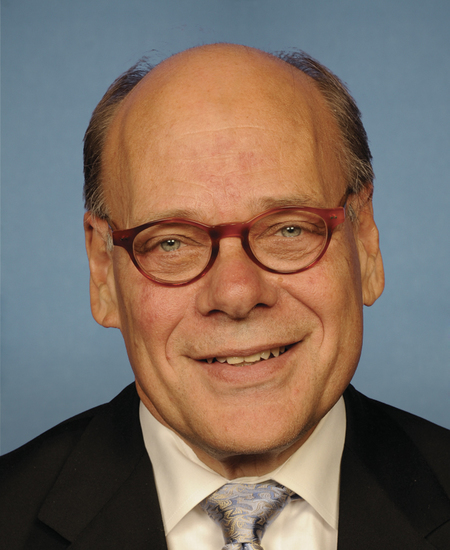
Rep. Steve Cohen
Sponsored bills
Alerting Local Leaders and Ensuring Responsible Guidelines for Youth Act or the ALLERGY Act This bill requires a local educational agency, in order to receive federal education funding, to establish and implement a policy on unwanted, aggressive behavior by a student toward another student with an allergy (i.e., allergy bullying).
CERCLA Liability Expansion and Accountability for Negligent and Unjust Pollution Act or the CLEANUP Act This bill includes petroleum products under the definition of hazardous substances for purposes of Superfund, the program that directs and funds the cleanup of sites contaminated with hazardous substances. Additionally, the release of a petroleum product shall be considered as a release under Superfund if liability for such release is established by any other federal law. Per the bill, a petroleum product is petroleum or oil of any kind, in any form, or any fraction thereof, and includes fuel oil, sludge, oil refuse, and oil mixed with wastes other than dredged spoil.
Superfund Reinvestment Act This bill authorizes the use of amounts in the Hazardous Substance Superfund for environmental cleanup costs under the Superfund program (which provides funding to clean up sites contaminated with hazardous substances). Receipts and disbursements of the Hazardous Substance Superfund must (1) not be counted for purposes of the President's budget, the congressional budget, the Balanced Budget and Emergency Deficit Control Act of 1985, or the Statutory Pay-As-You-Go Act of 2010; (2) be exempt from general budget limitations imposed by statute on expenditures and net lending (budget outlays); and (3) be available only for the allowable uses specified for the Superfund. This bill (1) reinstates and adjusts for inflation annually after 2021, the Hazardous Substance Superfund financing rate and the corporate environmental income tax threshold amount; and (2) extends the borrowing authority of the Superfund through 2029.
Improving National Safety by Updating the Required Amount of Insurance Needed by Commercial Motor Vehicles per Event Act of 2021 or the INSURANCE Act of 2021 This bill increases the minimum level of insurance required for motor carriers transporting property. The Department of Transportation must adjust the minimum insurance requirement every five years to account for inflation relating to medical care.
Global Electoral Exchange Act of 2021 This bill authorizes the Department of State to establish a Global Electoral Exchange Program to promote sound election-administration practices around the world. The State Department may award grants to qualified, tax-exempt, U.S.-based organizations that have expertise and experience in relevant topics, such as election-system integrity. Grants may be used to design programs to bring relevant individuals, such as election administrators and poll workers, together to study and discuss election procedures. The State Department shall periodically report to Congress on the program's activities.
Countering Russian and Other Overseas Kleptocracy Act or the CROOK Act This bill requires various actions designed to combat public corruption in foreign countries. The bill establishes within the Department of the Treasury the Anti-Corruption Action Fund to help foreign states fight public corruption and develop rule-of-law-based governance structures. For certain fines and penalties imposed under the Foreign Corrupt Practices Act, an additional fine shall be imposed and deposited into the fund. The Department of State must (1) manage U.S. government efforts to fight foreign public corruption, and (2) establish an interagency task force to assist in coordinating such efforts. Each U.S. embassy must have a point of contact responsible for coordinating the embassy's anti-corruption efforts. The State Department must report to Congress on its anti-corruption activities and make various reports publicly available online.
Access to Contraception for Servicemembers and Dependents Act of 2021 This bill addresses Department of Defense (DOD) contraceptive care and family planning services. Specifically, the bill prohibits cost-sharing with respect to TRICARE beneficiaries for specified prescription contraceptives. Additionally, the bill prohibits cost-sharing for TRICARE Select and TRICARE Prime beneficiaries in relation to any in-network method of contraception or contraceptive care (including with respect to insertion, removal, and follow-up), any sterilization procedure, or any related patient education or counseling service. The bill requires DOD to provide information on all methods of emergency contraception and care to sexual assault survivors at its medical treatment facilities. Upon request by a sexual assault survivor, DOD must provide such emergency contraception or a prescription for emergency contraception. Finally, DOD must establish a uniform standard curriculum for education programs on family planning for all members of the Armed Forces. Such education programs must be provided to service members during their first year of service and at other appropriate times, as determined by each military department.
Civilian Climate Corps for Jobs and Justice Act This bill establishes a Civilian Climate Corps Program and generally revises benefits provided to national service program participants. The bill establishes a Civilian Climate Corps to operate (1) a national climate service program; and (2) a national climate service grant program to help communities respond to climate change and transition to a clean economy, including through reducing carbon emissions. The bill also provides for allowances for participants in certain national service programs, including the Volunteers in Service to America (VISTA) program and the National Civilian Community Corps. The bill expands the exclusion from gross income, for income tax purposes, to exclude amounts received as educational awards or benefits and income attributable to discharges of student loan debt under the National and Community Service Act of 1990.
Environmental Health Workforce Act of 2021 This bill requires the Department of Health and Human Services (HHS) to carry out certain activities related to the environmental-health workforce. It also requires the Government Accountability Office to report on state-based practices for training and credentialing environmental-health workers. Specifically, HHS must develop model standards and guidelines for credentialing environmental-health workers and a plan to ensure its programs and activities meet the future needs of the environmental-health workforce. The bill also specifies that environmental-health workers are eligible for public-service loan forgiveness.